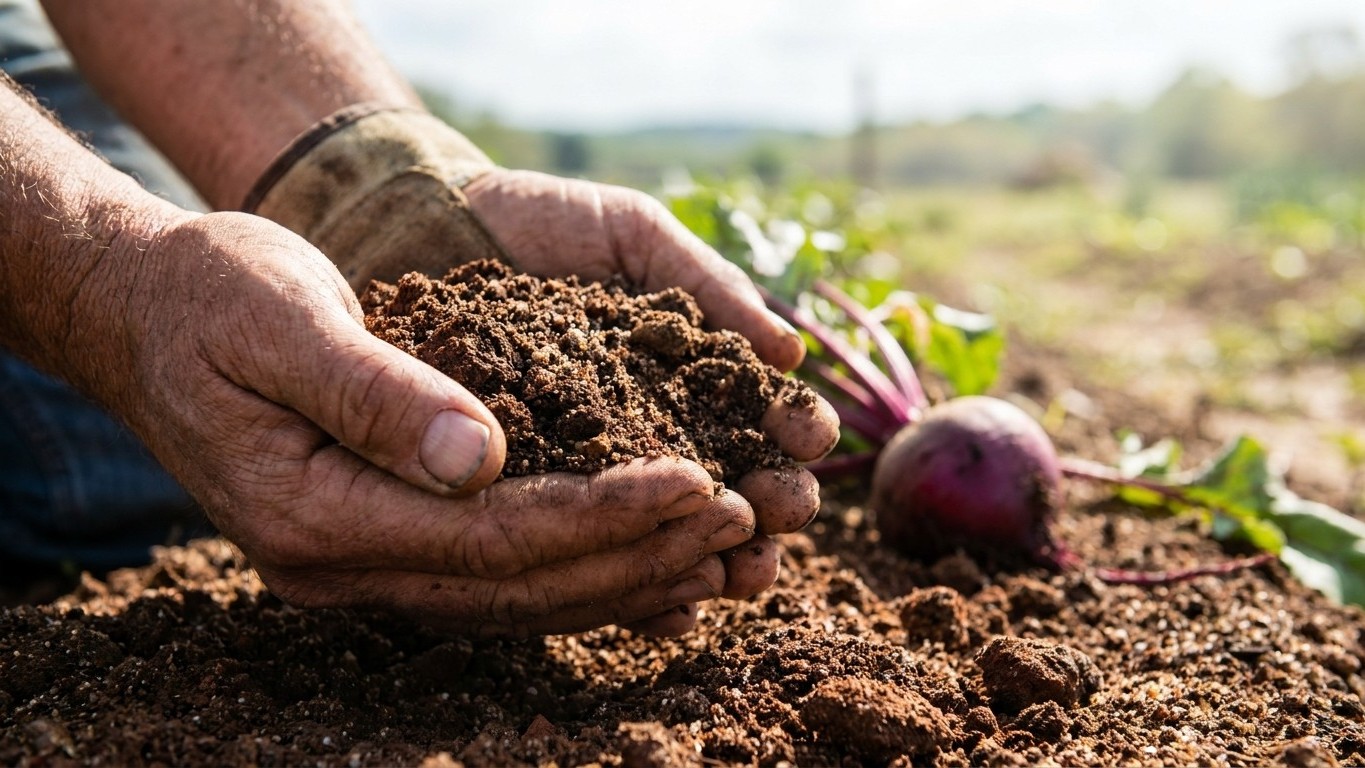

Connecticut’s representative soil, the Windsor series, is sand almost to a fault: 82 percent sand, excessively drained, strongly acid at the surface. That texture lets a beet root push down without a fight, but the same soil sheds water so fast that the first six weeks after sowing, not the whole season, decide whether the root stays sweet or turns to a bitter, forked stick.
The short answer
USDA’s State Soils program lists the Windsor series as the soil that represents Connecticut. It’s an Entisol, which means it’s young and has almost no layered profile to speak of. The surface horizon runs 82 percent sand, 2 percent clay, and 16 percent silt, with a pH around 5.1 and a drainage class of excessively drained. That last term is doing real work here: it doesn’t mean well-drained in the pleasant garden sense, it means water moves through so quickly the root zone can go from soaked to parched within days.
For a beet, that’s a mixed bag. Utah State University Extension is blunt about what the crop wants: deep, sandy, well-drained ground with organic matter worked in, no more than 1 inch of composted material per 100 square feet. Windsor-type soil checks the sand and drainage boxes almost too well. The organic matter figure recorded for this series, close to 95 percent at the surface, looks generous on paper, but that number describes a natural surface layer as mapped, likely a forest litter or organic cap, not a cultivated bed that’s been turned and planted for years. A worked garden row won’t carry anywhere near that percentage, and treating it as a target would be a mistake.
The acid pH matters too. At 5.1, the mapped surface sits well below neutral, and while the beet source used for this page doesn’t give a target pH, sandy acid ground of this kind rarely holds nutrients as evenly as a loam would. That’s a reason to test rather than assume, not a reason to panic.
On heat, the exact count of days a reference Connecticut location clears 90 F in a typical year isn’t part of the figures gathered for this page, so that specific number won’t be printed here. What is documented is the threshold that matters for the crop: once temperatures climb past 85 F while the plant is also short on water, the root turns woody. Connecticut summers, especially away from the coast, reach that mark often enough that the combination of heat and a dry sandy root zone is a real risk, not a rare one.
None of this describes any one garden exactly. Connecticut spans hundreds of mapped soil series, and river bottoms, hillside plots, and any yard a builder has graded or filled can sit nowhere near the Windsor profile. Treat these numbers as what the state’s ground tends to do, then confirm with a soil test on the actual bed.
The six weeks that decide it here
Beet seed goes into the ground 2 to 3 weeks ahead of the last frost, since the crop tolerates cool soil better than heat. At the coastal reference station, NOAA’s 1991-2020 climate normals put that last spring frost between April 2 and April 12. That’s the mildest window in the state; inland and northwest Connecticut typically stay cold longer into spring, so a gardener there is sowing later than someone near Long Island Sound, even though no separate inland date is published in the figures used here.
Using the coastal window as a reference, sowing lands somewhere in the second half of March to early April, which puts the first six critical weeks of root development squarely into April and into May. That stretch in Connecticut doesn’t settle into one pattern. Some years bring a wet, sluggish spring with cold rain lingering into May. Others swing dry, with windy stretches that pull moisture out of exposed ground fast. Many years do both, a wet week followed by a dry one, back and forth, which is the harder pattern to manage because it tempts a gardener to skip watering after rain and assume the job is done.
That assumption is exactly where the Windsor-type texture turns against the grower. Because the surface is 82 percent sand and excessively drained, rainfall that would sit in a clay-heavy bed for a week can drain through sandy ground in a day or two. A “wet” spring on paper doesn’t guarantee a wet root zone. Utah State’s Extension guidance is specific on the consequence: water stress in the first six weeks after sowing triggers premature flowering, known as bolting, and once a beet bolts, the root stops putting energy into itself and the harvest is effectively over.
The practical upshot is that the six-week window right after sowing is where bolting risk concentrates in Connecticut, and it’s a risk tied to how fast this soil drains rather than to how much rain falls in a given month. A rain gauge reading doesn’t tell a grower what the root zone actually holds; checking the soil itself does.
What goes wrong here
- Bolting from a “wet enough” spring that wasn’t. Rain totals can look normal while the sandy, excessively drained root zone dries out between storms during the first six weeks after sowing. The fix is to check soil moisture at root depth directly rather than trusting rainfall alone, and to water on a set schedule through that early window regardless of recent weather.
- Woody roots from a heat-and-drought combination later in the season. Once temperatures pass 85 F and the plant is also short on water, the root turns fibrous and loses eating quality. This is a separate failure from bolting, tied to mid-to-late season heat rather than the early six weeks, and the remedy is mulch to buffer soil temperature plus steady watering through hot stretches, not a one-time soak after the damage shows.
- Over-correcting sandy ground with too much compost. Gardeners working fast-draining, low-clay soil often assume more organic matter always helps and pile it on. Utah State’s guidance caps amendment at 1 inch of composted material per 100 square feet; going well past that rate isn’t the fix sandy soil needs, and mulch on the surface does more for moisture retention than extra compost worked into the bed.
- Nutrient trouble from an acid, unamended surface. A pH near 5.1, as recorded for the mapped Windsor surface, sits on the acidic side of where many vegetables perform best. Rather than assume that figure applies to a particular yard, a soil test on the actual bed is the only way to know whether lime or another correction is warranted before planting.
- Assuming the state soil describes the actual garden. Windsor series values describe a mapped, representative surface, not any one backyard. A bed built on fill, a low spot that holds water, or ground closer to a river can behave nothing like this profile, and building a watering or amendment plan on the state figures alone, without a local test, is a common and avoidable error.
Common questions
Does the Windsor series mean my Connecticut garden is sandy too?
Not necessarily. Windsor is the soil USDA lists as representative of the state overall, but Connecticut contains hundreds of mapped soil series. Yards on fill, near rivers, or in low-lying areas can differ completely. A soil test on the actual bed is the only reliable way to know what’s underfoot.
When should beets go into the ground in Connecticut?
The general rule is 2 to 3 weeks before the last spring frost. At the coastal reference station used here, that frost typically falls between April 2 and April 12, which is the mildest window in the state. Inland and northwest areas run colder for longer, so sowing there happens later, though no separate inland date is published in the figures cited on this page.
Is bolting the same problem as a woody root?
No, and mixing them up leads to the wrong fix. Bolting comes from water stress in the first six weeks after sowing and causes the plant to flower instead of growing a good root. Woodiness comes later, from heat above 85 F combined with water stress, and ruins the eating quality of a root that already formed. Both are watering problems, but at different points in the season.
How much compost should I add to sandy Connecticut soil before planting beets?
Utah State University Extension recommends no more than 1 inch of composted organic matter per 100 square feet. On fast-draining, sandy ground it can be tempting to add more, but exceeding that rate isn’t the guidance, and mulch on the surface is the better tool for holding moisture in that kind of soil.