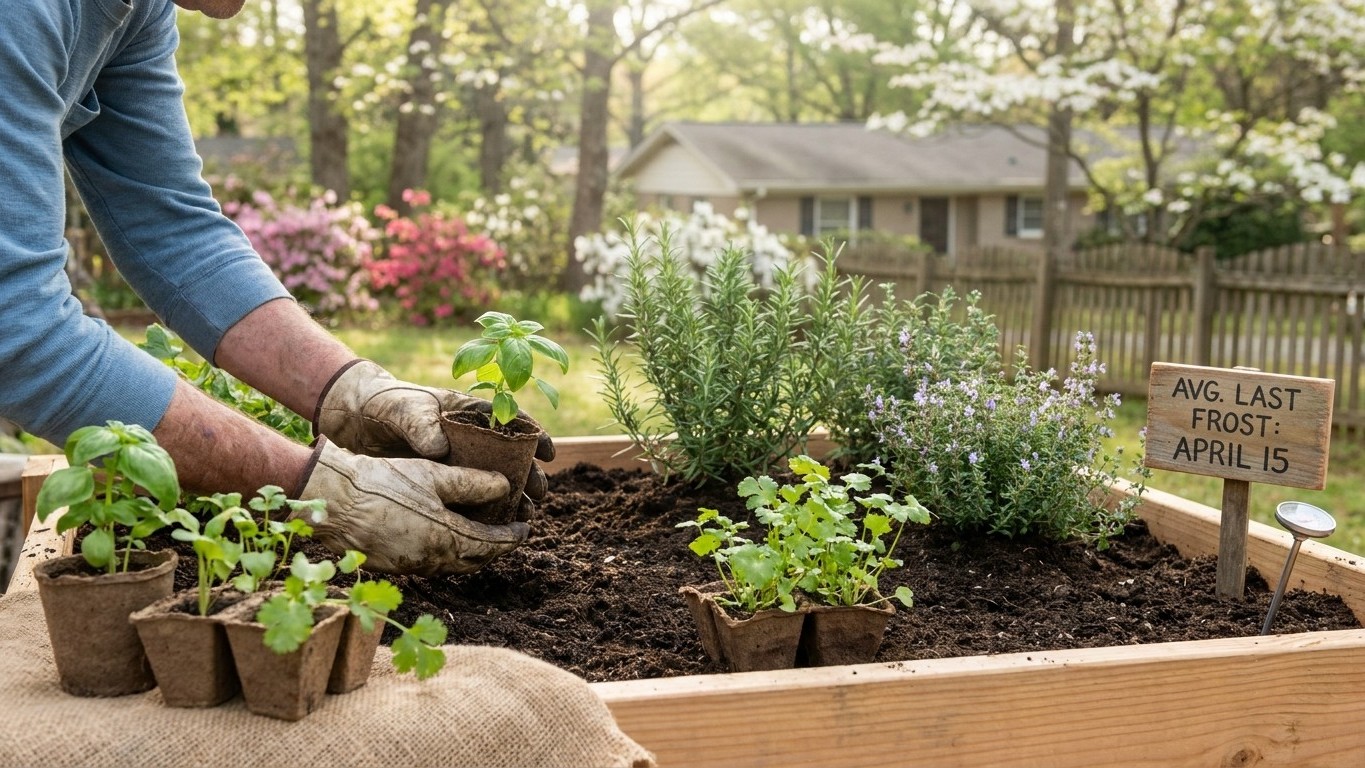

Sow tender herbs like basil, dill, and cilantro after your local last frost date, which in Connecticut falls somewhere between April 2 and April 12 depending on where you garden. Hardy herbs such as parsley and chives can go in a few weeks earlier. Get perennial woody herbs like rosemary and thyme in the ground once that frost window has passed, and expect to bring tender perennials indoors well before the first fall frost arrives between October 28 and November 10.
The short answer for Connecticut
Those frost windows aren’t fixed dates on a calendar. They’re probability bands: NOAA’s 1991-2020 Climate Normals for the Bridgeport reference station put the 32°F freeze risk at 30-70% across those spans, meaning even inside the window there’s real uncertainty from one year to the next, not to mention microclimate variation. That matters for herbs more than most vegetables, because a single unexpected dip below freezing can wipe out a tray of just-transplanted basil overnight.
Group your herbs by how they handle cold, and the calendar sorts itself out fast:
- Tender annuals (basil, dill, tender oregano starts): wait until after the April 2-12 window closes, and ideally a week beyond it for insurance.
- Cool-tolerant annuals and biennials (parsley, cilantro, chives): these germinate and grow fine in soil that’s still cool, so they can go in 2-4 weeks before that same window, once soil is workable.
- Woody perennial herbs (rosemary, thyme, sage, oregano): plant these after frost risk has genuinely passed. Their long-term survival outdoors depends less on spring planting timing and more on whether Connecticut’s winter cold will let them persist year over year, which is a separate question tied to hardiness zone.
On the fall side, the first frost arriving October 28 to November 10 sets your harvest deadline for anything tender still in the ground, and it’s also the point where you need to decide which perennial pots come indoors versus which woody herbs stay outside to test their luck against the coming winter.
One caution worth repeating: the Bridgeport station sitting on Long Island Sound is the mildest reference point in the state. If you garden inland or in the northwest hills, both of those windows shift, later in spring, earlier in fall, and the safe margin you should build in gets wider, not narrower.
What will not work here

Direct-sowing basil into cold soil is the most common herb-garden failure in this state, and it’s almost always a timing problem rather than a plant problem. Basil seed germinates poorly below roughly 60°F soil temperature, and soil that cold is exactly what you’ll find anywhere in Connecticut before that April 2-12 frost window closes. Gardeners who jump the gun get patchy germination, stunted seedlings, or a full stand that gets nipped the first cool night.
The reverse problem shows up with rosemary and other Mediterranean woody herbs left in the ground over winter. Connecticut’s coldest month carries an average daily minimum of 24.4°F at the Bridgeport reference station, and that’s the mild end of the state. Herbs bred for mild coastal Mediterranean winters simply aren’t built to shrug off repeated nights in the low-to-mid 20s, let alone the colder stretches inland. Treating rosemary as a permanent in-ground perennial here, rather than as a container plant you overwinter indoors or in a cold frame, is a bet that loses most years.
Humidity turns density into disease
Connecticut summers bring the kind of muggy, humid stretches that basil in particular hates when it’s planted too close together. Tight spacing that might get away with it in a drier climate becomes a fast track to downy mildew and other fungal problems here, since damp foliage that doesn’t dry out between dew and dusk is exactly what those pathogens want. Wider spacing and morning watering aren’t optional extras in this climate; they’re what keeps a planting alive through August.
Slow-maturing herbs from seed also run into a real ceiling. Parsley, for example, is notoriously slow and can take 70 days or more to reach usable size, which eats deep into a frost-free season that runs roughly from early-to-mid April to late October along the coast, and shorter than that inland. Starting slow herbs from seed outdoors, rather than from nursery transplants, is a gamble against a calendar that doesn’t leave much room for error.
What changes across Connecticut
Connecticut is not one garden, and the USDA hardiness zone range for the state, 6a to 7b, proves it. That’s a real spread built on a single measurement, the average annual extreme minimum temperature, and it means a herb that reliably overwinters in one part of the state can die outright in another. There is no single answer to “will this survive winter here” for the whole state, only an answer for a specific location within it.
The pattern follows geography in a fairly predictable way. Coastal areas along Long Island Sound, where the Bridgeport station sits, run milder and land toward the warmer end of that 6a-7b range, benefiting from the moderating effect of the water. Move inland, gain elevation, or head toward the northwest corner of the state, and conditions shift toward the colder end of the range, sometimes further. That’s also where the frost windows quoted earlier start to slide, later last-spring-frost dates, earlier first-fall-frost dates, both cutting into the usable growing season.
What that means practically for someone deciding when to plant a perennial herb: don’t take the statewide frost dates or the statewide hardiness range as your personal answer. Whether a rosemary plant survives outdoors, or whether you can push a basil transplant out a week early, depends on where inside that 6a-7b spread your own garden actually sits. This page can tell you the range and the mechanism behind it. It can’t tell you which end of the range applies to your yard, and no state-level page honestly can. For that, check the USDA Plant Hardiness Zone Map directly for your specific location before you rely on a planting date.
Where to check this for your own county
The University of Connecticut’s Cooperative Extension System is the authority to check next, and it publishes exactly the kind of county-level detail. Find it at extension.uconn.edu.
What to look for once you’re there is specific. First, any local planting calendar or frost-date guidance tied to your county or region rather than the statewide average used here; UConn’s local offices and county-based programs typically account for the coastal-versus-inland split that the Bridgeport station alone can’t capture. Second, variety trial results or herb recommendations specific to your area, since extension programs regularly test which cultivars of basil, parsley, and other herbs perform best against local disease pressure and season length, information that goes well beyond generic frost-date math.
It’s worth being plain about the hierarchy here. A county-level recommendation from your local extension office will always beat a state-level page like this one, because it’s built on conditions closer to your actual soil and microclimate. This page works from statewide climate normals and a single reference station on the coast. That’s useful for understanding the mechanism, why the dates are what they are, why the range exists, but it’s not a substitute for the finer-grained data your county extension office can offer once you know which part of Connecticut’s hardiness range you actually garden in.
Checking this against your own garden
No calendar beats what your own garden is telling you, and herbs give you a few reliable signals if you know to watch for them.
Soil warmth by feel is the first and most useful check. Push your hand a couple inches into the bed in spring; soil that still feels cold and damp to the touch, even on a sunny afternoon, is telling you basil and other warm-season herbs will sit and sulk rather than grow if you plant now, regardless of what the calendar date says.
The first true leaves on any seedlings you’ve started, whether indoors or in an early outdoor sowing of parsley or cilantro, are your second signal. Those are the leaves that appear after the initial pair of seed leaves, and they show the plant has moved past germination into real growth, a sign that conditions are genuinely supporting it rather than just tolerating it.
Third, watch how quickly cool-season herbs like cilantro respond to a warm stretch. If cilantro starts sending up a central flower stalk unusually fast, that’s bolting, and it’s telling you your particular spot runs warmer or drier than average for the season, a detail no regional frost date will ever capture. Read that signal, adjust your next planting a little earlier or later than the general window, and you’re gardening off your own microclimate instead of a coastal station’s thirty-year average.
Some gardeners also time this by the Moon: when to plant herbs by the moon, as almanac tradition rather than fact.