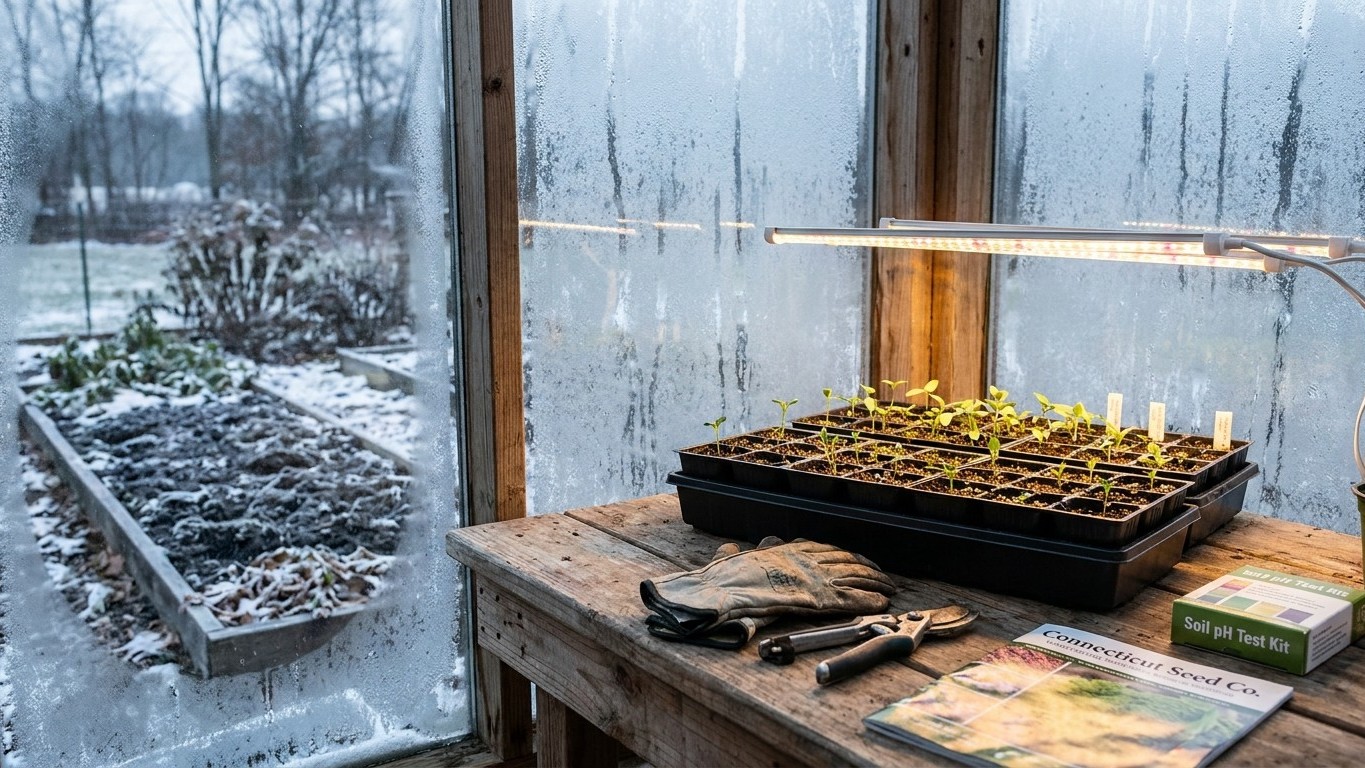

Nothing goes into open ground in Connecticut in January. The soil is frozen solid across most of the state, and the earliest planting window (garlic aside) is still weeks away. What January actually offers is prep work: dormant pruning, seed ordering, soil testing, and the first seed-starting trays under lights for crops that need a ten-to-twelve-week head start before the ground even thinks about thawing.
What goes in the ground in January

The honest answer is: almost nothing, and there’s no point pretending otherwise. NOAA’s 30-year climate averages for the Bridgeport area put the last spring frost between April 2 and April 12, and that’s the mildest, most coastal corner of the state. Inland and in the northwest hills, frozen ground and hard freezes routinely run weeks longer on both ends of the calendar. In January, the growing season for anything sown or transplanted outdoors is still roughly three months away.
That doesn’t mean the garden is off-limits. If the ground happens to be workable during a thaw, and it sometimes is for a day or two even in the coldest months, garlic and shallot cloves can still go in as a late option, though most growers who wanted a full-sized harvest planted back in fall. A late-planted clove will still produce, just smaller.
Cold frames and low tunnels are where the real outdoor action is. A cold frame built over a bed of hardy greens, spinach, mâche, or claytonia, can keep those plants alive and slowly growing through January’s short days, especially on the coastal side of the state where the USDA hardiness zone runs closer to 7a-7b rather than the 6a found in the northwest corner.
Bare-root fruit trees, roses, and cane berries can be planted the moment the ground is workable, though most Connecticut growers wait until late winter for that window to open reliably. Where the ground is frozen, those bare-root plants are better held in slightly damp sawdust or peat in an unheated garage until conditions improve.
Indoors, this is a good month to force rhubarb crowns or Belgian chicory roots in a dark, cool basement corner. Both give a genuine harvest weeks before anything outside stirs, and neither requires more than a bucket, some soil, and patience.
What to start under cover
Seed starting in January is entirely a matter of counting backward from that April 2 to April 12 frost window, not from the calendar page. Onions and leeks grown from seed need roughly ten to twelve weeks indoors before they’re sturdy enough to transplant, which puts a January sowing date squarely in range for an early-to-mid-April move outside, right as the frost risk clears.
Early cabbage and broccoli fall into an eight-to-ten-week window, which makes a January start workable for gardeners who want transplants ready the moment the soil can be worked in March or early April, hardened off under a cold frame first. Peppers, which are slower to size up and less forgiving of a chilly transplant shock, are better started toward the very end of January so they’re not sitting rootbound in cell trays for two extra months waiting on warm soil that won’t arrive until well into spring.
The two ways this goes wrong are mirror images of each other. Start too early, especially with peppers or tomatoes, and the plants outgrow their trays weeks before it’s safe to plant them out, turning leggy, stressed, and prone to transplant shock. Start too late, particularly with onions and leeks, and the plants never bulk up enough by transplant time to make full-sized bulbs or stalks; the growing season simply runs out from underneath them.
A heat mat and a set of grow lights matter more this month than at almost any other point in the year, since ambient light indoors in January is weak and short-lived, and cold windowsills rarely hold the 65 to 75 degree soil temperature that onion and leek seed need to germinate reliably.
What is ready to pick
Outdoors, there’s little to nothing coming out of a Connecticut garden this month, and no amount of optimism changes that. What keeps a household fed through January comes from what was put up earlier or tucked under cover before the ground froze.
Overwintered kale, and sometimes leeks, can still be dug or cut from under a blanket of snow, since both crops tolerate hard freezes and often taste sweeter after a few frosts convert starches to sugars. A cold frame planted with spinach or mâche back in fall will still yield a few handfuls on any week with enough daylight to keep the plants ticking over, even if growth has nearly stopped.
Indoors, sprouts and microgreens are the fastest return on effort available this month: a tray of pea shoots or sunflower microgreens is ready to cut in seven to fourteen days from seed, no grow light setup required beyond a bright windowsill.
The other January job on the food side is inspection, not harvest. Stored winter squash, potatoes, and onions need a walk-through every couple of weeks. Squash with a soft spot or a sweet smell should be used immediately, not left to spread rot to its neighbors. Potatoes that have started sprouting in storage are still edible but won’t keep much longer. Onions gone soft at the neck are past saving and belong in the compost, not back on the shelf.
The jobs that matter this month
Pruning and planning
Dormant pruning of fruit trees and cane berries is one of the highest-value jobs on the January calendar. With no leaves in the way, it’s far easier to see structure, cut out crossing or damaged branches, and shape apple, pear, and stone fruit trees while they’re fully asleep and least likely to react badly to the cut. Cane berries like raspberries benefit from having last season’s spent canes removed now, clearing space before new growth pushes in spring.
Seed ordering belongs on this month’s list too, and it has a real deadline attached: popular varieties, especially heirloom tomatoes and specialty peppers, routinely sell out by late winter. Ordering early is the only real insurance against ending up with a second-choice variety.
Soil, tools, and storage
Soil testing is worth doing while the garden is idle rather than waiting until spring planting is already underway and there’s no time to correct a pH problem. A basic test through the UConn extension service takes a few weeks to turn around, which makes January the natural window to send a sample in.
Compost piles built in fall still need turning through winter to keep them breaking down rather than freezing solid into an inert lump. Tools are worth cleaning and sharpening now, before the rush of spring makes it easy to skip. Raised bed frames, trellises, and fencing that took a beating over the growing season are far easier to repair while nothing is planted and the ground isn’t yet workable for anything else.
What not to do in January
The most common mistake is trusting a mild afternoon over the calendar. A 55-degree stretch in mid-January feels like an invitation, but the soil underneath hasn’t warmed nearly as fast as the air, and working wet, half-frozen ground compacts it in a way that causes drainage problems all season. Wait for the soil itself to be workable, not just the air to feel pleasant.
A related error is pulling mulch or row cover off overwintered crops the moment a warm spell arrives, then getting caught out when temperatures drop back hard a few days later, which is common in a Connecticut winter. Mulch and cold frame covers should stay in place through these swings; they’re protecting against the next cold snap, not just the current thaw.
Starting warm-season seedlings, tomatoes and peppers especially, too early is the classic seed-starting mistake. A tomato started in early January in most of Connecticut will be leggy, rootbound, and stressed long before it’s safe to go outside, since that transplant date is still roughly three months away even on the coast.
Finally, this is not the month to feed nitrogen to anything dormant, whether that’s a fruit tree, a berry cane, or an overwintered garlic bed. Dormant plants aren’t using nutrients, and a nitrogen application now either washes away before spring growth starts or pushes soft, frost-vulnerable growth at exactly the wrong moment.
Checking this against your own county
A state-wide frost window is a starting point, not an instruction specific to any one yard. The April 2 to April 12 range comes from a Long Island Sound coastal station, the mildest spot in Connecticut. Inland counties and the northwest hills run colder on both ends of the season, sometimes by two or three weeks, and elevation shifts things further still. Before locking in a seed-starting date, check the UConn extension service for county-level guidance and planting calendars tuned to local conditions rather than a single statewide average.
Common questions
Can I still plant garlic in January in Connecticut?
Only if the ground happens to be workable during a thaw, which isn’t guaranteed. Fall-planted garlic will always outperform a January clove, but a late planting still produces a smaller bulb by summer.
Is it too early to start tomato seeds in January?
For most of Connecticut, yes. With the last frost falling between April 2 and April 12 on the coast, and later inland, tomatoes started in January will be leggy and stressed by transplant time. Late February to March is the safer window.
What USDA hardiness zone is Connecticut in?
The state spans USDA zones 6a to 7b, with the mildest zones along the coast and the coldest in the northwest hills. That range affects which perennials and fruit trees reliably survive winter in a given yard.
What can I harvest from a Connecticut garden in January?
Very little outdoors beyond overwintered kale and leeks dug from under snow. Cold frame greens, indoor sprouts, and microgreens fill the gap, along with whatever’s left in cold storage from potatoes, squash, and onions.