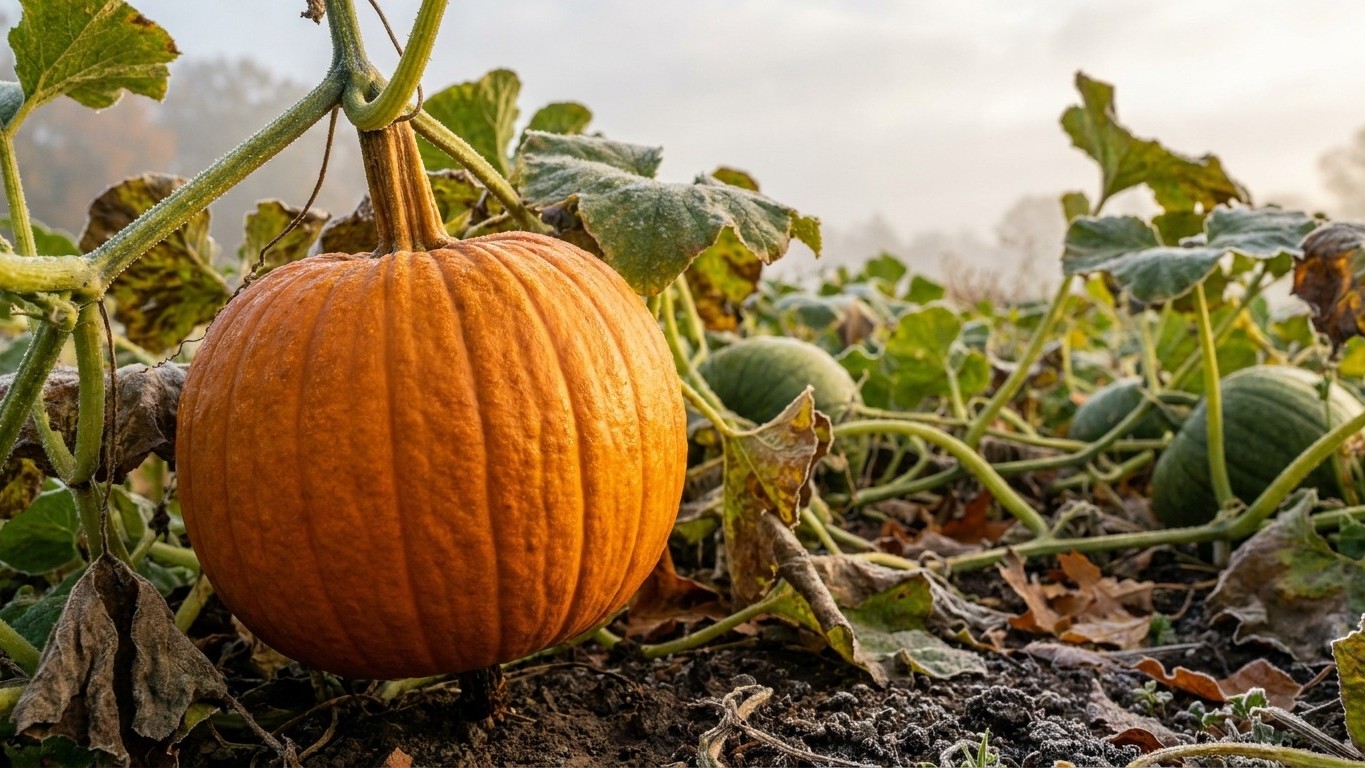

Northwest Territories growers get one real shot at a ripe pumpkin, and it hinges on when the flowers open, not when the seed goes into the ground. With an average first fall frost of September 18 and pumpkins needing 45 to 55 days from flower to harvest, the last safe flowering window lands in late July to early August. Miss it, and the fruit stays green on the vine, which raises the central question growers here face each year: Will Pumpkins Ripen Before Frost in Northwest Territories?
The short answer
Yellowknife’s average first fall frost date is September 18, according to Environment and Climate Change Canada’s 1981-2010 climate normals for the Yellowknife A station. Count backward from that date by the 45 to 55 days a pumpkin needs to mature after its flower opens, and you land on a window between July 25 and August 4. That is the latest a female flower can open and still have enough warm days left to turn a green globe into an orange one before the first hard frost of the season.
Notice that this is a window, not a deadline you can circle on a calendar and trust completely. September 18 is a mean date pulled from thirty years of records, not a guaranteed cutoff. In roughly half of those years, the actual first frost fell later than that average; in the other half, it fell earlier, sometimes by a wide margin. Treat July 25 to August 4 as the outer edge of what’s realistic for a flower to open, not a target you’re trying to hit right on the nose. For a fuller breakdown of these dates, see When to Sow Pumpkins in Northwest Territories. A flower that opens August 10 might still ripen in a mild year. It might not in a year when frost sweeps through in the first week of September instead.
There’s a geographic wrinkle too. Yellowknife A is a single weather station, and the Northwest Territories is not one climate. The territory stretches for hundreds of miles from its southern border up toward the Arctic coast, crossing a wide range of elevation and terrain along the way. Yellowknife sits in the milder, southern portion of that range, close enough to Great Slave Lake to get some moderating effect from it. Communities farther north, at higher elevation, or without that lake influence tend to see frost weeks earlier than the Yellowknife average. Gardeners outside the immediate Yellowknife area should treat this flowering window as an optimistic best case, not a regional constant they can rely on.
The practical takeaway follows from that arithmetic. With a season this tight, growers here generally do better starting seed indoors, transplanting once the outdoor soil has properly warmed, and choosing smaller varieties that ask for fewer total days than a full-size carving pumpkin needs, rather than betting the season on a jack-o’-lantern that requires every one of those 55 days from flower to finish. Varieties bred for cooler, shorter seasons carry names like Wee-B-Little, Baby Boo, Cannonball, Sugar Pie, New England Pie, Spooktacular, Bushkin, Autumn Gold, and Racer. Worth looking into locally, though no confirmed days-to-maturity figure for any of them appears here.
When to sow here
The average last spring frost in Yellowknife falls on May 25, but that date describes air temperature, not soil temperature. Pumpkin seed needs soil at 65 F to germinate reliably, according to Utah State University Extension, and in a subarctic climate like this the ground warms far more slowly than the air sitting above it. Soil that’s been locked in cold through a long winter typically needs several weeks past the last-frost average before it holds a steady 65 F at seed-starting depth. That gap between air warming up and soil catching up is the single biggest reason gardeners here miscalculate their planting date.
- Mark May 25 as the frost date, not the planting date. This is the average last spring frost for the Yellowknife A station. Treat it as the point after which the air is usually safe for tender seedlings, not as the point where the ground is ready to receive seed.
- Wait for the soil, not the calendar. Push a soil thermometer four inches down into a sunny bed and check it every few days once the frost date has passed. Don’t direct-sow pumpkin outdoors until it reads a steady 65 F, which in this climate typically arrives weeks after the May 25 average, not days after it.
- Warm the bed artificially if the season feels too short. Black plastic mulch or a floating row cover laid over the bed for roughly two weeks before sowing can pull that 65 F threshold forward, effectively buying back about two weeks of usable season on the front end of a very tight calendar.
- Start seed indoors instead, if the outdoor soil clock still runs too slow. Starting three to four weeks ahead under cover and transplanting once nights hold reliably above 50 F lets a young plant keep growing while the outdoor soil finishes its own, slower warm-up.
- Harden off before the move outside. A transplant that goes straight from a warm windowsill into open, still-cool ground can stall for a week adjusting to the shock, time a short growing season here genuinely cannot spare.
What goes wrong here
The math above isn’t academic. It shows up directly in which pumpkins ripen and which ones don’t, and most failures trace back to one of a handful of predictable causes.
- A flower opens after early August and the fruit never colors up. With only 45 to 55 days between flower and ripeness, and frost averaging September 18, a flower opening much past the early-August window is racing a clock it usually loses. The fix is planning the planting date backward from the flowering window rather than forward from the last frost, and pinching off new flowers once it’s clear they can’t finish in time, so the plant channels its remaining energy into fruit already set.
- An early frost catches a fruit still green on the vine. Because September 18 is only a mean date, a frost arriving a week or two ahead of schedule isn’t unusual. Covering vines overnight with a sheet or frost cloth when a cold night is forecast, and harvesting anything already showing color the moment frost threatens, can save fruit that would otherwise be lost outright.
- The vine collapses before the rind has hardened. A northern frost can kill the foliage while fruit is still soft-skinned and unfinished. Cutting the stem and moving the pumpkin somewhere it won’t freeze lets the rind keep curing off the vine, though it won’t gain any more size or color once it’s cut.
- Pests thin out the vine before the short window closes. A plant already racing the calendar has no spare time to recover from an insect setback. Check leaves and stems regularly rather than waiting for obvious wilting; this site’s pages on squash bugs and cucumber beetles cover identification and control specific to this territory.
Checking this against your own county
The Northwest Territories doesn’t divide into counties, and the numbers above come from a single station, Yellowknife A, sitting in the milder southern part of a territory that reaches hundreds of miles north to the Arctic coast. If you’re gardening anywhere else, from Inuvik to Fort Smith to Hay River, both your frost dates and your usable flowering window will likely differ from what’s laid out here, sometimes by weeks rather than days.
The Government of the Northwest Territories runs the territory’s agriculture services through its Department of Industry, Tourism and Investment. It’s the place to check for local frost history, soil conditions, and growing advice specific to your community before committing a planting date to a pumpkin that needs every one of its 45 to 55 days between flower and harvest to pay off.
Common questions
Can I still grow pumpkins in the Northwest Territories if I missed the July flowering window?
A flower opening in mid-August is working against the September 18 average frost with little margin left. Fruit that sets that late rarely finishes ripening on the vine, though a fruit that’s already colored up can sometimes continue curing indoors, somewhere it won’t freeze, even if it never gains more size.
Does starting pumpkin seed indoors fix the short-season problem?
It helps, but it doesn’t erase the calendar. Starting indoors moves the flowering date earlier by giving the plant a head start before outdoor soil reaches 65 F, but the 45 to 55 day clock from flower to harvest still has to fit before the first fall frost, whichever week that turns out to arrive.
What’s the real difference between the last spring frost and soil being warm enough to plant?
The last spring frost average for Yellowknife is May 25, but that’s an air-temperature reading. Soil at seed-starting depth warms on its own slower timeline, especially in far northern ground, and typically isn’t a steady 65 F until well after that date. Treat the frost date as a floor for safety, not a signal that it’s time to plant.
Should I harvest a pumpkin before frost even if it hasn’t fully colored?
Utah State University Extension recommends harvesting with the stem attached before frost hits. A pumpkin that’s mostly colored can often finish turning somewhere indoors where it won’t freeze; one that’s still fully green is unlikely to improve much once cut, but it’s still better off than one left on a vine that frost has already killed.