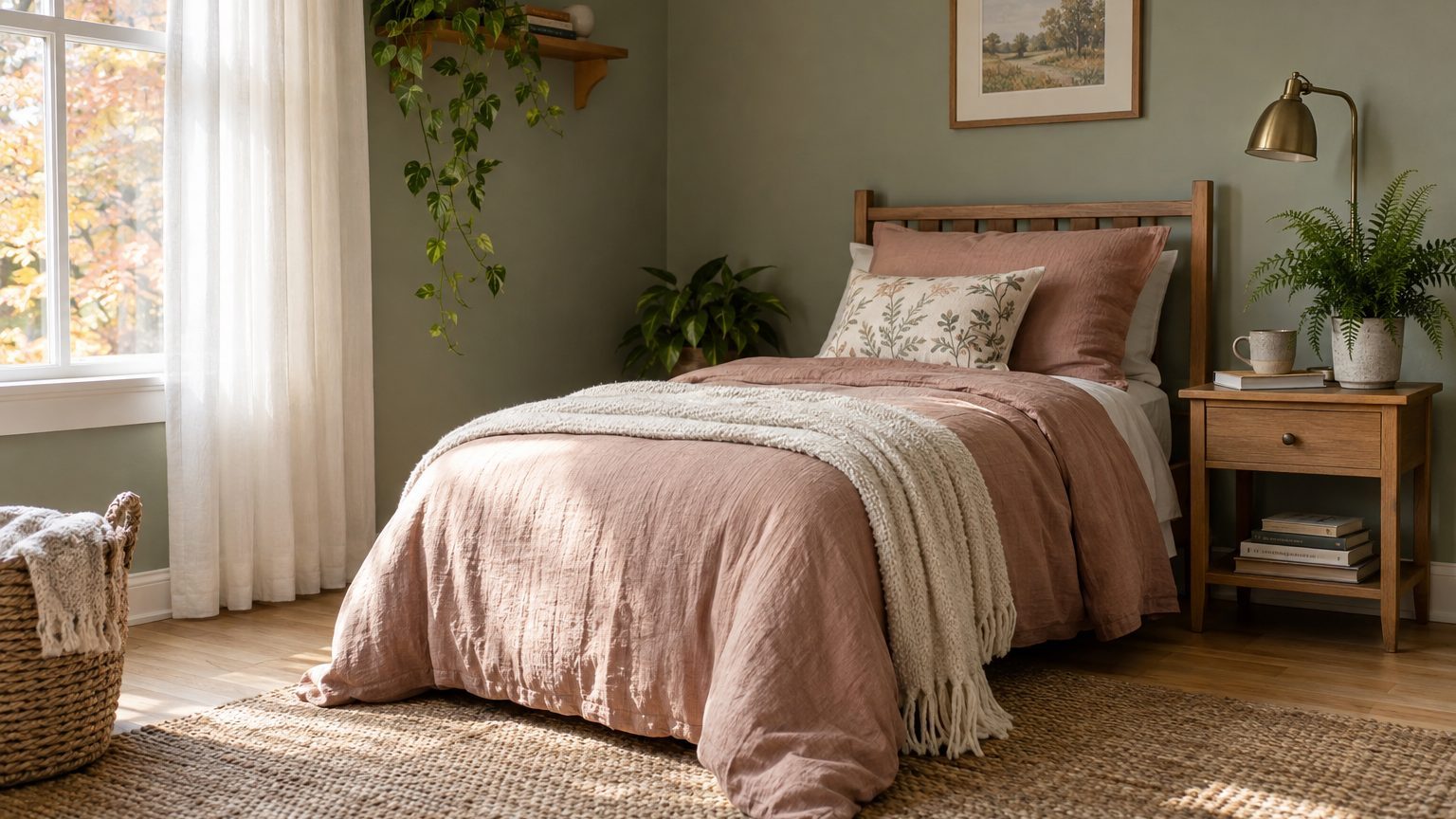

The safest bet is a muted, slightly grayed color with a warm undertone, in a washable finish. Think sage green, dusty blue, soft clay-blush, greige with a hint of rose, or a lavender that leans gray. These shades read as grown-up enough for a 14-year-old and gentle enough for a 5-year-old. The louder stuff (hot pink, neon purple, whatever character is trending) belongs on bedding, posters and removable décor, where a change costs a weekend instead of a gallon.
That is the short version. The reasoning behind it matters, because “neutral” is not the same as “lasting,” and a poorly chosen neutral can look worse than a pink wall in a few years.
Why dusty colors outlast bright ones
Paint pros talk about chroma, which is how saturated a color is. Bubblegum pink and primary blue have high chroma. Take the same hue and mix in a bit of gray or brown, and you get blush, rose clay, slate blue. Same family, far less shouting. High-chroma colors age badly because they are tied to a specific moment. A bright candy pink says “age four” the instant you see it. A dusty rose says nothing about age at all.
Undertone does the other half of the work. Every color carries a faint secondary hue. A pink with a blue undertone looks cool and a little sugary. A pink with an orange or brown undertone looks like terra cotta, plaster or a ballet slipper, and it sits comfortably next to wood floors, white trim and nearly any bedding a teenager might pick later. When you hold swatches side by side, look at which one seems to lean toward yellow, which toward blue, and which toward gray. Pick the one that leans warm if you want a color that will tolerate change.
Light reflectance value (LRV) is the number on the back of most paint chips, running from 0 for black to 100 for pure white. For a kid’s room, a mid-to-light range works well. Very light colors can look washed out in a dim room. Very dark ones swallow light and are the hardest to cover later. Paint a deep plum over, and you may need a coat of primer plus two coats of the new color. A gallon typically covers 350 to 400 square feet according to most manufacturers, and a 12-by-12 room with 8-foot ceilings has roughly 380 square feet of wall. Every extra coat is real money and real time.
Color families that hold up from kindergarten to high school
Sage and soft green top the list for good reason. Green reads as a neutral to the eye because it shows up everywhere in nature, and grayed greens pair with wood, white, black, pink, mustard and navy without a fight. A girl who loves purple at six and wants a “moody” room at fifteen can both live with sage. It tends to look calm in morning light and a little deeper in the evening, which suits a bedroom that doubles as a homework space.
Dusty blue is the other workhorse. Skip the baby-blanket shades and look for blues with a touch of gray, the kind that look almost green-gray on a cloudy day. They are forgiving on walls that are not perfectly flat, which describes most walls in houses built before the 1980s. Blue-gray also tends to read as a restful color for sleep spaces, though the claim is more about convention than clinical proof, so choose it because you like it.
Pink deserves a fair hearing, since it is what most parents are really asking about. The version that survives is the pale, warm, slightly beige blush, closer to the inside of a seashell than to a cupcake. Pair it with white trim and it looks fresh. Pair it with a deeper accent such as olive or navy and it matures overnight. Lavender follows the same rule: gray it down until it looks nearly like a stone in some light, and it stays appealing well into the teen years.
Then there is the warm neutral route. A greige with a rosy or peachy undertone, or a creamy white with a hint of yellow, gives a room a blank-canvas quality without feeling clinical. This is the right call if your daughter’s tastes change every six months, or if the room will become a guest room within a few years. It is also the best option when you plan to sell. Buyers walk through a bedroom in seconds, and a soft neutral does not trigger the “I’ll have to repaint this” reaction.
One color family to approach carefully is pure, cool gray. It is popular, but in a north-facing room it can turn flat and slightly institutional, especially in winter. If you love the gray look, choose one with a warm or greenish lean and test it before you commit.
Light and finish matter as much as the color
A paint chip under store lighting tells you very little. The direction a window faces changes everything. North-facing rooms get cooler, steadier, bluer light, so cool colors can look dull and warm ones come across as more welcoming. South-facing rooms get warm, bright light for most of the day, which means a cooler blue or green can look crisp rather than cold. East-facing rooms glow in the morning and go flat by afternoon. West-facing rooms turn golden at dusk, and a color that looked soft at noon can look orange at 6 p.m.
The fix is simple but people skip it. Paint a sample on a big piece of poster board or directly on the wall, at least two feet square, and live with it for a few days. Look at it in the morning, at midday, in the evening, and under the lamps your daughter actually uses at night. Do it on two different walls, because a wall near a window and a wall in the corner can look like two separate colors. Tape the sample next to her bedspread and her favorite posters, too. If the color fights the things that are staying, you will know right away.
Finish is the unglamorous part that decides how long the paint looks good. Flat paint hides wall flaws but marks up easily and does not tolerate scrubbing. Eggshell and satin handle fingerprints, tape residue and the occasional marker line far better. For walls in a kid’s room, most painters lean toward eggshell or satin, and a semi-gloss on trim and doors, which take the most abuse. Low-VOC or zero-VOC formulas are worth choosing in a bedroom, since the room will be closed up at night and she will be sleeping in it within a day or two of painting. Open the windows, run a fan, and give it more drying time than the can says.
One safety note for older homes: if the house was built before 1978, test the existing paint for lead before sanding or scraping anything in a child’s room. Hardware stores sell test kits, and wet-sanding or simply skipping the sanding step keeps dust down.
Let the phase live somewhere cheaper than paint
Here is the strategy that actually makes a wall color last. Treat the walls as the stable layer and give the changing interests their own layer. Bedding is the easiest. A duvet cover is a fraction of the cost of repainting, and it can be swapped when she outgrows horses or glitter or a certain band. Curtains, a rug, a lamp shade and a few framed prints do the same job, and they all travel with her when she moves on.
Removable wallpaper and large peel-and-stick decals are the next step up. They let her have a bold pattern on one wall without a commitment, as long as you test a small patch first, since results vary with wall texture and the age of the paint underneath. Fresh paint needs to cure for a few weeks before you stick anything to it, or the paint may peel off with the adhesive.
Paint can still play along. Give her real input, but inside a boundary. Narrow the field to three swatches you can live with, then let her choose. A child who feels ownership is far less likely to demand a redo in eight months, and you have already screened out the colors you would regret. For a younger girl, this might be the choice between sage, blush and dusty blue. For a tween, it might extend to a painted ceiling or the inside of the closet, small surfaces where a bolder shade costs a quart rather than a gallon. A deeper color on a single wall behind the bed is also manageable, though remember that darker accent walls are what make repainting harder later.
Older girls bring a different set of questions, mostly about mood, study space and how the room looks in photos. If your daughter is already past the cartoon-character years, the guide to A Teenage Girl’s Room: She Chooses, You Live With It covers how to negotiate with someone who has strong opinions. And if the room has stained wood baseboards, a chair rail or paneling you cannot or will not paint, A Room Full of Wood Trim You Are Not Allowed to Paint explains which wall colors work with the wood instead of against it. For the wider picture on choosing color by room and by who sleeps in it, the Decor section collects the rest of the series.
A practical habit to finish: when the last brush is cleaned, write the color name, brand, sheen and date on the lid of the can in marker, then seal it tightly and store it indoors, away from freezing temperatures. Latex paint that freezes can clump and separate. Stored well, a leftover quart handles scuffs and nail holes for years, and it lets you match the wall perfectly when she moves out and the room gets its next life.