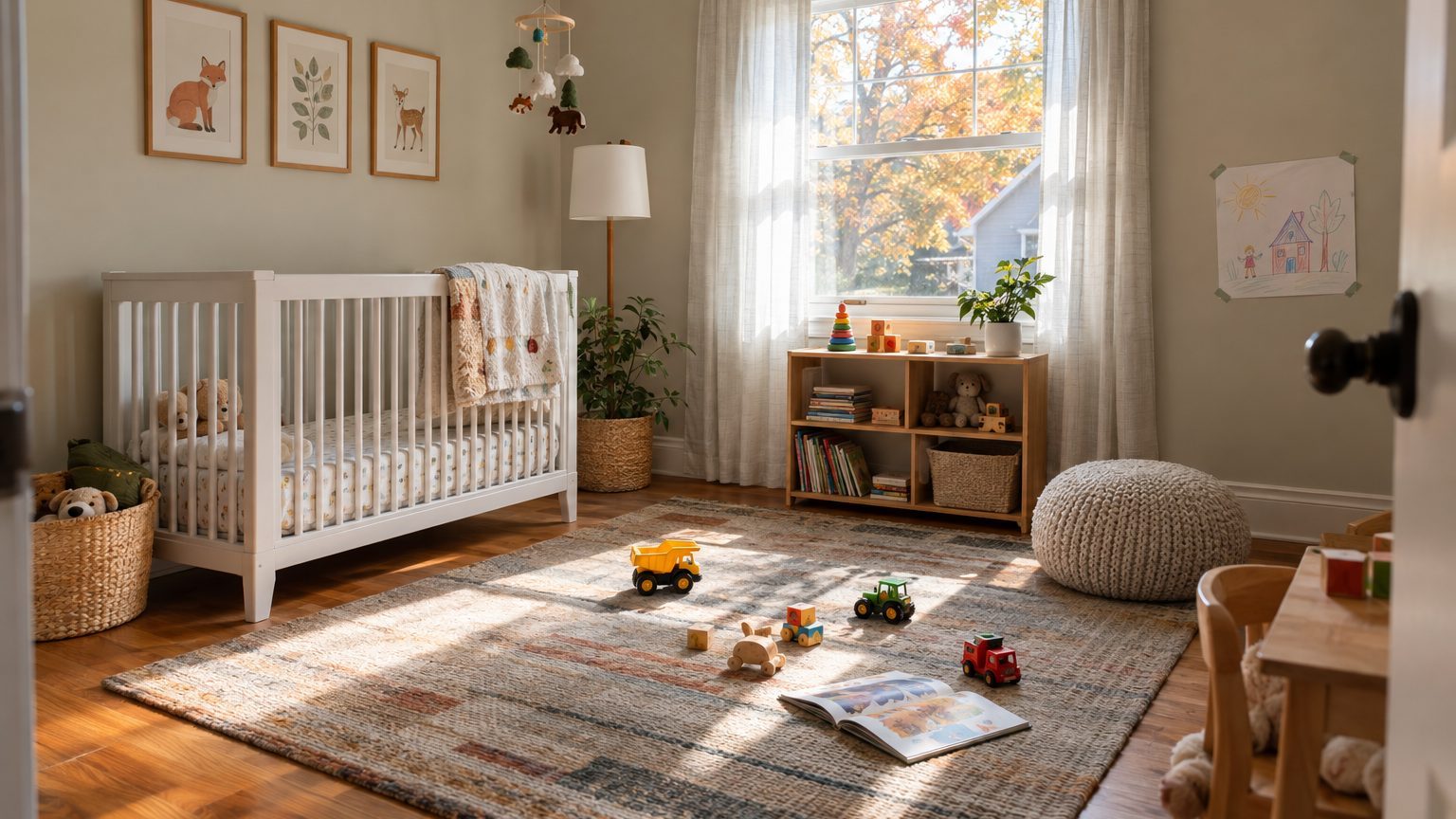

Pick the sheen before the shade. In a toddler’s room, the walls need to survive crayons, sticky fingerprints, and the occasional spaghetti launch, and a washable eggshell or satin finish in a soft mid-tone will do that better than any specific hue. A gorgeous sage green in flat paint looks tired within six months. A decent greige in a scrubbable finish still looks fine at age five.
That is the short version of Decor advice for the 1-to-3 crowd. The rest of this piece covers how sheen levels behave, which toddler room colors hold up, and what to check before a single roller touches the wall.
Why the finish decides how the room ages
Paint comes in a ladder of sheen: flat, matte, eggshell, satin, semi-gloss, gloss. Each step up has more resin and less pigment filler, which makes the dried film harder and less porous. Stains have less to grab onto, and a damp cloth removes them without taking paint along.
Flat and matte finishes are beautiful on a ceiling or in a quiet guest room. They are also the worst performers around small hands. Rub a smudge on dead-flat paint and you often burnish the spot, leaving a shiny patch that looks worse than the original mark. Melamine sponges (the white “magic eraser” type) work by micro-abrasion, so they can dull or strip lower-sheen paint outright.
For toddler walls, eggshell is the practical floor and satin is the sweet spot. Satin reflects a little light, but in a bedroom with a lamp and a window that sheen is subtle. Semi-gloss belongs on trim, doors, and the baseboards where shoes and toy trucks do their damage. Gloss on walls shows every roller mark and every bump in the drywall, so skip it.
One trick borrowed from old schoolhouses and diners still works: split the wall. Run a scrubbable finish from the floor to roughly 36 inches, about the height a standing toddler can reach, and use a softer matte above. A chair rail or a strip of painter’s tape and a steady hand marks the line. Done in the same color with two sheens, the split is nearly invisible. Done in two colors, it becomes a design feature, with the darker shade below where the grime lives.
Paint quality matters here too, and it is not just marketing. Cheaper paints tend to carry more filler, so even a satin version can wipe off poorly. Look at the can for words like “scrubbable” or “stain resistant” and check the manufacturer’s data sheet, which usually states washability in plain terms. Skip paint-and-primer-in-one products unless the walls are already in good shape, since priming is where drywall patches and old dark colors get sealed.
Colors that work with toddler life (and with the light)
Once the finish is settled, color is a much easier decision. Three practical rules cover most of it.
Mid-tones hide the most. Pure white shows every handprint. Deep navy or charcoal shows dust, scuffs, and any burnished spot. The colors that forgive best sit in the middle of the value range: warm greige, muted sage, dusty blue, soft clay, a buttery cream. Fingerprints and crayon ghosts blend into them, and touch-ups are easier because a small patch is less likely to flash against the surrounding wall.
Lower saturation also pays off over time. A bright primary red or a neon yellow can feel stimulating at the bedroom hour that is supposed to be wind-down time, and it tends to date fast. Pediatric sleep guidance leans on routine, darkness, and a calm environment far more than on any proven wall color, so there is no medical reason to choose pastel blue over pale green. Choose what keeps the room restful to you, because you are in there at 2 a.m. too.
Light changes everything. A room facing north gets cool, steady daylight that can turn gray-blues cold and flat, so warmer undertones (cream, soft peach-beige, warm sage) hold it up. South-facing rooms flood with warm light, which lets cooler greens and blues read clean instead of icy. East-facing bedrooms glow in the morning and go dim by afternoon, which matters if the room doubles as a playroom. West-facing ones turn orange at dinner time and can make a yellow wall look almost brown.
Check a color by painting a sample board, roughly 2 feet by 2 feet, and moving it around the room across a full day. Judge it next to the actual bed, curtains, and rug. Small chips lie, because a color covering four walls bounces light back at itself and usually reads deeper and stronger than the swatch.
Light reflectance value (LRV) is a number printed on many paint chips or the manufacturer’s site, running from 0 (black) to 100 (white). A room with little daylight does better with colors above roughly 60, while a bright room can carry something deeper. Rooms with borrowed or limited light follow different rules, and the logic in A Finished Basement Is a Room With Borrowed Light applies directly if the toddler’s space is a lower-level playroom.
Accent colors without repainting every year
Toddlers love loud color, and loud color is cheapest to supply in things that move: bedding, a rug, wall art, a bin of blocks. Keep the walls calm and let the bright primaries live on textiles you can replace for the price of a pizza night. By age four or five, tastes shift toward dinosaurs, then princesses, then something nobody predicted. Painted walls are the slowest and messiest thing to change, so they should be the most neutral element in the room.
If the toddler shares with an older sibling, the calculus shifts toward compromise tones that two people can live with. Two Children, One Room, Two Opinions covers that negotiation in detail.
Safety checks before the first coat
Toddlers put everything in their mouths, and that includes window sills, crib rails, and the edges of walls. That habit is the reason the unglamorous checks come before color chips.
Start with the age of the house. Lead-based paint was banned for residential use in the United States in 1978, so any home built before then may have it under later layers. The EPA’s Renovation, Repair and Painting rule requires certified, lead-safe work practices when contractors disturb painted surfaces in pre-1978 homes and child-occupied spaces, and the same cautions apply to DIYers even though the rule covers paid work. Sanding or scraping old paint can create fine dust that settles on floors, exactly where toddlers crawl. The EPA and CDC both state that no blood lead level has been identified as safe for children. A lead test kit from a hardware store can give a quick indication, and a state-certified lab or inspector gives a firm answer. Check with your state health department, since some states, such as Massachusetts and Maryland, run their own lead programs with additional requirements for rentals.
If lead paint is present and in good condition, painting over it (encapsulating) is often safer than scraping it. Peeling, chipping, or friction surfaces such as window tracks and doors call for professional abatement or lead-safe repair.
Next, the paint itself. Low-VOC and zero-VOC labels refer to the base paint, and colorants added at the store can bring some volatile compounds back, especially in deep, heavily tinted shades. Ask for a zero-VOC colorant system, which most major paint retailers can run, or choose lighter colors that use less tint. Third-party certifications such as Green Seal or GREENGUARD Gold test for emissions and are worth looking for if you want something more than a marketing claim.
Ventilation and timing are the practical part. Paint feels dry to the touch in an hour or two, but the film keeps hardening for weeks. Most manufacturers describe full cure as taking around two to four weeks, depending on temperature, humidity, and the product. Washing a wall too early can mar it. Plan to paint at least several days before a toddler sleeps in the room, run a fan or open windows, and wait until the smell is gone. Painting the nursery on a Saturday and moving the crib back that night is a common plan, and it is a poor one.
Furniture finishes deserve the same scrutiny. A freshly painted dresser or crib off-gasses as well, and a crib that is secondhand and old may carry lead paint on the rails. The Consumer Product Safety Commission sets lead limits for children’s products, but older hand-me-downs predate those rules.
Renters, and rooms that will change fast
Plenty of toddlers live in rentals, and a landlord’s “no painting” clause does not have to kill the plan. Many leases allow painting if you restore the original color before moving out, and some landlords will approve a neutral shade in writing. Get that approval in an email, not a casual conversation.
When painting is off the table, peel-and-stick wallpaper on a single wall, washable fabric panels, and large framed prints bring color without a deposit risk. Removable products vary in how they behave on textured or older paint, so test a small hidden patch first and leave it for a few days. Wall decals peel cleanly more often than wallpaper, though flat or poorly adhered paint can come off with them.
The bigger picture for any toddler room is that it is a short-lived design. Between ages one and four, the child moves from crib to toddler bed, from nap schedule to preschool, and from chewing on a board book to drawing on the wall with whatever is nearby. Paint choices that assume a gentle, tidy toddler will fail. Choices that assume chaos tend to survive.
A concrete test before committing: brush a sample of the finish onto a scrap of drywall or painted board, let it dry a full week, then smear it with a washable marker and a smudge of peanut butter, and wipe with a damp cloth. If the surface cleans up without a shiny patch or a visible streak, it has earned a place on the wall. If not, move up one step in sheen and try again.