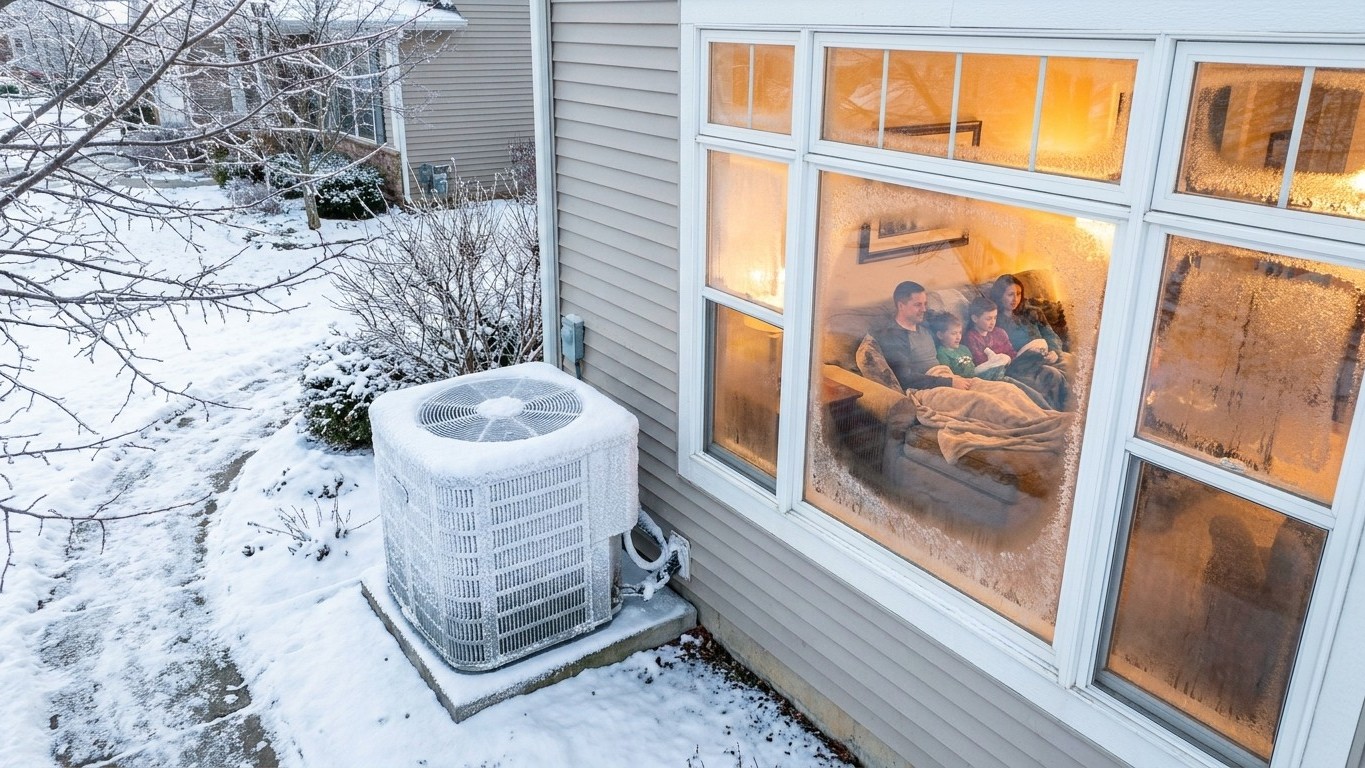

There’s no single temperature at which a heat pump quits. What changes is how much heat is left in the outdoor air for the system to move indoors, and that amount shrinks steadily as the mercury drops. Whether that decline becomes a problem in your living room depends on the specific equipment installed, how well the house holds heat, and whether a backup source is standing by to fill the gap. The real answer lives on a spec sheet, not in a rule of thumb.
The answer this page will not invent

Search around long enough and someone will hand you a number: below a certain temperature, a heat pump supposedly stops doing useful work. That number doesn’t exist as a universal fact. It can’t, because a heat pump doesn’t generate heat the way a furnace does. It extracts heat that’s already present in outdoor air and concentrates it indoors. Even air that feels brutally cold to skin still contains thermal energy, just less of it than air at 50°F. As the outdoor temperature falls, there’s simply less heat available to move, so the system’s output capacity falls with it. That’s the mechanism. Where the fall becomes unacceptable for a given house is not a fact about heat pumps in general, it’s a fact about one specific model paired with one specific building.
This is why a confident-sounding threshold, repeated often enough online, does more harm than good. Two homes on the same street can have wildly different experiences with the same outdoor temperature. One has a system chosen and sized for the regional climate, tight Insulation, and a backup heat source that only occasionally needs to step in. The other has an undersized unit in a drafty older house, and the same cold snap that barely registers next door turns into a genuinely uncomfortable week. Neither outcome says anything about heat pumps as a category. It says something about that particular combination of equipment and building.
The place to find a real answer for your own setup is the equipment’s own performance data, specifically the capacity ratings published at low outdoor temperatures. Manufacturers test and publish how much heating capacity a given model retains at various outdoor conditions, often down into single digits and below zero on cold-climate models. That chart, not a forum post or a general rule, tells you what your specific system can deliver when it’s genuinely cold outside. If you don’t have that document, it typically comes with the installation paperwork or can be requested from the installer or manufacturer using the model number on the unit’s nameplate.
None of this means the question is unanswerable, only that the honest answer requires looking at your equipment rather than repeating a number that sounds authoritative but applies to no house in particular.
What actually changes as it gets colder
Instead of a cutoff, what actually happens is a gradual sequence of changes, most of which are completely normal operation rather than signs of trouble. Knowing where your own experience falls on that sequence is more useful than chasing a threshold that doesn’t exist.
- Mildly cool weather: the system cycles on and off much like it would for cooling in summer, delivering warm air with short, quiet runs.
- Cold weather: run times lengthen noticeably. The unit stays on longer to move the same amount of heat, because there’s less of it in the outdoor air per cubic foot moved. This is normal and expected, not inefficiency.
- Colder weather: air coming out of the vents feels cooler to the hand than it did in milder conditions, even though the room is still warming. The temperature rise across the indoor coil is smaller at these outdoor conditions, and that’s expected behavior, not a malfunction.
- Frost and defrost cycles: outdoor coils build frost in cold, humid air. The system periodically reverses briefly to melt it off, sometimes producing a puff of what looks like steam and a short pause in heating. This is routine maintenance the system performs on itself, not a breakdown.
- Backup engagement: at some point, output from the heat pump alone no longer matches the house’s heat loss on the coldest days, and a backup heat source, electric resistance strips or a furnace in a dual-fuel setup, begins contributing to close the gap.
The mistake most homeowners make is panicking at stage two or three, assuming warm air that isn’t blazing hot means something is broken. In reality, stages one through four are the system working exactly as designed. Stage five is the point where the design has anticipated cold enough weather that a second heat source needs to help, and that’s built into the system on purpose, not a failure of the heat pump.
Why some units are specified for cold climates
Not every heat pump is engineered the same way for low outdoor temperatures. Some models are specifically designed and rated to retain more of their heating capacity as it gets colder, using features like larger compressors, variable-speed operation, and refrigerant systems tuned for wider temperature swings. That’s a real engineering distinction, and it’s worth asking an installer about directly rather than assuming every unit performs the same way once the weather turns.
What a buyer should ask for is the manufacturer’s published capacity-versus-temperature data, sometimes called a performance map, showing how much heating output the unit delivers at a range of outdoor temperatures down to whatever the model is rated for. A model built with cold climates in mind will show a flatter curve, meaning it holds onto more of its rated capacity as temperatures fall, compared to a standard model whose output drops off more steeply.
It’s worth being clear about what a general efficiency label does and doesn’t tell you here. The U.S. ENERGY STAR program certifies air-source heat pumps against efficiency thresholds, and those thresholds differ by system type:
| System type | Minimum HSPF2 | Minimum SEER2 |
|---|---|---|
| Split system, non-ducted | 8.5 | 15.2 |
| Split system, ducted | 8.1 | 15.2 |
| Single-package equipment | 8.1 | 15.2 |
Notice that ENERGY STAR asks more of the non-ducted split system, 8.5 HSPF2 versus 8.1 for ducted systems, for the same certification. That’s not an arbitrary gap. A ductless system has no duct losses to overcome, so it starts with a built-in advantage over a ducted system moving the same air through metal or flex duct runs, and the certification reflects that.
These figures are certification thresholds for overall seasonal efficiency, not a cold-weather rating and not a prediction of how a given unit performs at a specific low outdoor temperature. HSPF2 measures heating performance across an entire average heating season, blending mild days with cold ones into a single seasonal number. For a full explanation of what that rating measures and how to read it, see the HSPF2 guide on this site.
What this means in practice
How much any of this matters depends heavily on where the house sits and what other heating options are common there. Data from the U.S. Energy Information Administration’s 2020 Residential Energy Consumption Survey shows just how differently central heat pumps show up across states. In Maryland, 64% of homes report a furnace as their main heating equipment, and 19% report a central heat pump. In Washington state, 47% run on a furnace and 9% on a central heat pump. In Maine, 46% use a furnace, 31% rely on a steam or hot-water boiler, and the central heat pump figure isn’t reported at all in that survey.
| State | Furnace | Central heat pump | Other notable primary heat |
|---|---|---|---|
| Maryland | 64% | 19% | — |
| Washington | 47% | 9% | — |
| Maine | 46% | Not reported | 31% steam or hot-water boiler |
That “not reported” figure for Maine matters more than it looks. It doesn’t mean zero homes there use a central heat pump. It means the sample size was too small, or the resulting estimate too unreliable, for the survey to publish a number with confidence. Reading it as zero would be a mistake, but so would assuming heat pumps are absent from colder climates just because one survey couldn’t pin down a figure there.
What this pattern suggests is less about geography setting a hard limit and more about how heating systems get paired with backup in different regions. In places where furnaces or boilers dominate, heat pumps that do get installed are more often part of a combined setup rather than the sole heat source. The practical question for any homeowner considering one, or living with one already, isn’t whether it’s cold enough locally for a heat pump to make sense. It’s what backup heat exists in the system, and realistically how often that backup will need to run over a typical winter. For more on how that backup engages and what’s normal to see from it, see the auxiliary heat guide, and for homes that pair a heat pump with a furnace specifically, the dual-fuel guide covers how that handoff between the two systems works.
Common questions
Will my heat pump stop working if it gets extremely cold outside?
A properly matched system with adequate backup won’t leave a house without heat. Its own output from the heat pump portion will decline as it gets colder, and the backup source takes on a larger share of the load. What matters is whether the backup is sized and working correctly, not whether the outdoor temperature has crossed some fixed line.
Is it normal for the air from the vents to feel cool in cold weather?
Yes. Air that feels lukewarm rather than hot can still be warmer than the room and still be heating it effectively. The temperature rise across the coil is naturally smaller when outdoor air is colder, and that’s expected behavior at that stage, not a sign of malfunction.
What’s happening when the outdoor unit looks frosted over or briefly puffs out what looks like smoke?
That’s frost buildup and a defrost cycle, both routine in cold, humid conditions. The system periodically reverses briefly to melt frost off the outdoor coil, sometimes producing a visible puff of vapor. It typically resolves on its own within minutes and doesn’t require intervention.
How do I find out how my specific unit performs in cold weather?
Check the manufacturer’s published capacity data for that model, sometimes called a performance map, which shows heating output at a range of outdoor temperatures. That document, tied to your unit’s model number, is a far more reliable guide than a general rule of thumb, since it reflects how your actual equipment behaves rather than heat pumps as a broad category.