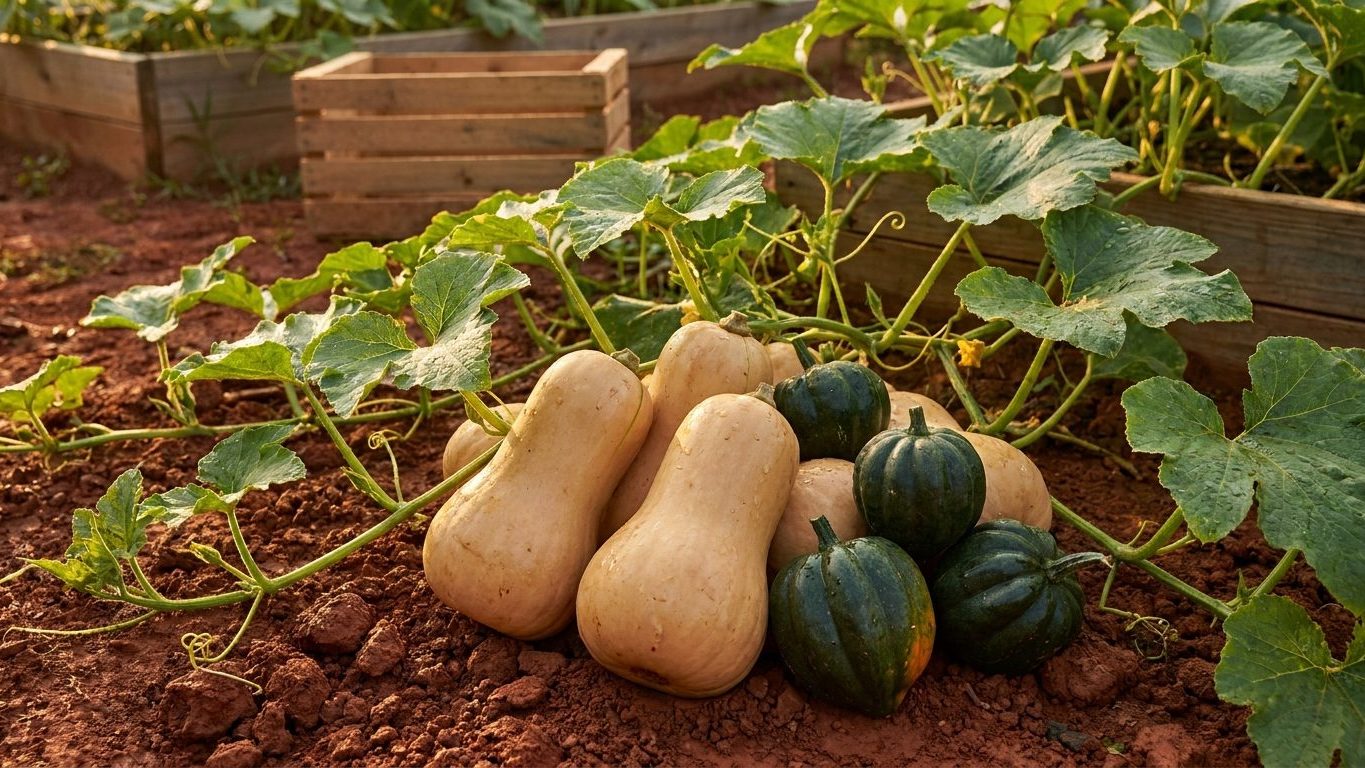

Delaware’s frost-free window runs long enough to grow almost any winter squash type to full maturity, so the real decision here is about heat, humidity and pest pressure, not running out of days. Mid-season vining types like butternut are the safest all-around choice, with quick bush types such as acorn and delicata working well for smaller plots or a second planting.
The short answer for Delaware
Start with the frost dates for the reference station, station USW00013781, because they set the outer edges of the season. Last spring frost there falls between April 3 and April 14, and the first fall frost arrives between October 26 and November 7. Take the tightest possible window, from the latest spring frost to the earliest fall frost, and a Delaware garden still gets roughly 195 frost-free days. Take the widest window and it stretches past 215 days. Even the slowest winter squash types, the ones extension programs describe as needing around 110 to 120 days from transplant to mature fruit, fit inside that window with weeks to spare for curing. Season length is not the limiting factor here, which changes what “best variety” actually means for this state.
What does matter is the summer heat load and the way rain falls. The reference station logs 17.6 days a year at or above 90F, a moderate load rather than an extreme one, but it lands during the exact stretch when fruit is sizing on the vine. Rainfall in June, July and August adds up to about 13.1 inches, front-loaded toward June at 4.67 inches and tapering to a drier August at 3.98 inches. That combination, warm early summer rain followed by a hotter, drier back half, favors varieties that tolerate a dry finish better than ones that need steady moisture straight through harvest.
Given that, the practical ranking by type looks like this for most Delaware gardens:
| Type | Typical days to maturity | Stem/vine-borer exposure | Fit for Delaware |
|---|---|---|---|
| Acorn / delicata (bush or short vine) | roughly 80-100 days | hollow stem, more exposed | Good for succession planting, watch for borer |
| Butternut (vining) | roughly 100-115 days | solid stem, less exposed | Best general-purpose choice |
| Kabocha / buttercup (vining) | roughly 95-110 days | solid to semi-solid stem | Solid second option, likes the heat load |
| Large Hubbard / banana squash (long vining) | roughly 110-120+ days | hollow stem, more exposed | Workable only if started at the early end of the frost window |
Butternut’s solid stem is the reason extension guides across the mid-Atlantic keep recommending it over acorn or Hubbard types in humid, borer-prone regions, and Delaware’s climate profile fits that pattern.
What will not work here
A short growing season is the classic reason a winter squash fails, but that is not Delaware’s problem, given the 195-plus frost-free days already available. What actually sinks a crop here comes from three sources tied directly to the numbers above, and none of them involve running out of time.
The first is watering on a fixed weekly schedule through the hottest stretch. With 17.6 days a year hitting 90F or above and August averaging only 3.98 inches of rain, the driest of the three summer months, a squash plant sizing fruit in late July and August can hit a moisture deficit even in a state with decent annual rainfall. Large-fruited types, Hubbard and banana squash especially, abort blossoms or stall fruit growth when that gap opens, because they need the most sustained moisture during the exact weeks Delaware tends to be driest.
The second failure mode is spacing that ignores how front-loaded the summer rain is. June brings 4.67 inches, the wettest of the three summer months, right as vines are filling in. Crowd plants close together at that point and foliage stays wet longer after each rain, which is exactly the setup powdery and downy mildew need in a humid mid-Atlantic climate. Dense bush varieties packed into small raised beds see this first, usually as a white film on lower leaves by midsummer.
The third is planting a variety with a hollow stem and skipping crop rotation. Delaware’s hardiness zone range, 7a to 8a under the USDA Plant Hardiness Zone Map, means winters are mild enough that squash vine borer pupae overwinter successfully in the soil most years. Acorn and Hubbard types, with their hollow stems, give the borer larvae an easy tunnel into the plant; butternut’s solid stem is measurably harder for them to colonize. A gardener who plants acorn squash in the same bed three years running, in a zone mild enough that the pest population never gets knocked back by a hard winter, is stacking the odds against a full harvest regardless of how much season is left on the calendar.
What changes across Delaware
Delaware is small on a map but it is not one garden climate. The USDA Plant Hardiness Zone Map places the state across a 7a to 8a range, and that spread alone means there is no single last-frost date or single best variety that applies from the top of the state to the bottom. A garden sitting toward the cooler end of that range should expect a later effective last frost and a somewhat shorter safe window for the slowest-maturing types, closer to the tight 195-day estimate. A garden toward the warmer end of the range gets closer to the 215-day estimate and more room for error on planting date.
That zone difference also interacts with the heat and pest pressure already discussed. Warmer pockets of the state tend to push closer to, or past, the 17.6-day average for readings at or above 90F, which raises the stakes on the August watering gap for large-fruited types. Warmer zones also tend to have milder winter soil temperatures, which does nothing to help the squash vine borer problem, since colder winters are one of the few things that naturally suppress that pest’s overwintering survival.
None of this means a gardener should try to calculate their own zone from a general description of north versus south, coastal versus inland. The USDA hardiness map is built for exactly this purpose, plotted by address rather than by county name, and it accounts for local factors, elevation among them, that a written description cannot capture. The right move is to look up the specific zone for the garden’s own location on that map rather than assume where a 7a-to-8a range starts and stops within the state.
Where to check this for your own county
Everything above is a state-level picture, built from one reference station’s frost dates and heat and rainfall normals. A state-level picture is useful for choosing a squash type, but it is not a substitute for what a county-level source can tell a specific garden, and that gap is worth closing before ordering seed.
The University of Delaware Cooperative Extension is the land-grant source for that county-level detail, and its programs are reachable online. Two things are worth looking for there specifically. The first is a local planting calendar, since county agents adjust recommended sowing windows based on soil temperature records and frost patterns that a single Wilmington-area weather station cannot capture for, say, a low-lying field in Sussex County or a sandy plot near the coast. The second is any list of winter squash varieties that have actually been trialled in Delaware conditions, whether through master gardener demonstration plots or county-level variety trials, because a variety that performs well in a university trial bed under local disease and pest pressure is a stronger recommendation than a general type ranking built from climate normals alone.
A county-level recommendation from the extension office will always beat a state-level one. It sets the general shape of the decision, mid-season vining types as the safe default, quick bush types for succession, long-season types only for the earliest planters, but the extension office is where that general shape gets adjusted to an actual soil type, an actual microclimate and an actual local pest history.
Checking this against your own garden
Frost dates and rainfall averages describe a region. They do not describe the particular patch of ground a squash plant is actually rooted in, and three simple observations will tell a gardener more about that patch than any date on a calendar.
The first is soil warmth checked by hand. Winter squash seed germinates poorly in cold, wet soil no matter what the last-frost date says, so pushing a finger a few inches down and feeling for warmth, not just dryness, before sowing is a better test than the calendar. Cold soil that feels damp and heavy points to a spot that will need raised beds or black plastic mulch to warm up on schedule.
The second is the timing of the first male flowers. Squash plants typically produce male flowers before female ones, and a long gap with no female flowers, or male flowers that drop without any fruit set following, often signals a pollinator shortage rather than a weather problem. A garden with heavy male-flower drop and few fruits despite healthy vines is telling the gardener to hand-pollinate or plant more flowering companions nearby, not to blame the season.
The third is how quickly true leaves appear after the seedling’s first round leaves. Slow true-leaf development in otherwise warm weather usually points to a nutrient gap, often nitrogen, in that specific bed rather than anything about the variety or the regional climate. Watching that sequence, soil warmth, then flower timing, then true-leaf speed, gives a far more reliable read on a particular garden’s microclimate than any state-wide frost date ever could.