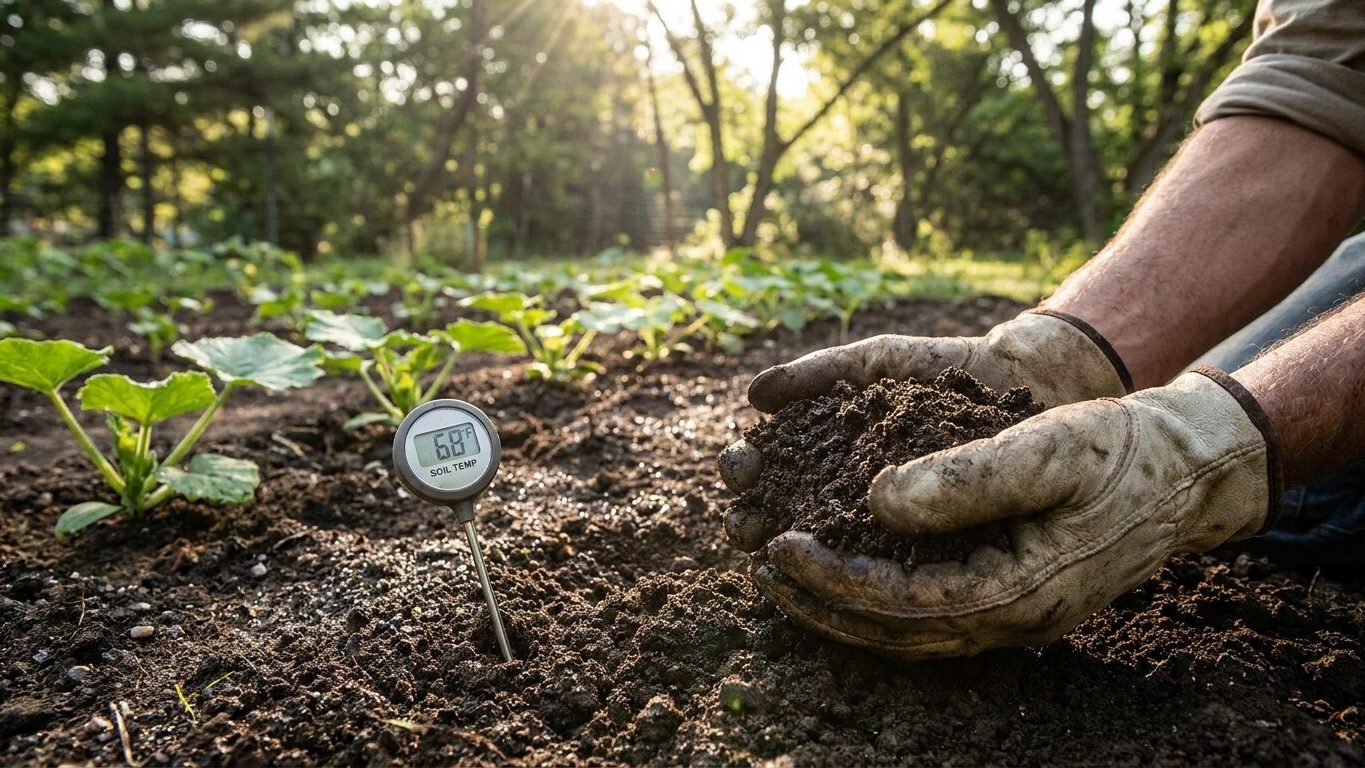

Sow winter squash outdoors in Delaware once soil has warmed past 60°F, typically mid-May through mid-June. That window gives most varieties the 80 to 110 days they need to mature before the first fall frost, which arrives at the reference station between October 26 and November 7. Everything below explains where that window comes from and where it shifts.
The short answer for Delaware
Start with the frost dates, because they’re the anchor for every other decision. At the Wilmington reference station (USW00013781), NOAA’s 1991-2020 Climate Normals put the last spring 32°F freeze in the April 3 to April 14 window, and the first fall 32°F freeze between October 26 and November 7. Those dates mark the 30-70% probability band, not a guarantee: they tell you when a freeze becomes as likely as not, not the day it will or won’t happen. A gardener planting exactly on April 14 still has real freeze odds left over.
Winter squash seed doesn’t germinate reliably in cold soil, and it rots faster than it sprouts when the ground is still wet and cool from spring rain. Most Delaware soil doesn’t hold steadily above 60°F until a few weeks after that last-frost window closes, which pushes the practical direct-sow start to somewhere around late April at the earliest, and more safely into mid-May.
Work backward from the fall end of the calendar and the window opens up further. If the first fall frost lands on the early side, October 26, and a variety needs 100 days to mature, the latest safe sowing date sits around mid-July. That means Delaware gardeners have roughly two full months, mid-May through mid-July, to get seed in the ground and still finish before frost, depending on which variety they’ve chosen and how long it needs.
Put together, that gives a working calendar: direct sow winter squash from mid-May through mid-June for most varieties, with a hard outer edge around early-to-mid July for the shortest-season types. Anything sown after that risks running out of warm days before the vines can size and cure their fruit.
What will not work here
Two Delaware numbers do more damage to a squash patch than the frost dates ever will. The reference station logs an average of 17.6 days a year at 90°F or hotter, and summer rainfall averages about 13.1 inches across June, July, and August, with August running driest at just 3.98 inches. That combination, heat load plus a dry stretch late in summer, is what actually determines whether a planting succeeds.
Watering on a fixed schedule
A gardener who waters once a week on autopilot is planning for a rainfall pattern Delaware doesn’t reliably deliver. June brings 4.67 inches on average and July 4.41, but August drops to 3.98, right when fruit is sizing and vines are under the heaviest heat stress of the season. Sandy soil, common in parts of Kent and Sussex counties, drains that rain within a day; clay soil upstate holds it for a week. A weekly schedule built for one soil type starves plants on the other.
Tight spacing in a humid summer
Delaware’s summer humidity, paired with 13.1 inches of rain landing mostly as scattered thunderstorms rather than steady soaking, creates the exact conditions vine diseases favor: wet foliage that stays wet because air can’t move through a crowded bed. Squash spaced too close together for the sake of saving garden space trades a little extra yield for a much higher chance of powdery mildew and vine collapse by late summer.
Sowing before the soil is ready
Because the April 3-14 frost window is a probability band and not a hard stop, seed pushed into the ground right at the edge of it often sits in soil still too cold to germinate cleanly. The seed doesn’t die from frost, it rots from cold, wet dormancy, which looks identical to a failed planting three weeks later. Waiting those extra two or three weeks for soil to actually warm costs nothing given how much runway sits on the other end of the calendar.
What changes across Delaware
Delaware isn’t one climate. The USDA Plant Hardiness Zone Map, built on 1991-2020 average extreme minimum winter temperatures, places the state across zones 7a to 8a. That spread matters more than its size suggests, because it separates the coastal counties along Delaware Bay and the Atlantic side of Sussex County, which run warmer, from interior and upper New Castle County, which run cooler.
A zone 8a garden near the coast likely sees its last spring frost earlier than the April 3-14 window recorded at the Wilmington reference station, and its first fall frost later than the October 26-November 7 figure. A zone 7a garden inland, particularly one at any elevation, should expect the opposite: a later last frost in spring and an earlier first frost in fall, effectively shrinking the safe planting window described above.
That’s the direction of the shift, not a personal instruction. This page can’t tell an individual reader which zone their own yard sits in, because the boundary runs through the state at a scale finer than a statewide article can resolve. What it can say is that the hardiness zone map itself, searchable by ZIP code through the USDA’s public tool, settles the question in under a minute, and that a reader closer to the coast has more room to experiment with later sowing dates than one inland does.
Where to check this for your own county
This page gives Delaware’s statewide picture, built from one reference station’s frost and rainfall normals. A county recommendation beats a state one every time, because it accounts for local soil, local elevation, and local microclimate in ways a single airport weather station can’t. That’s exactly what the University of Delaware’s Cooperative Extension provides.
University of Delaware Cooperative Extension is the place to look for two specific things. First, a county-level planting calendar that reflects the actual frost pattern for New Castle, Kent, or Sussex County rather than the Wilmington airport average used here. Second, a list of winter squash varieties that extension agents have actually trialled in Delaware conditions, which tells you far more about real-world performance against local humidity and pest pressure than a seed catalog description ever will.
Extension offices also field direct questions from gardeners in their coverage area, which matters most in the borderline weeks, right around that April 3-14 frost window or when deciding how late into July a sowing can still go. A phone call or email to the local office, referencing the specific county, will get an answer calibrated to a single town rather than an entire state spanning two hardiness zones.
Some gardeners also time this by the Moon: when to plant winter squash by the moon, as almanac tradition rather than fact.
Checking this against your own garden
Every date above comes from a weather station average, and averages miss the specific patch of ground a reader is actually working. Three direct observations outrank all of it.
Soil warmth by feel is the first and most reliable check. Push a bare hand two inches into the bed in the morning; if it feels cool rather than merely cold, the soil is likely holding in the range winter squash seed wants. Ground that still feels like it did in March, even after the calendar says mid-May, is telling you the local microclimate is running behind the reference station, and sowing should wait regardless of what date it is.
The first flush of male flowers is the second signal. Squash plants send out male blooms before female ones, sometimes by a week or two, and their appearance means the plant has moved fully into its growing phase rather than just surviving. A garden that reaches this stage noticeably earlier or later than a neighbor’s, even one a few miles away, is revealing a real microclimate difference worth remembering for next season.
The first true leaves, the second set that appears after the initial seed leaves, confirm the plant has rooted well and is drawing real nutrition from the soil rather than running on stored seed energy. Slow, pale true leaves after a normal germination usually point to soil that’s still too cool or too wet, the same condition that causes rot in seed sown too early. Watching for that shift, rather than counting days on a calendar, is the closest thing a home gardener has to a soil thermometer.