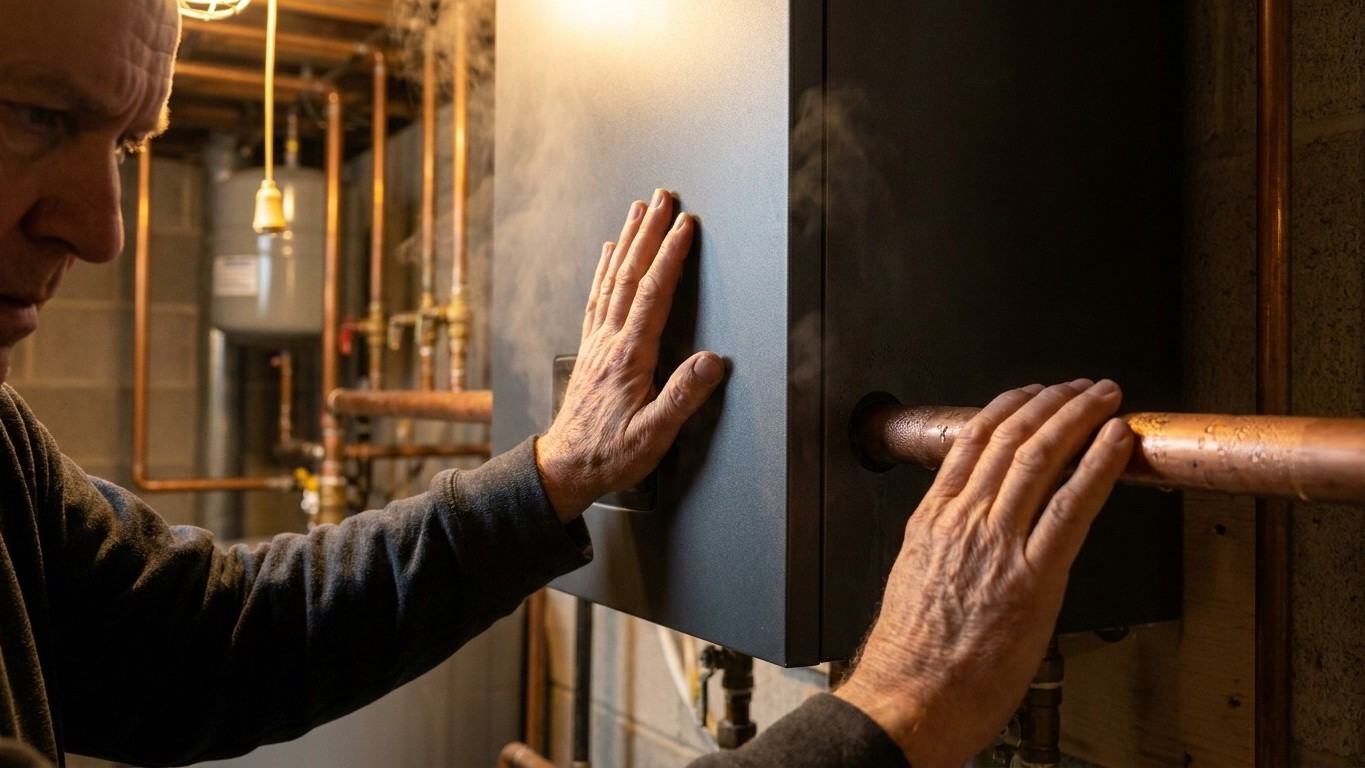

A boiler that stays on but never warms the rooms is failing at one of two jobs: producing heat, or moving that heat to where you live. The fix depends entirely on which one broke. A cold boiler casing points to an ignition or fuel problem. A hot boiler with cold radiators points to a pump, valve, or air-lock problem downstream. Sorting out which category applies takes about five minutes with your hand, and it decides whether you call a plumber, an HVAC tech, or just bleed a radiator yourself.
Two very different faults
Every “boiler not heating” complaint splits into one of two mechanical failures, and they don’t share a cause or a fix. The first is a combustion failure: the burner never lights, so the appliance never generates heat in the first place. The second is a distribution failure: the burner fires normally, the water inside gets hot, but that heat never reaches the rooms. Confusing the two wastes a service call, because a technician sent to fix a stuck valve won’t find anything wrong with the burner, and vice versa.
Check the boiler itself
Put a hand flat on the boiler’s outer casing, then on the pipe leaving it toward the heating system. If both are cool to the touch after the thermostat has been calling for heat for ten or fifteen minutes, the appliance isn’t making heat at all. That’s a firing problem, and it usually traces back to power, fuel, or a safety lockout inside the unit rather than anything in the pipework.
Check the pipes and radiators
If the boiler casing and the outgoing pipe are both hot, the fault is downstream. Walk to the radiators or baseboard runs and feel each one from top to bottom. A radiator that’s hot at the top and cold at the bottom is holding trapped air and needs bleeding. A radiator that’s cold across its entire face, while the pipe feeding it is warm, usually means a closed or stuck valve at that radiator, not a boiler fault at all. A whole zone that’s stone cold while the boiler runs hot points to something bigger: a dead circulator or a zone valve that never opened. That distinction, one cold radiator versus a whole dead zone, is the difference between a five-minute fix and a call for parts.
When it does not fire
When the boiler itself never gets warm, work through the causes in the order they’re most likely to occur. Most no-heat calls resolve at the first two or three steps, not the last one.
- Power and switch: confirm the boiler’s own switch, any external service switch, and the breaker feeding it are all on. Many boilers have a dedicated switch that looks like a light switch on the wall near the unit, and it gets bumped off more often than anyone admits.
- Thermostat calling: raise the setpoint well above room temperature and listen or watch for the boiler to respond. A thermostat with dead batteries or a broken wire will show a display but never actually call for heat.
- System pressure in its normal band: most residential boilers refuse to fire, or shut themselves down mid-cycle, when the system pressure falls outside the range printed on the appliance label. Low pressure is the single most common reason a boiler locks itself out, and the full explanation, including how to read the gauge and where to top it up, is covered on this site’s dedicated boiler pressure page.
- Fuel supply: for gas units, confirm the gas valve is open and that other gas appliances in the home are working; for oil units, check the tank level and the reset button on the burner. Because a boiler is a fuel-burning appliance, any suspected fuel or combustion fault is also a carbon monoxide concern. CO is colorless and odorless, and a working CO alarm near the appliance is not optional. An electric boiler, by contrast, burns no fuel and carries none of this risk.
- Lockout light: most modern boilers display a fault code or a lit lockout indicator when they’ve safely shut themselves down rather than run unsafely. That code, decoded against the manual for your specific model, usually points straight at the failed component instead of leaving you guessing.
The U.S. Fire Administration puts annual professional service in the same category as smoke detector checks, stating plainly to “maintain heating equipment and chimneys by having them cleaned and inspected each year by a professional.” A boiler that locks out repeatedly, even if it restarts each time you reset it, is telling you it needs that inspection now rather than at the usual fall service date.
When it fires but nothing gets warm
A boiler that’s hot to the touch while the house stays cold has a distribution problem, and there are really only four usual suspects behind it.
The four usual suspects
A stopped circulator pump is the most common of the four. The pump’s job is to push hot water out to the radiators or baseboards; if it’s seized, unplugged, or electrically dead, the boiler can run all day and the heat simply never leaves the mechanical room. A stuck zone valve is the second: on systems split into multiple heating zones, each zone has its own valve, and one that fails to open leaves that entire zone cold while the rest of the house heats normally. Air trapped in the loop is the third: air pockets block water flow at exactly the high points where radiators sit, which is why bleeding is a distribution fix rather than a boiler fix. A system that’s badly out of balance is the fourth: too much flow reaches the radiators closest to the boiler and too little reaches the far end of the loop, so some rooms roast while others stay cold even though every valve is technically open.
Diagnosing which of the four applies means listening and feeling in sequence: is the circulator pump warm and humming (rules out the first cause), do all zones respond when called individually (rules out the second), and are the cold radiators cold at the top specifically (points to the third). The mechanics of the circulator pump itself, including how to tell a seized pump from a simply unpowered one, are covered on this site’s circulator pump page; the step-by-step process for bleeding air and balancing flow between radiators lives on the radiator bleeding and radiator balancing pages rather than here.
It’s worth knowing that even well-installed hydronic systems drift out of tune on their own. A U.S. Department of Energy study on hydronic heating performance in multifamily buildings found that “control settings are often best guesses and are not typically optimized.” That study covers apartment buildings and central systems, not single-family boilers, and its savings figures don’t transfer to a house. But the underlying point does: nobody fine-tunes a heating system once and leaves it perfect forever, and a system that heated evenly two winters ago can still drift out of balance without any single part actually failing.
Common questions
Does a boiler that won’t heat always mean it needs replacing?
No. Most no-heat calls trace back to a lockout, a pressure drop, a dead pump, or a stuck valve, all of which are repairs rather than replacements. Efficiency does become a separate question once a boiler is genuinely old: AFUE (annual fuel utilization efficiency) measures how much of the fuel’s energy actually becomes heat in the home versus escaping up the flue, and a unit rated at 0.90 AFUE turns 90 percent of its fuel into usable heat. Federal purchasing guidance from DOE’s Federal Energy Management Program compares models at 0.84, 0.90, and 0.97 AFUE, but that guidance is written for federal agencies buying in bulk, not for a homeowner weighing a repair against a replacement.
Why does my boiler run constantly but the house never reaches temperature?
This is usually a distribution problem rather than a firing problem: check for a system badly out of balance, where rooms near the boiler overheat while distant rooms stay cold, or a circulator running weakly rather than fully seized.
Is a cold radiator always a sign of trapped air?
Only if it’s cold at the top and warm at the bottom. A radiator that’s cold across its entire surface while the feed pipe is warm points to a closed or stuck valve at that radiator, not air.
Can low pressure cause a boiler to fire but still not heat properly?
Yes, and it’s more common than a full lockout. Pressure that’s low but still above the lockout threshold can cause a boiler to short-cycle or heat weakly without shutting off entirely, which feels like a distribution problem even though the root cause sits back at the pressure gauge.