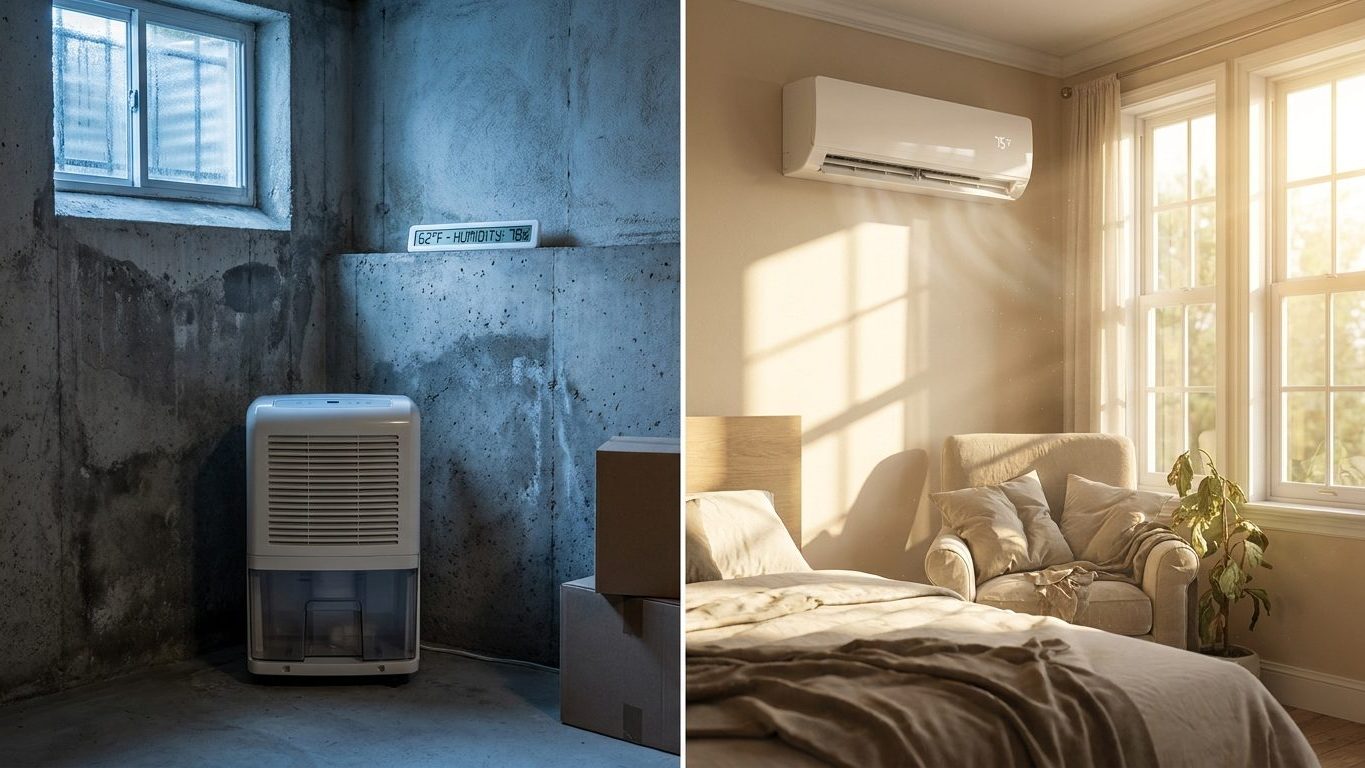

The short answer: you need a dehumidifier when the air feels damp but isn’t hot enough for the air conditioner to run, and you need the air conditioner when the air is hot, whether or not it’s also humid. The two machines solve different problems, and using one to fix the other’s job usually means paying for equipment that’s fighting the wrong battle.
Two machines that both remove water
An air conditioner and a dehumidifier both pull water out of the air, and that overlap is exactly what confuses people standing in a store aisle. A central air system cools your house by pushing air across a cold coil. Moisture in that air condenses on the coil and drips away, so dehumidifying is a side effect of cooling, not the point of the machine. The point is temperature.
A dehumidifier runs the process almost backward. It also has a cold coil that condenses moisture out of the air, but instead of sending that cooled air into your living room, it takes the heat pulled from the water and dumps it right back into the same air stream before blowing it out. The result is air that’s drier but slightly warmer than when it went in.
That detail rarely makes it into the buying decision, and it should. A dehumidifier doesn’t cool anything. It’s not a lesser or cheaper air conditioner. It’s a machine built for spaces where temperature isn’t the issue, where nobody’s uncomfortable from heat, but everyone notices the musty smell, the sweating pipes, or the box of holiday decorations growing a fuzzy coat.
Put one in a hot bedroom expecting relief and you’ll get less humidity and more heat, which can cancel itself out on a sticky night. Put one in a basement that never gets hot but always feels heavy and clammy, and it does exactly what it’s built for, with none of the wasted effort of running a cooling system for a room that isn’t warm.
The confusion gets worse because both machines use the same core technology, a compressor and a refrigerant loop, just arranged to send the leftover heat in opposite directions. Nobody needs to know the plumbing of that loop to make the right call. What matters is a simple filter: is the discomfort about temperature, or about the dampness itself? Answer that, and the rest of the decision mostly makes itself.
When each one is the answer
Different rooms send different signals, and matching the machine to the signal is where most people go wrong. A hot, humid upstairs bedroom on a July afternoon wants cooling first, because the discomfort is driven by temperature and the air conditioner removes moisture as it works anyway. A cool, damp basement in June, where the thermometer reads comfortable but everything feels sticky, wants a dehumidifier, because there’s no heat to remove and running a cooling system there accomplishes nothing except a lower electric bill’s evil twin.
| Situation | Right machine | Why |
|---|---|---|
| Hot, humid upstairs room on a summer afternoon | Air conditioner | Heat is the primary complaint; moisture removal comes along for free |
| Cool, damp basement in June | Dehumidifier | No heat to remove; the cooling system would have nothing to do |
| House feels cold and clammy while the AC runs | Neither, first check the system | Usually a sizing or airflow problem, not a humidity problem to paper over |
| Crawlspace under the house | Dehumidifier, after sealing | Ground moisture and outside air need to be blocked before drying makes sense |
| Laundry room with a vented dryer and no AC duct | Dehumidifier | Steady moisture load from washing and drying, no cooling need |
The third row deserves more attention than it usually gets. A house that feels cold and clammy while the air conditioner is actively running isn’t sending a humidity signal at all. It’s sending a sizing signal. An oversized air conditioner cools the air fast, satisfies the thermostat, and shuts off before it has run long enough to pull meaningful moisture out of that air. You end up with a room that’s cold to the touch but still humid to the skin, and the instinct to add a dehumidifier on top of that system treats the symptom while ignoring the actual mismatch between the equipment and the house. Before buying anything, it’s worth reading through this site’s humidity guide, which walks through how equipment sizing and runtime affect moisture removal separately from temperature.
The crawlspace and laundry room rows share something too: both are moisture sources feeding the rest of the house, not comfort zones people sit in. A dehumidifier earns its keep there precisely because nobody’s asking those spaces to feel cool, just dry.
The case where it is clearly right
The cleanest argument for a dehumidifier shows up in the shoulder seasons, the stretch of spring or fall when a basement turns damp but the days aren’t warm enough to justify running central air at all. The cooling system that would have quietly dried the air as a byproduct of its normal cycle sits idle, because nobody needs the house cooled. Meanwhile the basement keeps collecting moisture from the ground, from spring rain, from a laundry line hung indoors, with nothing pulling it back out. That’s the gap a dehumidifier fills, and it’s the one situation on this list where the appliance isn’t a workaround for something else, it’s simply the only tool doing the job that season.
A few practical points make the difference between a machine that runs well and one that becomes another chore:
- Use a drain line instead of the internal tank whenever one is available nearby, such as a floor drain or a condensate line already in the basement. A tank that has to be carried out and emptied gets skipped, and a skipped emptying means the unit shuts off and stops working long before anyone notices.
- Keep the unit pulled away from walls and furniture so air can actually circulate around it. A dehumidifier crammed into a corner is drawing from and exhausting into the same small dead-air pocket, which slows the whole process down.
- Know what happens in a cold basement. Below a certain temperature, some units start frosting their own coil the same way a freezer builds up ice, and once that happens the machine effectively stops dehumidifying until it defrosts. Cold basements in early spring or late fall are exactly where this shows up.
Skip the temptation to chase a specific humidity number on a gauge. This brief, and honestly most homes, don’t need one. What matters are the signs. Too damp looks like condensation beading on cold pipes or window frames, a musty smell that lingers after you’ve cleaned, or a faint dampness on concrete you can feel with a bare hand. Too dry, on the other hand, shows up as static shocks off doorknobs and wood trim that starts to crack or pull away at the joints. Neither extreme needs a number attached to it. They need attention when you notice them, and a dehumidifier addresses one side of that without you ever having to read a percentage off a dial.
Running one without wasting it
A dehumidifier left to run on its own terms wastes electricity and does a mediocre job, and the fixes are mostly the same habits that keep any appliance with a coil and a fan working the way it’s supposed to. Airflow around the unit matters as much as it does for a full HVAC system. ENERGY STAR puts it plainly for the broader system, noting that “airflow problems can reduce your system’s efficiency by up to 15 percent,” and the same principle scales down to a single dehumidifier: block the intake or exhaust with boxes and laundry baskets, and the machine works harder for less result.
The filter is the easiest part of that airflow story to ignore, and the first one to fix. A dehumidifier’s filter catches dust before it reaches the coil, and a clogged filter chokes the air moving through the unit the same way a dirty furnace filter does. Rinsing or replacing it on a regular schedule, whatever the manufacturer specifies for that model, keeps the coil clean far longer than trying to scrub a dust-caked coil later. And the coil does collect dust, the same way any refrigerant coil in the house does, whether it belongs to a furnace, an air conditioner, or a standalone dehumidifier sitting in a basement corner.
None of this matters if the space itself is open to the outdoors. A crawlspace with vents still open to outside air, or a garage with daylight visible under the door, is a space where a dehumidifier is pulling moisture out of a room that’s simultaneously pulling it right back in from outside. The machine runs constantly, the humidity barely moves, and the electric meter spins for no real gain. Sealing and, where needed, draining the space comes first. Only after that groundwork is done does running a dehumidifier make sense, and the crawlspace guide on this site covers what sealing that space actually involves before any appliance gets added to it.
Common questions
Can a dehumidifier replace an air conditioner in summer?
No. It removes moisture but adds a small amount of heat back into the room as it works, so it won’t cool a hot space and can make a warm room feel slightly warmer while drier.
Will a dehumidifier fix a basement that stays damp even in winter?
It can help, but check first whether the temperature drops low enough for the unit to frost its coil and stop working. Persistent dampness through winter often points to a groundwater or sealing issue that needs addressing separately.
Why does my house feel humid even with the air conditioner running?
An oversized system cools quickly and shuts off before it has run long enough to remove much moisture, leaving the air cold but still damp. That’s a sizing question for the cooling system, not a job for an added dehumidifier.
Does a dehumidifier help in a garage or crawlspace?
Only after the space is sealed from outside air. Running one in a space with open vents or gaps under a door means it’s fighting a constant, unwinnable battle against outside moisture.