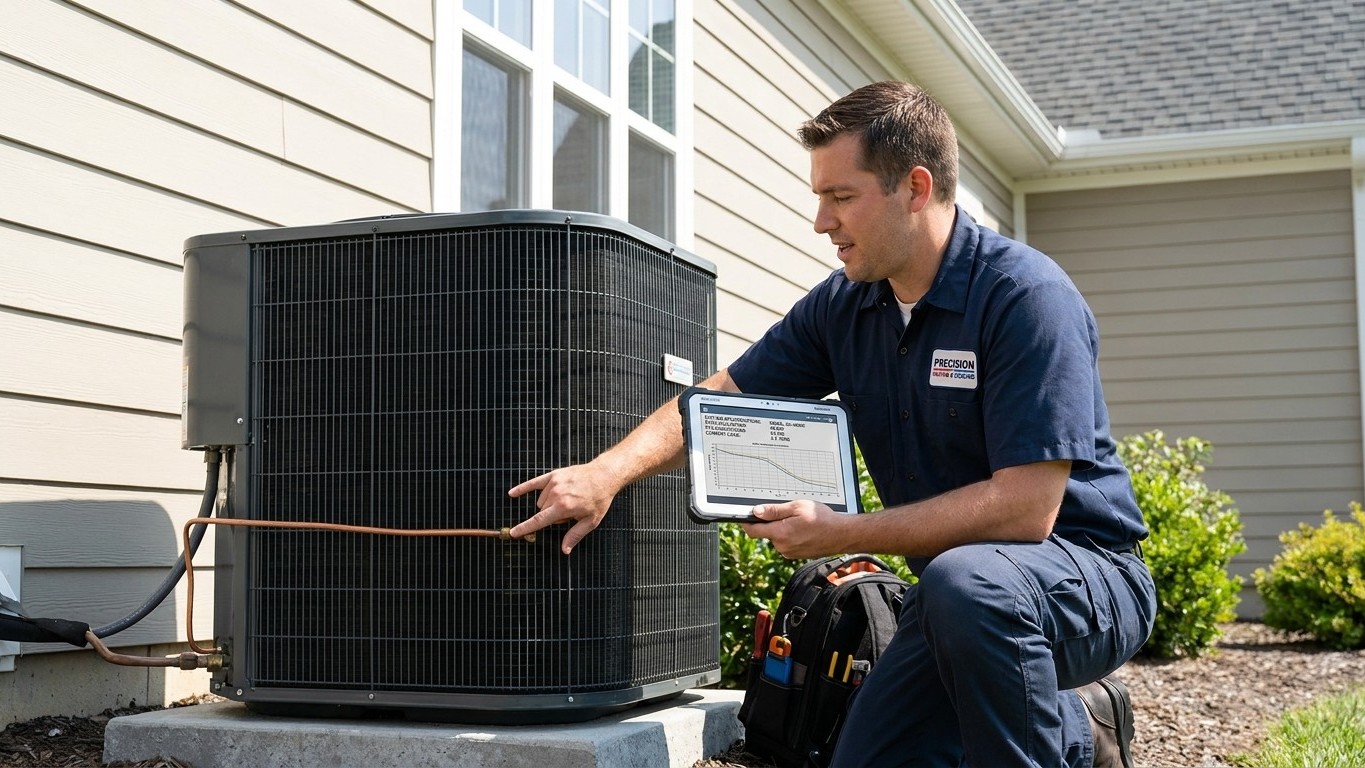

There’s no single BTU number that fits every house because central air sizing depends on square footage, ceiling height, insulation, window exposure, and how many people and appliances add heat to the space. The only reliable way to land on the right size is a room-by-room load calculation, not a flat square-footage rule.
What Size Central Air Conditioner You Need
Central air conditioners are rated in tons of cooling capacity, and one ton equals 12,000 BTU per hour of heat removal. A 2-ton system moves 24,000 BTU/hr, a 3-ton system moves 36,000 BTU/hr, and so on. That’s the vocabulary contractors use, and it’s worth knowing before you talk to anyone about replacing a system.
The mechanism behind sizing is simple in concept: a bigger house, more windows facing the sun, or a poorly insulated attic all mean more heat entering the living space, so the system needs more capacity to pull that heat back out fast enough to keep up. ENERGY STAR publishes a chart for room air conditioners that shows this relationship clearly, matching square footage to the BTU capacity needed to cool that space.
| Area to be cooled (sq ft) | Capacity needed (BTU/hr) |
|---|---|
| 100 up to 150 | 5,000 |
| 150 up to 250 | 6,000 |
| 250 up to 300 | 7,000 |
| 300 up to 350 | 8,000 |
| 350 up to 400 | 9,000 |
| 400 up to 450 | 10,000 |
| 450 up to 550 | 12,000 |
| 550 up to 700 | 14,000 |
| 700 up to 1,000 | 18,000 |
| 1,000 up to 1,200 | 21,000 |
| 1,200 up to 1,400 | 23,000 |
That chart is a starting point published by ENERGY STAR for individual rooms, not a full load calculation for a whole house. It shows you the relationship between area and capacity, which is exactly what scales up when a contractor sizes a central system across every room, hallway, and staircase in the home. But a house isn’t one big room, and central air has to account for how heat moves between floors, how much shade the roof gets, and how tight the ductwork seal is, none of which shows up in a per-room table.
The mistake most homeowners make isn’t undersizing, it’s the opposite. An oversized unit is a real fault, not a safe cushion. It cools the air fast, satisfies the thermostat, and shuts off, but it never runs long enough to actually pull moisture out of the air. The room hits the target temperature, then feels cold and damp instead of comfortable, because humidity removal takes sustained runtime, not a quick blast of cold air.
How to tell, in your own house
Before calling anyone, there’s real information you can gather yourself. Do these in order, because each step builds on the last, and the order is what keeps you from paying for work you didn’t need.
- Find your current system’s rating. The outdoor condenser unit has a nameplate, usually on the side or back, listing model and capacity information. If your system already struggles or overcools, this tells you what you’re starting from at no cost.
- Add up your conditioned square footage. Walk the house with a tape measure or pull dimensions from a listing or appraisal. Count only heated and cooled living space, not the garage or unfinished attic.
- Watch how the house behaves on a hot day. Does it cool quickly but feel sticky and damp afterward? That’s the oversizing symptom described above. Does it run nonstop and never quite reach the thermostat setting? That points the other way, toward a system straining against a load it can’t fully handle.
- Check airflow at the vents and swap the filter. A dirty filter or a closed vent can mimic sizing problems that have nothing to do with tonnage. This costs a filter’s price and a few minutes, and it rules out the cheapest explanation before you assume the equipment itself is wrong.
- Bring in a professional for a Manual J load calculation. This is where homeowner work ends. A proper load calculation factors in insulation values, window orientation, ceiling height, air leakage, and local climate data, none of which you can measure accurately with a tape measure and a thermostat. Anyone handling refrigerant charge or connecting new equipment to your electrical service also needs to be a licensed HVAC contractor with EPA refrigerant certification. That’s not a homeowner task, and it’s not one to shortcut.
Someone who only does the first three steps still walks into a contractor conversation with real numbers instead of a guess, which changes how that conversation goes.
What it costs you to ignore it
A mismatched system doesn’t fail outright, it just costs you slowly in ways that are easy to blame on other things. An oversized unit short-cycles, meaning it starts and stops far more often than it should, and every start puts extra mechanical strain on the compressor, the part most likely to fail first and the most expensive to replace. That damp, clammy feeling isn’t just discomfort either, it’s a sign moisture is sitting in the ductwork and on interior surfaces, conditions that invite mold growth over time.
An undersized system carries a different cost. It runs continuously during peak heat, trying to close a gap it physically can’t close, which means the compressor and blower motor log far more operating hours than they were designed for over the system’s lifespan. That extra runtime also means higher electricity use for the same result, a house that never quite feels right.
Neither problem announces itself with a warning light. They show up as rooms that never feel comfortable, a system that seems to run more than it should, and equipment that wears out earlier than its expected lifespan. Getting the size right the first time is what keeps all of that from becoming a slow, quiet drain on both comfort and equipment.