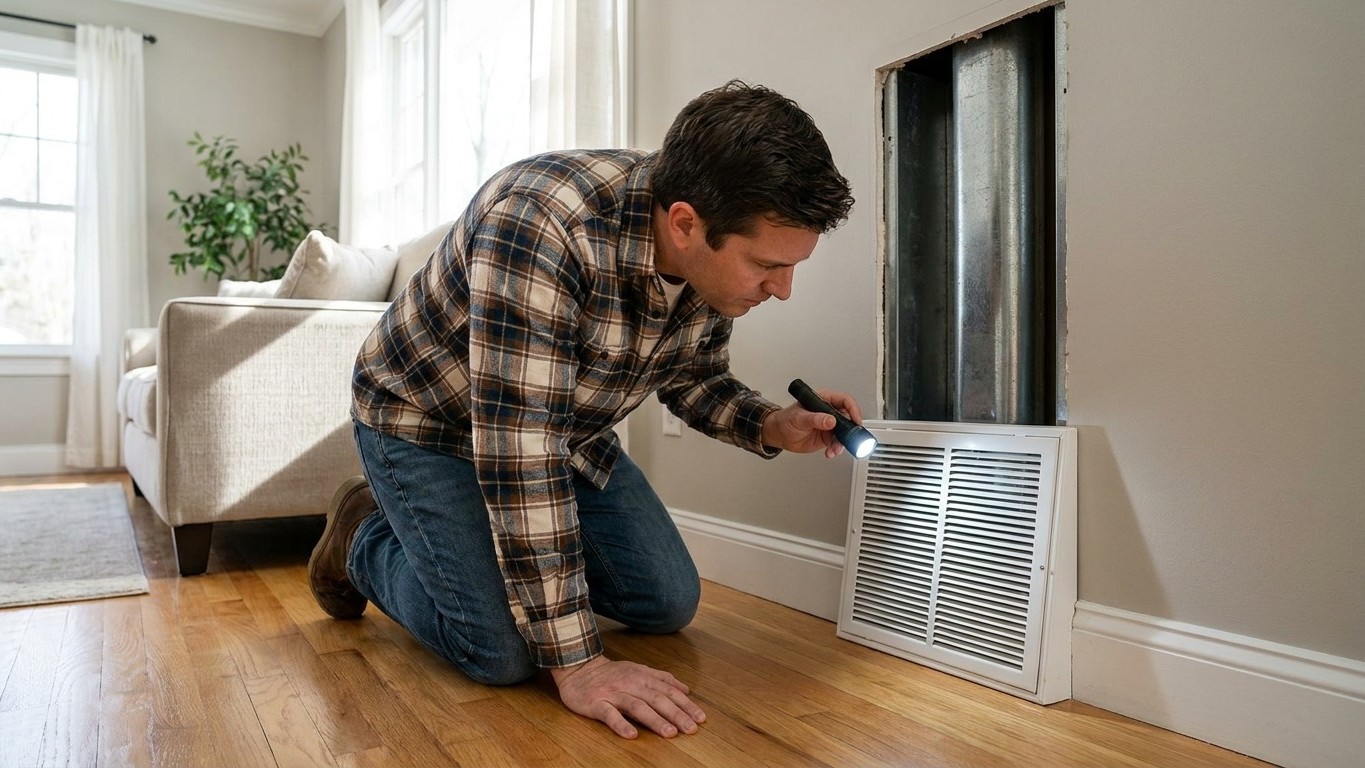

A weak or dead register almost always traces to one specific point between the grille and the furnace, not a system-wide failure. This applies to forced-air systems only; radiators, hot water baseboard, and ductless mini-splits don’t have registers or ducts, so none of this troubleshooting applies to them. The fix is to start at the vent itself and work backward, checking one thing at a time until the air either shows up or the problem reveals itself.
Work backwards from the register

Most guides list every possible cause of a dead vent in random order: closed damper, crushed duct, bad blower, clogged filter. That’s not how a technician actually finds the problem, and it’s not the fastest way for a homeowner to find it either. The efficient method moves in one direction only, starting at the register the reader is standing in front of and working toward the furnace or air handler, one section at a time.
Each step in that chain either solves the problem or rules out a chunk of ductwork. Check the register itself first. If that’s clean, move to the section of duct just behind it. If that’s fine, follow the run toward the trunk line. By the time you reach the equipment, you’ve either found the blockage or you know it isn’t in this room’s branch at all, which points somewhere else entirely. That elimination is the value of doing it in order instead of guessing.
No air versus not enough air
Before troubleshooting starts, it helps to know which problem you actually have. “No air” means the register is dead, no detectable movement at all. “Not enough air” means something is coming out, just weakly. These point in different directions and mixing them up wastes time.
The test is simple and takes about ten seconds. Hold a single sheet of paper flat against the grille. If it doesn’t move at all, you have a true no-air situation, likely a closed damper, a disconnected boot, or a full blockage somewhere in the run. If the paper flutters weakly or gets pulled in slightly, you have reduced airflow, which usually means a partial restriction, a long run, or a system-wide issue affecting every register in the house. Do this test at the register in question and at one or two other registers in the house for comparison. That single comparison tells you whether the problem is isolated to one room or spread across the whole system, which changes everything about where to look next.
At the register
The first three checks cost nothing and take less than five minutes combined. They also solve the problem more often than people expect, which is why they come first instead of last.
Take the grille off the wall or floor before doing anything else. This is the step almost every troubleshooting guide skips, and it’s the one that answers the question directly about a third of the time, because two of the three checks below are invisible with the cover on.
- Check the damper lever. Many registers have a small lever or wheel on the face that opens and closes an internal damper. It can get bumped shut by furniture, a vacuum cleaner, or a curious pet, and it’s easy to miss because the grille looks identical whether it’s open or closed. Slide it fully open and test again with the paper.
- Check for physical obstruction. A rug, a couch, a stack of boxes, or a bed frame pushed over a floor register blocks airflow just as effectively as a mechanical failure, and it happens constantly in bedrooms where furniture gets rearranged. Pull anything within a foot of the grille away and retest.
- Check the boot behind the grille. The boot is the metal box that connects the register to the duct running through the wall, floor, or ceiling. In older installations, or after any nearby work like flooring or insulation, this connection can pull loose or separate at the seam. With the grille off, look and reach in a few inches. If you can see or feel a gap between the boot and the duct, or if the duct itself has clearly slid away from the boot, you’ve found the problem, and it’s visible the moment the cover comes off.
If all three check out clean, damper open, nothing blocking the grille, boot solidly connected, the problem is further back in the duct run, and that’s the next place to look.
Along the run
If the register itself checks out, the next stretch to examine is the ductwork feeding it, whether that’s a flexible duct running through an attic or crawlspace, or rigid metal running through a wall cavity. Several distinct failures happen along a run, and each one leaves a different physical sign.
| What happens | Where it shows up | What it looks like |
|---|---|---|
| Flex duct kinked over framing | Attic, over a joist or truss | A sharp bend where the duct sags across a framing member, pinching the inner liner and cutting airflow at that point |
| Duct crushed by storage | Attic, near stored boxes or equipment | Flattened or compressed sections where weight has been set directly on the flexible duct |
| Run separated at a collar | Any connection point between duct sections | A visible gap or loose connection where two duct segments or a duct and a fitting no longer meet |
| Branch damper closed at the trunk | Where the branch duct meets the main trunk line | A small handle or lever on the trunk, often unlabeled, set to the closed position |
| Run too long and too restrictive | Rooms far from the furnace or air handler | No visible damage at all, just consistently weak airflow at the far end of a long branch |
The separated-connection scenario deserves particular attention because it’s common and easy to miss if you’re not looking in the right place. According to ENERGY STAR, “in a typical house, however, about 20 to 30 percent of the air that moves through the duct system is lost due to leaks, holes, and poorly connected ducts.” A run that has come apart at a collar doesn’t just lose some air along the way, it can end up delivering conditioned air into the attic instead of into the room it was built to serve. That’s air you’re paying to heat or cool that never reaches a living space at all.
How far a homeowner should go
Checking for kinks, crushed sections, and obvious gaps in an accessible attic or basement is reasonable DIY territory. Reconnecting a separated duct joint with mastic sealant or metal tape is also within reach for most homeowners. But ductwork buried inside finished walls or ceilings, and any branch damper you can’t identify with confidence, is where it makes sense to call in a professional rather than start cutting into drywall.
When the duct is not the problem
If the register and the visible duct run both check out clean, the cause probably isn’t local to that one room at all. Four system-wide issues can produce a weak register that looks like a local duct problem but isn’t.
A clogged filter restricts airflow at the source, starving every register in the house, though rooms farthest from the equipment often show it first and worst. A closed or blocked return duct in another part of the house can throw off the whole system’s balance, weakening some rooms while others run fine. A blower set to the wrong speed, sometimes changed during an unrelated repair, delivers less total air than the ductwork was designed around. And a system that’s undersized for the square footage it’s asked to condition will always struggle to push adequate air to the rooms furthest from the equipment, no matter how clean the ducts are. ENERGY STAR notes that “airflow problems can reduce your system’s efficiency by up to 15 percent,” which is a meaningful loss even when nothing about the ductwork itself is damaged.
Here’s the tell that saves an afternoon of chasing the wrong thing: if every register in the house is weak, not just one, the problem is not in this room’s duct. It’s in the filter, the return, the blower setting, or the equipment’s capacity, and no amount of checking dampers and boots in one bedroom will fix it. That single comparison, this room versus every other room, is the fastest way to decide whether you’re looking at a local duct issue or a system-wide one that needs a technician.
Common questions
Can a closed vent in one room affect airflow in other rooms?
Yes. Closing a register redirects that air elsewhere in the system, which can increase pressure in the ducts and sometimes cause whistling or leaks at weak connections elsewhere. It’s generally better to leave registers open even in unused rooms.
Why does only one room in the house have weak airflow?
When only one register is affected, the cause is almost always local to that room’s branch duct, a closed damper, an obstruction, a disconnected boot, or a kinked or crushed section along the run. System-wide causes like a dirty filter or blower issue tend to weaken every register at once, not just one.
Is it normal for rooms farthest from the furnace to have weaker airflow?
Some drop-off is expected on long runs, since duct length and the number of turns both reduce airflow. But a total absence of air, versus a mild reduction, still points to a specific blockage rather than distance alone.
Should I try to fix a disconnected duct myself?
If the disconnection is in an accessible attic, basement, or crawlspace, reconnecting it and sealing the joint with mastic or metal tape is a reasonable DIY repair. If the duct is inside a finished wall or ceiling, it’s worth calling a professional rather than opening up finished surfaces.