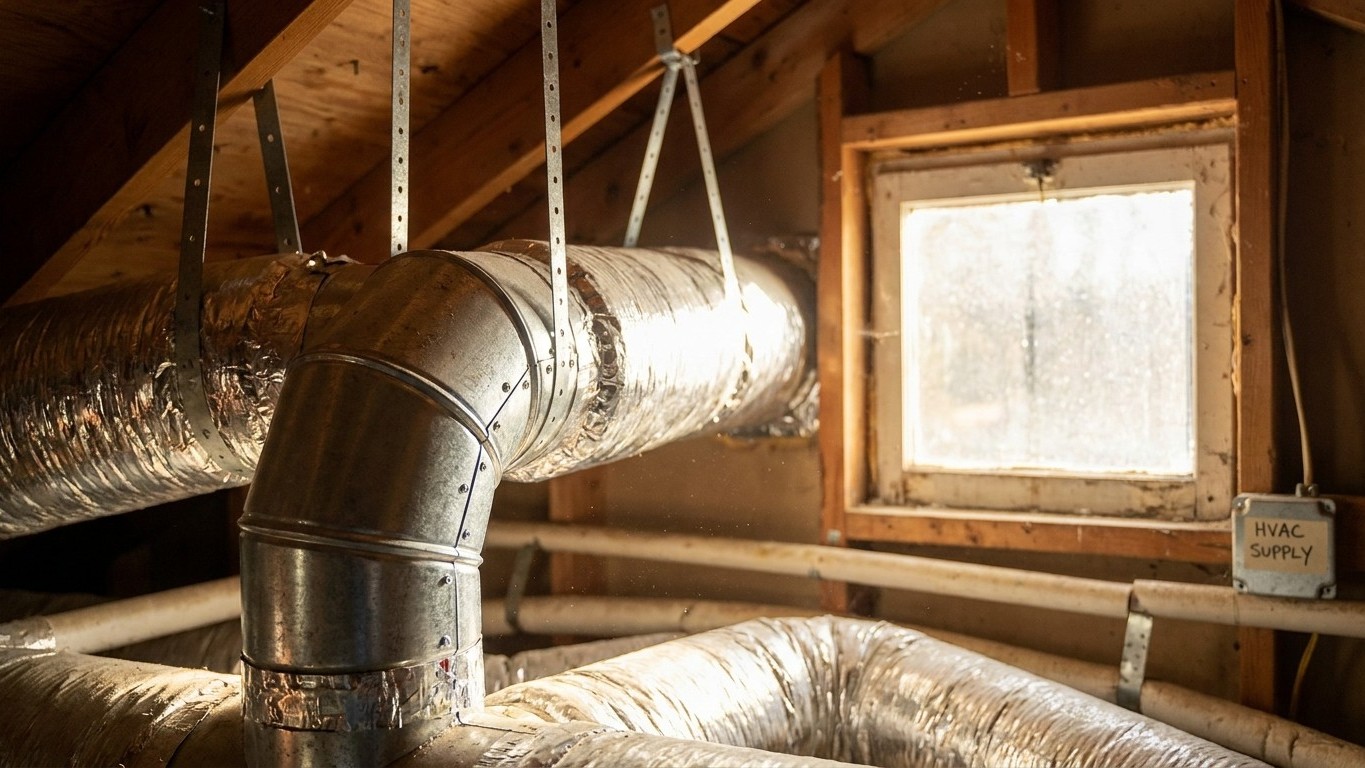

Duct noise sorts into four distinct sounds, and each one names its own cause. A boom or metallic pop at start-up usually means a large sheet-metal panel flexing under pressure. A whistle or steady rush means air squeezing through an opening too small for the volume moving through it. A tick as the system cools is just metal contracting against wood. None of these mean the ductwork is failing.
The noise tells you where to look
Forced-air systems move air through sheet-metal or flex ducting using a blower, and that blower creates pressure swings every time it starts, stops, or changes speed. Those pressure swings are what most duct noise is actually about. This section only applies to ducted, forced-air heating and cooling. Radiators, hot water baseboard, and ductless mini-split systems don’t move air through ducts at all, so none of what follows applies to them.
Four sound families cover almost every complaint homeowners bring to a technician. A boom or oil-canning sound, sharp and sudden, happens when a flat panel of ductwork snaps from one shape to another as pressure changes. A whistle, thin and high-pitched, means air is being forced through a gap or opening that’s too narrow for the volume trying to pass. A rush or roar, lower and steadier, is the same restriction problem at a larger scale, usually further back in the system. A tick or pop, small and repetitive, is sheet metal expanding or contracting against a joist, a hanger strap, or another duct it’s resting on.
Knowing which family you’re hearing narrows the search dramatically. A homeowner who says “it booms when the furnace kicks on” has already ruled out three of the four causes before a technician even opens a toolbox. That’s the value of learning to name the sound instead of just reporting “the ducts are noisy.” The two sections below take these sound families one at a time, starting with the ones that startle people the most and ending with the ones that are actually the easiest to solve.
Booming and popping
The boom that makes people jump when the furnace or air handler starts is almost always oil-canning. Picture a large, flat panel of sheet-metal ductwork, the kind found on trunk lines close to the equipment, where the ducts are widest and the metal has the most unsupported surface area. When the blower starts, static pressure inside that duct changes fast. A thin metal panel with no reinforcement can flex from a slightly concave shape to a slightly convex one almost instantly, and that snap is the boom you hear. It happens most on the biggest ducts nearest the equipment because that’s where the panels are largest and the pressure change is most sudden. Smaller, better-braced sections rarely do it at all.
A different sound, a tick or a pop that continues intermittently as the system runs or shuts down, comes from something else entirely: thermal movement. Metal ductwork expands slightly when warm air passes through it and contracts as it cools. If that duct is resting against a floor joist, a hanger strap, or another duct, the friction as it slides even a fraction of an inch creates a tick. It’s genuinely harmless. It just sounds alarming enough that homeowners often assume something structural is wrong, when really it’s just metal sliding against wood the way an old floorboard creaks underfoot.
Fixing it
Both problems have straightforward remedies, and most fall within a confident DIYer’s reach for the last two:
- Stiffen or cross-brake the flexing panel. A shallow diagonal crease pressed into a flat sheet-metal section (a “cross-break”) adds rigidity and stops it from popping between two shapes. This step usually calls for a sheet-metal technician, since it means reworking the duct itself.
- Check for a flexible connector at the equipment. Many furnaces and air handlers use a short fabric or rubber connector between the unit and the ductwork specifically to absorb vibration. If it’s missing, torn, or has hardened with age, replacing it is a simple, low-cost fix that often solves boom problems on its own.
- Free any duct that’s bearing directly on framing. Sliding a piece of foam pipe insulation or a rubber isolation strip between the duct and the joist or hanger stops the metal-on-wood contact that causes ticking, without needing to move or resupport the duct itself.
Whistling and rushing
A whistle or a steady rushing sound almost never means something is wrong with the duct material. It means air is moving too fast through an opening that’s too small for it, and the fix is finding that opening rather than the duct itself. Air takes the path of least resistance, and when that path narrows, it speeds up and turns audible, the same way a garden hose whistles when you pinch the end.
Several places tend to cause this, and they’re worth checking in order before assuming anything more serious:
| What to check | Why it causes noise |
|---|---|
| A damper that’s nearly closed | Forces the full air volume through a narrow slot instead of the full duct opening |
| A register that’s partly blocked | Furniture, rugs, or drapes covering part of a supply or return grille narrow the effective opening |
| A filter that’s choking the return | A clogged or undersized filter restricts the air the blower is trying to pull in |
| A return that’s undersized for the system | Not enough return path for the air volume the blower is designed to move |
| A blower set faster than the duct can carry | Speed settings sized for a bigger duct system push too much air through smaller ductwork |
The stakes here go beyond noise. According to U.S. ENERGY STAR, “Airflow problems can reduce your system’s efficiency by up to 15 percent.” A whistling duct isn’t just an annoyance; it’s often a sign the whole system is working harder than it should to move the same amount of conditioned air.
One instinct worth naming directly: closing a register to quiet down a noisy or overly cold room usually doesn’t fix anything. It just pushes the same air volume through a smaller opening, which raises pressure and often makes the whistle louder, or shifts it to another register or joint entirely. If a room runs hot or noisy, the better move is checking the duct sizing and damper balance for that branch, not choking off the vent and hoping the air gives up trying to get through.
What can be quietened, and what cannot
Most duct noise responds to fairly modest fixes. Interior duct lining absorbs some of the turbulence noise inside larger trunk lines. Flexible connectors at the equipment isolate vibration from the blower. Larger or better-balanced returns reduce the velocity that causes whistling in the first place. Slower blower speeds, where the system allows adjustment, cut down on both the boom at start-up and the rush during steady operation. All of these are legitimate, proven fixes, and a technician who understands airflow can usually apply one or more of them without touching the equipment itself.
But there’s a limit worth being honest about. A system that’s simply oversized for the ductwork it’s connected to will always be loud, no matter what lining, connectors, or damper adjustments get added. If the blower is built to move more air than the duct network can carry quietly, every fix above just softens the edges of a mismatch that’s baked into the system’s design. No foam liner or flexible boot changes the physics of too much air trying to fit through too little duct.
In that situation, the actual remedy is resizing: either the ductwork gets enlarged and rerouted to handle the air volume the equipment produces, or the equipment gets replaced with a unit properly matched to the existing ducts. That’s not a small project, and it’s not something a homeowner should expect to solve with a weekend of DIY work. It usually means bringing in a contractor who can run the load calculations and duct sizing together, rather than treating the noise as a cosmetic problem to patch around.
Common questions
Is duct noise dangerous?
Booming, whistling, and ticking sounds are almost always mechanical, tied to airflow or thermal movement, not signs of a safety hazard. That said, a sudden new noise paired with a burning smell or unusual equipment behavior warrants a technician’s attention regardless of what the sound itself is.
Why is my duct noise worse in winter?
Colder outdoor air widens the temperature swing between the duct and the surrounding framing, which increases thermal expansion and contraction. That’s why ticking and popping sounds are often more noticeable during heating season than during cooling season.
Will duct cleaning stop the noise?
Not directly. The EPA’s 1997 guidance on duct cleaning notes that the practice has never been shown to prevent health problems, and has also not been shown to be harmful. It addresses air quality, not the mechanical airflow restrictions that cause whistling or booming.
Can I fix a whistling register myself?
Checking for a nearly closed damper, a blocked register, or a dirty filter is reasonable DIY territory. If those checks don’t solve it, the cause is likely duct sizing or blower speed, and that’s where it makes sense to call in a technician rather than keep adjusting registers.