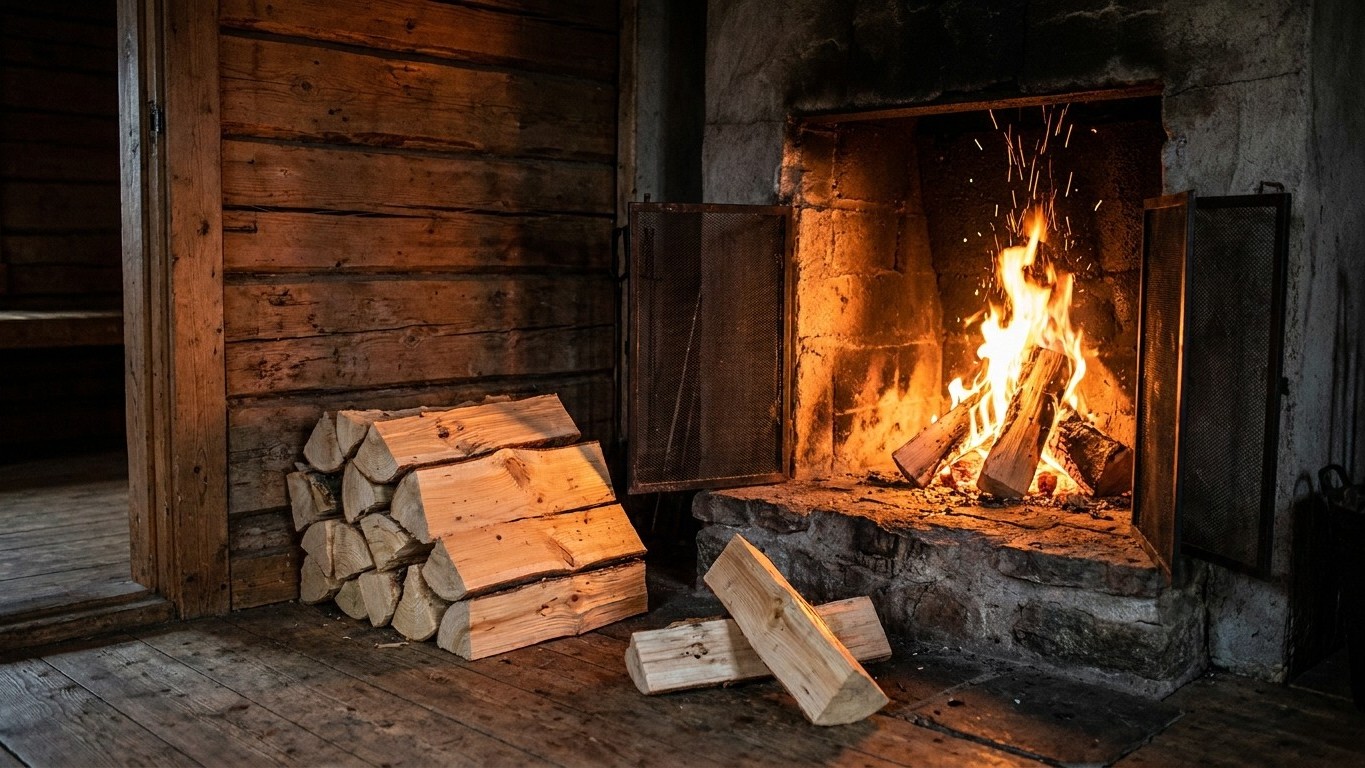

Spruce burns hot enough to take the chill off a cabin fast, but it burns out just as quickly, throws sparks that can pop out of an open hearth, and leaves behind a sooty residue that demands more chimney attention than oak or maple ever will. As a softwood, spruce belongs in the shoulder-season firewood category: good for quick warmth, bad for an all-night burn, and best kept out of open fireplaces unless you enjoy dodging embers.
How Spruce Stacks Up for Heat Output

Firewood is usually ranked by BTUs per cord, a rough measure of how much heat a full cord (128 cubic feet stacked) will release when properly seasoned. According to SDSU Extension, spruce lands at 16 million BTU per cord of seasoned wood, depending on the species (Engelmann, black, white, or Sitka) and how dry the wood actually is. That puts it well below dense hardwoods like white oak or sugar maple, which routinely clear 24 million BTU per cord, roughly 40 percent more energy from the same stack of logs.
What that difference feels like in practice: a wood stove loaded with oak might hold a bed of coals for six or seven hours overnight. Load that same stove with spruce and you’re often reloading in three or four. For someone splitting their own wood, that means cutting and hauling nearly twice the volume of spruce to get the same season’s worth of heat as a hardwood lot would provide.
Spruce does have one advantage tied to that lower density: it’s lighter to split and haul, and it ignites faster than dense hardwood rounds. That makes it a reasonable choice for people who value ease of handling over maximum burn time, particularly in regions of the Rocky Mountains and the Pacific Northwest where spruce is simply what grows locally and hauling in oak from three states away isn’t realistic.
Why Spruce Throws So Many Sparks
Spruce has a reputation among campers and woodstove owners for popping, and that reputation is earned. The wood contains pockets of resin and trapped moisture in its cell structure, even after seasoning, and when those pockets heat up faster than they can vent, the built-up steam and gas escape with a small explosion, sending sparks and occasionally small wood fragments flying.
This matters more with an open fireplace or a campfire ring than it does with a closed wood stove. An ember popping out of a screened stove insert is a non-event. That same ember landing on a wool rug six feet from an open hearth is how house fires start. The National Fire Protection Association consistently lists heating equipment, including fireplaces, among the leading causes of home structure fires each winter, and spark-prone species like spruce, along with pine and other resinous softwoods, add unnecessary risk to an already hazard-prone appliance.
If spruce is what’s available, a few adjustments cut down the sparking noticeably. Splitting the rounds smaller than usual exposes more resin pockets to controlled, gradual heating rather than sudden bursts. A tight-fitting spark screen in front of any open fireplace is close to mandatory. And keeping the firebox loaded with a mix of spruce and a denser hardwood, rather than all spruce, tends to moderate the popping since the fire burns more evenly overall.
The Smoke and Creosote Question
Resinous softwoods like spruce get a bad reputation for chimney fires, and there’s real substance behind it. The resin content means spruce smoke carries more unburned particulates and volatile compounds than hardwood smoke, and when that smoke cools as it moves up a chimney, those compounds condense into creosote on the flue walls. Over a season of regular spruce burning, creosote buildup accumulates faster than it would with oak, ash, or hickory.
The real culprit, though, isn’t spruce itself so much as unseasoned spruce burned in a smoldering, low-oxygen fire. Green or wet spruce produces thick, cool smoke loaded with moisture and unburned resin, which is exactly the recipe for heavy creosote deposits. Properly seasoned spruce burned hot and with good airflow produces far less of a problem. The Chimney Safety Institute of America recommends at least one inspection per year regardless of species, but anyone burning spruce or other softwoods regularly should lean toward inspecting twice a season, especially before the coldest months when the stove runs longest.
Smoke color offers a quick field check. Thin, nearly invisible smoke from the chimney means a hot, efficient burn. Thick gray or white smoke, especially paired with a campfire smell lingering around the house, signals a fire that’s smoldering rather than combusting, which is when creosote accumulates fastest, spruce or otherwise.
Seasoning Spruce Properly
Spruce needs six to twelve months of proper seasoning to drop from a green moisture content around 50 percent down to the 20 percent or lower that burns cleanly. Because the wood is less dense than hardwood, it actually dries faster once split and stacked off the ground, which is one of its few genuine advantages. A moisture meter is the only reliable way to confirm it’s ready. Reading above 20 percent, hold off. Below that, it’s good to burn.
Stacking spruce in a single row, off the ground on pallets or rails, with the top covered but the sides open to airflow, speeds up drying considerably compared to a tightly packed pile. Splitting rounds smaller than you would for oak also helps, since spruce’s lower density means smaller splits dry through faster without sacrificing much burn time.
Best Uses for Spruce Firewood
Spruce earns its keep in specific situations rather than as an everyday heating fuel. It excels as kindling and as the wood that gets a cold stove roaring quickly before denser logs go in, since it catches fire faster than hardwood and builds heat rapidly. Campers and cabin owners in spruce-heavy regions often use it for exactly this: quick fires for cooking or evening warmth that don’t need to last past bedtime.
It also works well during shoulder seasons, those stretches in early fall or late spring when a house needs a couple hours of heat in the morning or evening but not an all-night burn. Loading a stove with spruce for a quick, hot fire that burns down to coals in a few hours suits that kind of intermittent heating far better than a slow-burning hardwood would, which might smolder for hours after the room is already warm enough.
Where spruce falls short is as a primary heating fuel through a long winter. Anyone relying on wood heat as a main source, particularly in colder states like Minnesota, Wisconsin, or Maine, generally finds spruce alone requires far more frequent reloading and far more total cords cut and stacked to get through the season, compared to relying on oak, hickory, or hard maple. Many households in spruce-rich regions solve this by mixing species: spruce for the quick morning fire, hardwood for the overnight burn.
One detail worth knowing before buying a cord labeled simply “spruce”: species within the spruce family vary more than people expect. Black spruce, common across the northern U.S. and Canada, runs slightly denser and hotter-burning than white spruce, while Engelmann spruce, found at higher elevations in the Rockies, tends to be lighter and faster-burning still. If a firewood seller can’t specify which spruce species is in the load, it’s worth asking, since the difference in BTU output between the driest black spruce and the lightest Engelmann can run close to 10 percent, enough to matter over a full winter’s supply.