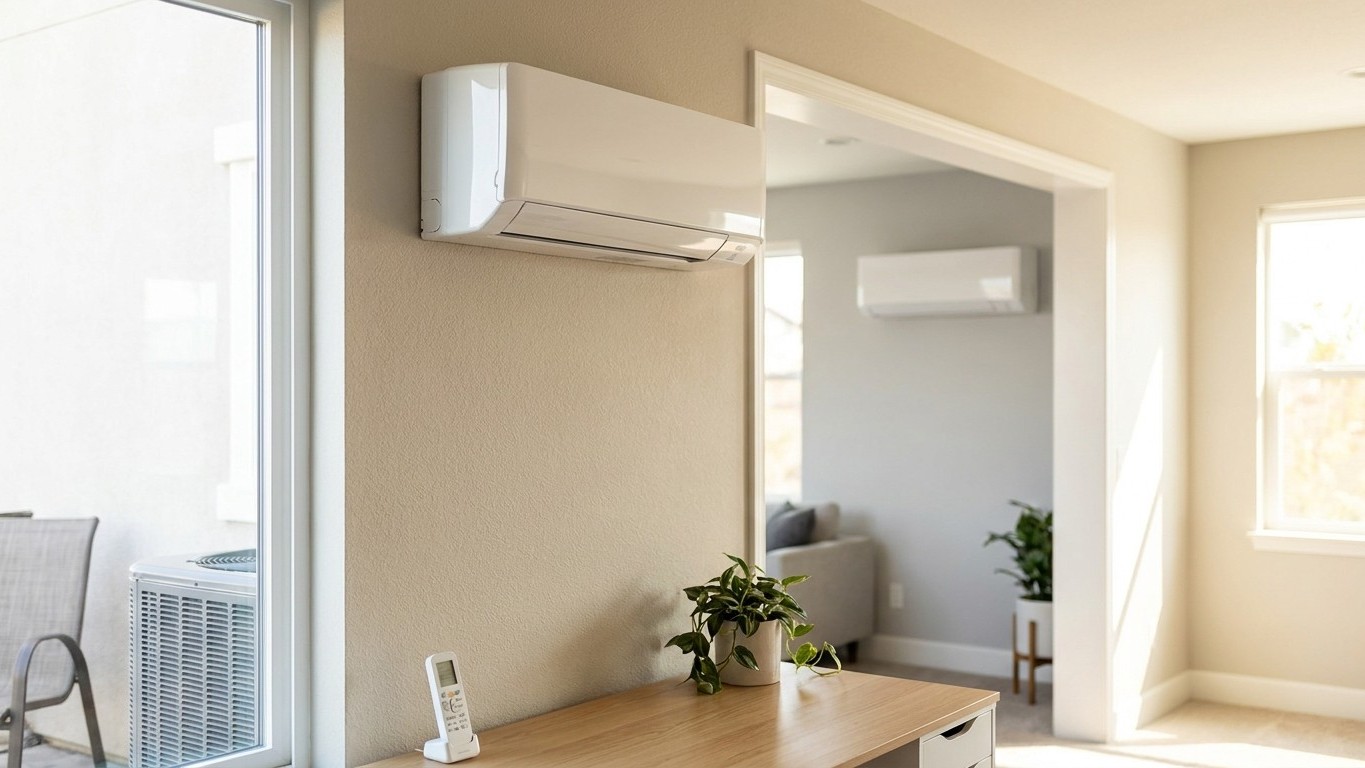

When two heads want different things, the system doesn’t argue for long. One outdoor compressor runs a single refrigerant cycle at any given moment, so the first zone that calls for heating or cooling generally sets the terms for the rest. Some multi-zone equipment can split the difference; a lot of it can’t. The practical answer is to know which kind you have before the first cold October morning turns into a house-wide standoff.
One compressor, several rooms

A ductless Mini-Split has no ductwork at all. There’s an outdoor unit, one or more indoor heads, and a line set running between them carrying refrigerant, electrical power, and a condensate drain. That’s the whole system. If someone hands you advice about duct leaks, duct cleaning, or a furnace filter, they’re describing a different kind of equipment entirely, file it away for whatever forced-air system is elsewhere in the house, because it has nothing to do with the heads on your wall.
In a multi-zone setup, that single outdoor compressor feeds several indoor heads through separate line sets, one per room or zone. Each head comes with its own remote, its own thermostat sensor, and its own setpoint. That’s the entire appeal of the arrangement: the bedroom can run at 68 while the home office sits at 72, and neither room has to compromise for the other. Nobody’s fighting over a single central thermostat mounted in a hallway.
That independence is also where every quirk in this article comes from. A single outdoor unit is being asked to satisfy multiple, sometimes conflicting, demands through one compressor and one refrigerant loop. Contractors sometimes call this “one brain, many mouths,” which is a decent way to picture it, the outdoor unit is the brain, and it can only think about one instruction at a time, even when several heads are talking to it at once.
Where ductless fits nationally
According to the U.S. Energy Information Administration’s 2020 Residential Energy Consumption Survey, 89% of U.S. homes use some form of air-conditioning equipment. Of those, 67% rely on a central system and 26% use an individual unit, a category that lumps together ductless mini-splits, window units, and portable units. The survey doesn’t break that 26% down further, so there’s no way to say what share belongs to mini-splits specifically versus a window unit propped in a bedroom sash.
The regional spread is worth noting too. Connecticut has air conditioning in 90% of homes, but only 34% run it through a central system, the rest lean on individual units of some kind. Hawaii sits at the other extreme: just 57% of homes report air conditioning at all, and 48% of those are individual units, reflecting a climate where whole-house central cooling is often unnecessary. Multi-zone mini-splits live inside that “individual unit” category, alongside equipment that works very differently.
When one room wants heat and another wants cooling
Here’s the limitation that catches new owners off guard, and it deserves to be said plainly rather than buried in a spec sheet: many multi-zone Mini-Split systems cannot heat one room while cooling another at the same time. The outdoor unit runs one refrigerant cycle at a time, either heating mode or cooling mode, and whichever zone calls first usually determines what the whole system does next.
Picture a house with a north-facing room that loses heat fast and a south-facing room that bakes in afternoon sun, even on the same October day. The north room’s head calls for heat. If that call registers first, the outdoor unit shifts into heating mode for the whole system, and the south room’s head, still set to cool, effectively can’t get what it’s asking for until the cycle changes. In practice, the south room might just run its fan, or blow air that isn’t doing what its remote says it’s doing. It’s not a malfunction, it’s the physics of one compressor serving conflicting requests.
This is exactly why the question deserves to come up before the purchase, not after. Whether a given system can genuinely run simultaneous heating and cooling across different zones depends entirely on the equipment, some multi-zone lines are built with that capability, engineered to route refrigerant differently to different heads at once, while plenty of others are not. Treating this as a universal trait of “multi-zone mini-splits” as a category is the mistake. It’s a spec that varies by product line, and it’s one of the few questions worth asking directly of an installer or in the equipment documentation before signing anything.
For households where one exposure runs consistently hotter or colder than another, a sunroom next to a basement-level office, say, this single fact can shape which system makes sense at all. A household that needs true simultaneous heating and cooling across zones, and doesn’t confirm the equipment supports it, may end up with a system that technically has “two zones” but functionally behaves like one zone with two remotes attached. Confirming this upfront costs nothing. Discovering it in January, mid-cold-snap, costs comfort in whichever room lost the argument.
The head that is too big for its room
Multi-zone systems carry their own version of an oversizing trap, and it’s sneakier than the version people worry about with whole-house equipment. Each indoor head is matched to the room it serves, and a head that’s too large for that room won’t run efficiently, it short-cycles instead, firing up, satisfying the thermostat almost instantly, shutting off, and starting the whole process again a few minutes later.
The symptom is distinctive once you know to look for it: a small room that never quite feels right. It gets cold fast, then clammy, because the head blasts cold air for a short burst and shuts down before it has time to properly dehumidify the space, a mini-split’s dehumidification happens gradually, over a longer, steady run, not in quick bursts. Meanwhile the system as a whole seems restless, cycling on and off more than it should, because that one oversized head keeps tripping its own satisfaction point and calling the outdoor unit back into action.
This is where a single oversized head can drag down a system that otherwise would have worked fine. It’s a common story: a homeowner adds “just one more head, for the hallway,” treating it as a minor afterthought to an existing multi-zone layout. But a hallway is often a small, oddly-shaped space, and a head sized more for convenience than for the actual heat gain and loss of that space becomes the zone that short-cycles. The rest of the system, previously stable, starts behaving erratically too, because the outdoor compressor is now responding to that one zone’s frequent, brief calls in addition to everything else it was already managing.
None of this is solved by guessing at a bigger or smaller number. Getting a head’s capacity right for its specific room depends on square footage, ceiling height, insulation, window area, and a handful of other variables that don’t fit neatly into a rule of thumb, that’s exactly the kind of math worth working through on the site’s dedicated sizing guide rather than estimating on the spot. What matters here is recognizing the symptom: a room that runs cold and damp while the system as a whole never quite settles down is usually a sizing problem, not a refrigerant problem, and rarely a problem with the system’s brains.
One head that will not run
When a single head refuses to respond while the rest of the house is running fine, the fix usually isn’t complicated. Work through it in order, because each step rules something out before you move to the next.
- Check that head’s own remote first, its mode setting, its battery, and whether it’s actually set to call for heating or cooling rather than sitting in fan-only or a timer mode.
- Confirm the outdoor unit is running at all by checking whether the other heads in the house are working normally. If they are, the outdoor unit and the power supply to the system are fine.
- Look at that specific head’s air filter and its condensate drain. A clogged filter or a blocked drain can cause an indoor head to shut itself down or refuse to call for cooling, even while the rest of the system runs without issue.
- Check that indoor unit’s own error display, if it has one. Note whatever code appears exactly as shown, then look it up in that unit’s manual, codes differ by manufacturer and even by model line, so a code that means one thing on one brand’s head can mean something else entirely on another.
The diagnostic logic here matters more than any single step. If one head is down and every other head in the house is running normally, the problem sits with that head or its own line set, not with the outdoor unit. If every head in the house has stopped at once, the problem is almost certainly the outdoor unit itself or the power and refrigerant supply feeding it. That distinction alone tells you whether you’re looking at a localized indoor issue or something that needs attention at the outdoor unit.
One more thing worth flagging honestly: if a head that used to cool well is now running weak, or the system seems to be losing capacity across the board, that can point to a refrigerant leak, the line set has lost some of its charge. That’s not something to diagnose further with a gauge or a service valve at home; it’s a call to a technician licensed to handle refrigerant, since opening that side of the system requires equipment and certification most homeowners don’t have on hand.
Common questions
Can I add a new head to an existing multi-zone system later?
Sometimes, but it depends on whether the outdoor unit has spare capacity and connection ports for another line set. Adding a head to a system that’s already running at its limit is exactly the kind of change that can introduce the short-cycling problem described above.
Does every zone need to be on the same mode, heating or cooling?
Not necessarily, but whether zones can run in different modes simultaneously depends on the specific equipment. Some multi-zone lines support it, many don’t, confirm this with the manufacturer’s documentation for your particular system rather than assuming.
Why does one room feel humid even though its head is running?
Short cycling is a common cause. A head that satisfies its thermostat quickly and shuts off doesn’t run long enough to properly wring moisture out of the air, which is a sign that head may be oversized for that particular room.
Is a multi-zone mini-split the same thing as central air with multiple thermostats?
No. Central air moves conditioned air through ductwork to registers throughout the house from one air handler. A multi-zone mini-split has no ducts at all, each head is a standalone unit connected to the outdoor compressor by its own line set, which is why each room can be controlled independently in the first place.