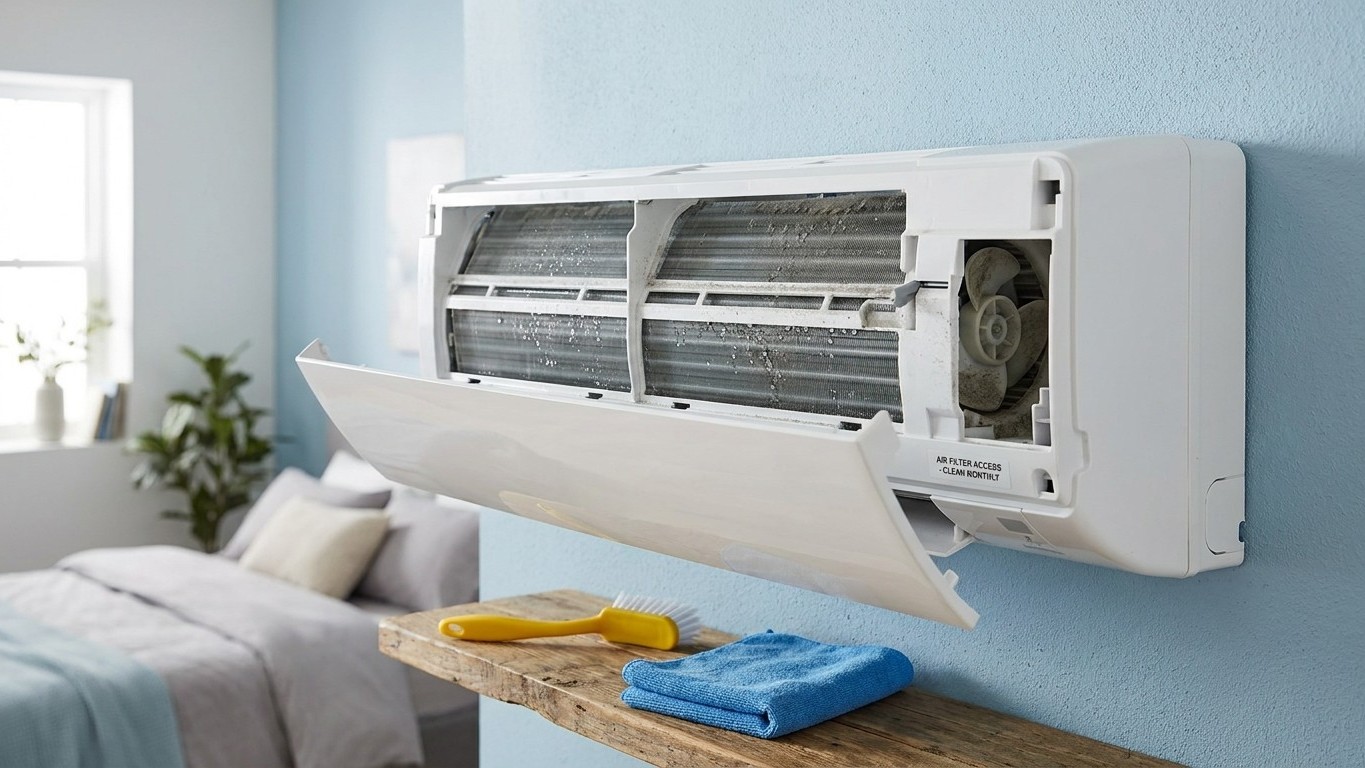

That musty smell usually comes from moisture sitting on the indoor coil, dust packed into the screens, or a condensate drain that has stopped draining. None of it is dangerous, and none of it calls for duct cleaning, a new filter, or refrigerant work. The fix is mechanical: wash what comes apart, check what might be blocked, and change the habit that lets the coil dry out between cycles instead of staying damp in a closed box.
Why this system in particular

A ductless Mini-Split cools by running refrigerant through a coil inside the indoor head, and that coil stays wet for the entire time the unit is running in cooling mode. Warm room air passes over cold metal, moisture condenses out of it, and that water needs somewhere to go. Most of it drips into a drain pan and out through the condensate line. Some of it just sits as a film on the coil fins, on the plastic housing around them, and on the barrel-shaped fan that pushes air across the whole assembly.
Once the compressor cycles off, that dampness doesn’t disappear. It sits inside a small, dark, plastic enclosure with almost no airflow moving through it. Add household dust, which gets pulled in constantly by the intake, and you have the three conditions mold and mildew need: moisture, darkness, and something organic to feed on. It’s a small, self-contained environment, closer to a damp sponge left in a closed cabinet than to anything resembling open ductwork.
That distinction matters, because a ductless mini-split has no ductwork at all. There’s an outdoor unit, one or more indoor heads mounted on a wall or ceiling, and a line set running between them that carries refrigerant, electrical power, and the condensate drain. There’s no plenum, no supply runs, no return grille pulling air through a house’s framing. If someone has told you to have your ducts cleaned or to swap out a furnace filter, they’ve handed you advice for a completely different kind of system.
That’s not a small technicality. Duct cleaning services, duct sealing, and central filter changes address air handlers and duct networks that a mini-split simply doesn’t have. The smell coming off a ductless head has a local, contained cause, and it needs a local, contained fix, applied directly to the head itself rather than to a system it isn’t part of. Understanding that the moisture problem lives entirely inside a small plastic housing, rather than spread through a house’s duct network, is what makes the next two sections worth doing right.
The screens, and what is behind them
Most people who try to fix a musty mini-split stop at the first thing they see, which is the front screen. That’s a reasonable place to start, but it’s only half the job, and the smell often lives in the half nobody checks.
- Switch the unit off at the wall or remote before touching anything, so the fan isn’t running while you work.
- Lift or unclip the front panel, which on most models hinges upward and stays propped open.
- Slide out the mesh screens sitting just behind the panel. They usually unclip or lift straight out without tools.
- Wash them in warm water, let them air dry completely, and set them aside rather than leaning them somewhere damp.
- Look past where the screens sat, at the aluminum fins of the coil and the barrel-shaped fan sitting just below it.
What you find at that last step tells you how far a homeowner can reasonably take this. A layer of dust sitting on the coil fins is something you can usually reach and wipe down carefully by hand, without bending the thin aluminum. But if you see a dark film, streaking, or visible growth on the barrel fan itself, that’s past the point of a do-it-yourself pass. The fan’s curved blades sit deep in the housing, they’re hard to reach without partial disassembly, and scrubbing them incorrectly risks throwing the fan out of balance. That’s the line between a monthly clean and a job for someone who deep-cleans mini-split heads for a living.
The U.S. ENERGY STAR program puts it this way for central systems: “Inspect, clean, or change air filters once a month in your central air conditioner, furnace, and/or heat pump.” That sentence is written for central air conditioners, furnaces, and central heat pumps, the equipment that runs on ductwork and a whole-house filter. A ductless head doesn’t have that kind of filter. What it has is a pair of washable screens, and the monthly rhythm ENERGY STAR describes for central filters is the same idea worth applying to those screens, even though the sentence itself isn’t written about mini-splits.
Whatever you clean, get it bone dry before it goes back in. A damp screen refitted into a dark, closed housing is exactly the setup that caused the smell in the first place, just reset to day one.
The smell that comes from the drain
The cause people miss most often isn’t inside the head at all. It’s the condensate drain line, the small tube that carries all that coil moisture from the indoor unit, through the wall, and out to the exterior of the house. If that line is blocked, or if it was installed with a rise or sag somewhere along its run, water doesn’t make it outside. It sits in the tube instead, and standing water inside a warm plastic line will start to smell within days, whether or not the head itself is clean.
Checking it doesn’t require opening anything up. Find where the line exits the exterior wall, usually a small tube poking out near where the line set enters the house. On a hot, humid day, once the unit has been running in cooling mode for a while, that outlet should be dripping or at least visibly damp. If it’s bone dry while the unit is actively cooling and the house is humid, that’s the line telling you it’s not moving water the way it should, which usually means a clog somewhere between the drain pan and the outside world.
A blockage in that line doesn’t just cause odor. Left alone, standing condensate can back up into the drain pan, overflow, and start dripping inside the house around the indoor head, which is a bigger repair than a smell. Catching it at the dry-outlet stage, before that happens, is the whole point of checking it. For a full walkthrough of clearing and testing that line yourself, the condensate drain guide on this site covers it step by step.
Stopping it coming back
Cleaning the screens and clearing the drain solves the smell that’s already there. Keeping it from coming back is a different job, and it comes down to a short list of habits rather than a one-time fix.
- Before shutting the unit down for the day, or for the season, run its FAN or DRY mode for roughly thirty minutes. That gives the coil time to dry out on purpose instead of sitting wet in a closed box overnight or all winter.
- Pull and wash the intake screens on a monthly rhythm during the cooling season, the same cadence ENERGY STAR describes for central filters, just applied to the ductless screens instead.
- Check and clear the outside end of the condensate drain each spring, before the cooling season puts real moisture through the line again.
- When the barrel fan behind the screens shows visible buildup or growth rather than just dust, have the head professionally deep-cleaned rather than attempting to disassemble it yourself.
Of everything on that list, the dry-out run is the single habit that does the most work, because it addresses the actual mechanism instead of just cleaning up after it. A coil that’s given time to dry before the fan and compressor shut off stops feeding the damp, dark conditions that cause the smell in the first place, which means the whole problem shows up less often to begin with.
None of this calls for sprays, air fresheners, or any chemical treatment poured into the line or wiped onto the coil. The moisture and the airflow are the actual problem, and fixing those two things directly does more than any product marketed as a fix ever will.
Common questions
Is a musty mini-split smell a health risk?
Mold and mildew growing on a coil or fan can affect indoor air quality, particularly for people sensitive to allergens, but the smell itself is a maintenance signal rather than an emergency. Addressing it with cleaning and drying resolves most cases without further action.
Can I use a bleach or vinegar spray on the coil myself?
This page focuses on mechanical fixes, cleaning, drying, and clearing the drain, rather than chemical treatments, since coil fins are delicate and easy to damage with the wrong approach. If buildup goes beyond a light dust layer, a professional deep clean is the safer route.
Does the smell mean the unit is losing refrigerant?
No. A musty smell is a moisture and airflow issue, unrelated to refrigerant charge. Refrigerant loss shows up as reduced cooling capacity, not odor, and diagnosing or correcting a low charge is a job for a licensed technician rather than something to check at home.
Why does the smell show up more in spring or after winter?
A unit that sat unused for months, especially without a dry-out run before shutdown, gives the coil and drain line plenty of time to hold trapped moisture. The first few cooling days of the season often stir that stale, damp air loose, which is exactly why the spring drain check on this page matters.