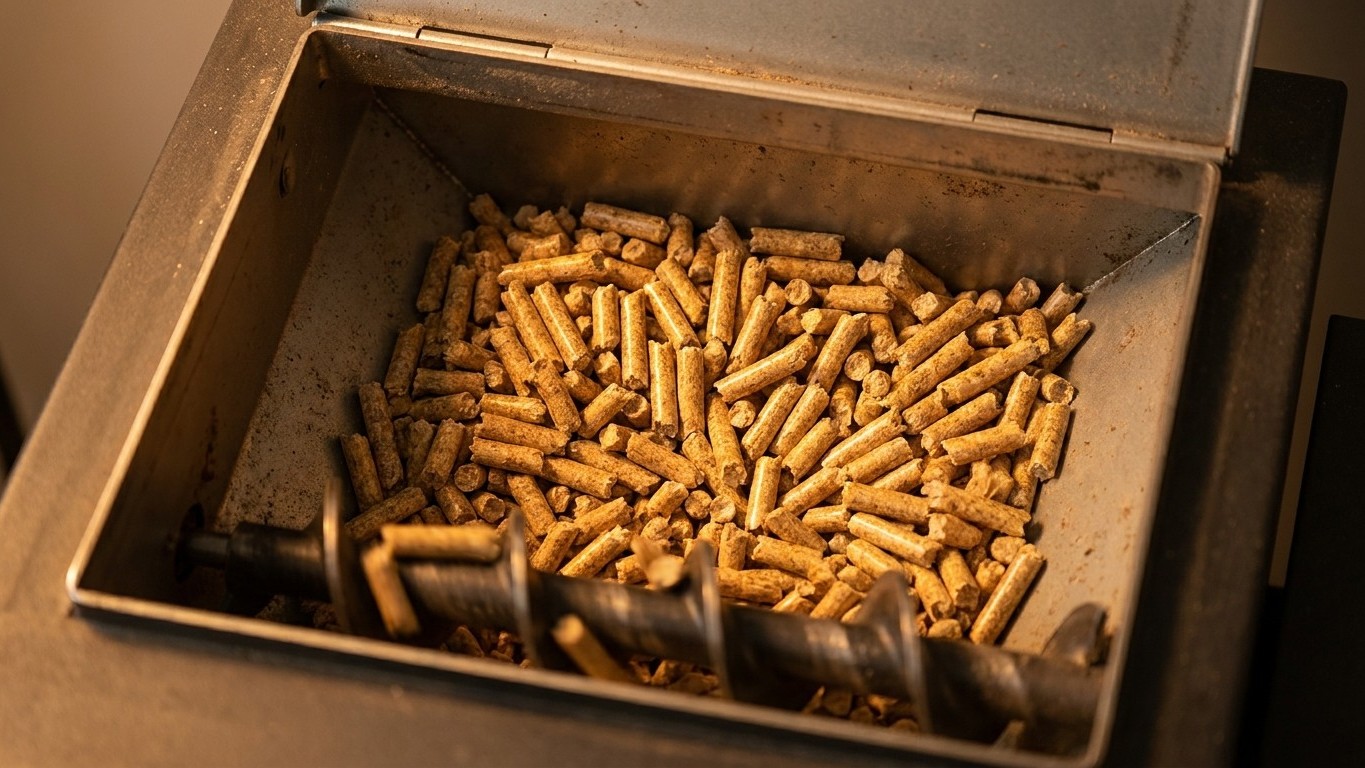

A full hopper typically burns for anywhere from 8 to 24 hours, depending on the stove’s setting and hopper capacity. There’s no single number because the math depends on two things you control: how big the hopper is, and how fast pellets feed into the fire. Once you know both, the burn time is a simple division problem, not a mystery.
Hopper size divided by feed rate

The U.S. EPA describes the basic mechanism plainly: “The pellets are poured into a hopper, which automatically feeds into the stove.” That automatic feed is an auger, a slow-turning screw that pulls pellets from the hopper into the burn pot at a rate the stove’s control board sets. Everything about burn time flows from that one detail.
Here’s the arithmetic. Hopper capacity is measured in pounds. Feed rate is measured in pounds per hour. Divide the first by the second, and you get the number of hours between fills. A hopper holding 40 pounds of pellets, fed at 2 pounds per hour, runs for roughly 20 hours. Push the feed rate to 4 pounds per hour for more heat, and that same hopper empties in about 10 hours. Same fuel, same stove, half the runtime.
This is why two people with the identical stove model report wildly different burn times. One keeps the thermostat low and the feed rate on a modest setting because the house holds heat well. The other cranks it up on the coldest nights because the EPA’s own range for heating capacity, “8,000-90,000 Btu per hour,” covers a huge span, and a stove sized for a small cabin behaves very differently from one sized for a larger open floor plan.
Where to find your actual numbers
Nobody publishes a universal chart of hopper size versus feed rate because every model differs. The hopper capacity is stamped on the appliance label or listed in the owner’s manual. The feed rate at each setting is also in that manual, often as a table showing low, medium, and high positions with corresponding pounds per hour. Once you have both figures for your specific stove, the division is yours to do.
Pellet quality changes the equation too, though not the math itself. The EPA notes: “Pellets can differ significantly in how well they’re made and how well they burn. Lower quality pellets may provide less heat and create a fine dust. Higher quality pellets tend to burn cleaner and produce less ash.” A stove fed low-grade pellets may need a higher feed rate to produce the same heat output, which shortens the interval between fills even though the hopper size never changed. The stove isn’t burning more pellets because it’s inefficient. It’s compensating for fuel that delivers less energy per pound.
Getting through the night
The question homeowners actually care about is simpler than the arithmetic above: will this thing still be burning when I wake up? Three factors decide that. A larger hopper buys more hours outright. A modest feed setting, rather than the highest one, stretches those hours further. And pellets that don’t bridge or jam keep the auger delivering fuel steadily instead of stalling out at 3 a.m.
Most owners find a rhythm within a week or two. If overnight temperatures drop and the stove needs to run on a higher setting to keep the house comfortable, the hopper won’t stretch as far, and a fill before bed becomes routine rather than optional. Stoves with larger hoppers give more cushion here, since the same feed rate simply lasts longer when there’s more fuel sitting above the auger.
Why clearance matters even more overnight
An appliance running unattended for eight or more hours is exactly the scenario safety guidance is written for. The U.S. Fire Administration states: “Keep anything that can burn at least 3 feet from all heat sources including fireplaces, wood stoves, radiators, space heaters or candles.” That three-foot rule isn’t a suggestion for daytime use only. It matters most overnight, when nobody’s in the room to notice a stack of firewood, a laundry basket, or a pile of mail that’s crept closer to the stove’s radiant surface over the course of an evening.
There’s also the electrical piece, which is easy to forget until it becomes a problem. The EPA points out: “Pellet stoves need an electrical supply to work because they use motorized components to feed the fire and blow out hot air.” A power outage stops the auger cold, no matter how much fuel sits in the hopper. Homes that rely on a pellet stove as a primary heat source through winter storms often pair it with a backup power plan, since a full hopper does nothing if the auger motor has no electricity to turn it.
The USFA also recommends a step that pays off long before any overnight burn: “Maintain heating equipment and chimneys by having them cleaned and inspected each year by a professional.” The EPA echoes this from the maintenance side, noting that stoves “need to be regularly cleaned to ensure that the stove runs efficiently and safely,” and should be “professionally cleaned at least once a year.” A stove that hasn’t seen a chimney inspection in years is a worse candidate for unattended overnight burns than one that has.
When the hopper is full and the fire dies
Sometimes the hopper is full, the settings look right, and the fire still sputters out. That’s not a burn-time problem in the arithmetic sense. It’s a bridging problem, and it’s one of the most common complaints pellet stove owners run into.
Bridging happens when pellets form an arch or clump over the auger instead of dropping straight down into the burn pot. From the outside, the hopper still looks full, maybe even nearly untouched, but the stove is starving because fuel isn’t reaching the fire. Three things usually cause it:
- Fines, the sawdust-like crumbs that accumulate at the bottom of a bag or hopper over time, packing together and blocking the feed path.
- Damp pellets, which swell and stick together instead of flowing loosely, often the result of a hopper lid left open or bags stored somewhere humid.
- Odd pellet length, where a batch runs longer or more irregular than usual and catches against the hopper walls or auger throat instead of sliding through cleanly.
The fix starts with a look inside the hopper. A gentle stir or a light tap on the hopper’s exterior wall is often enough to collapse a bridge and get pellets moving again. If that doesn’t work, the hopper may need to be emptied partway to clear out compacted fines from the bottom, where they tend to settle first. Switching to a fresh bag, ideally stored somewhere dry, solves the problem for owners whose bridging traces back to moisture rather than fines.
Persistent bridging, especially if it happens with multiple pellet batches and storage conditions ruled out, points toward the auger mechanism itself rather than the fuel. A worn auger flighting, a motor running slower than it should, or a feed tube with a rough spot can all create the same symptom: fuel that won’t advance even though the hopper reads full. That’s a mechanical question rather than a fuel question, and it’s covered in detail on our page dedicated to auger problems and troubleshooting.
Bridging aside, it’s worth remembering the sheer variety of equipment on the market shapes how any of this plays out. The EPA notes that it “currently certifies over 90 different pellet stoves,” each with its own hopper geometry, auger design, and feed tolerances. What causes bridging in one model’s narrow hopper throat may never occur in another with a wider feed path, which is one more reason the owner’s manual for your specific stove is worth more than any general rule of thumb.
Common questions
Does a bigger hopper always mean a longer burn time?
Only if the feed rate stays the same. A large hopper set to a high feed rate can empty faster than a small hopper on a low setting. Hopper size and feed rate both matter, and neither one alone tells the full story.
Can I run a pellet stove overnight without checking on it?
Many owners do, once they know their stove’s typical burn time at the setting they use overnight and have confirmed the three-foot clearance rule is being followed. It still relies on steady electricity, since the auger motor needs power to keep feeding fuel through the night.
Why does my stove burn through pellets faster than the manual suggests?
Lower-quality pellets often require a higher feed rate to produce the same heat, which shortens the interval between fills even at an unchanged setting. A dirty burn pot or overdue cleaning can also push the stove to work harder than it should.
What should I do if the hopper looks full but the fire is going out?
Check for bridging first: pellets clumped or arched above the auger instead of flowing down. A stir or a tap on the hopper wall often clears it. If it keeps happening, the auger mechanism itself may need attention.