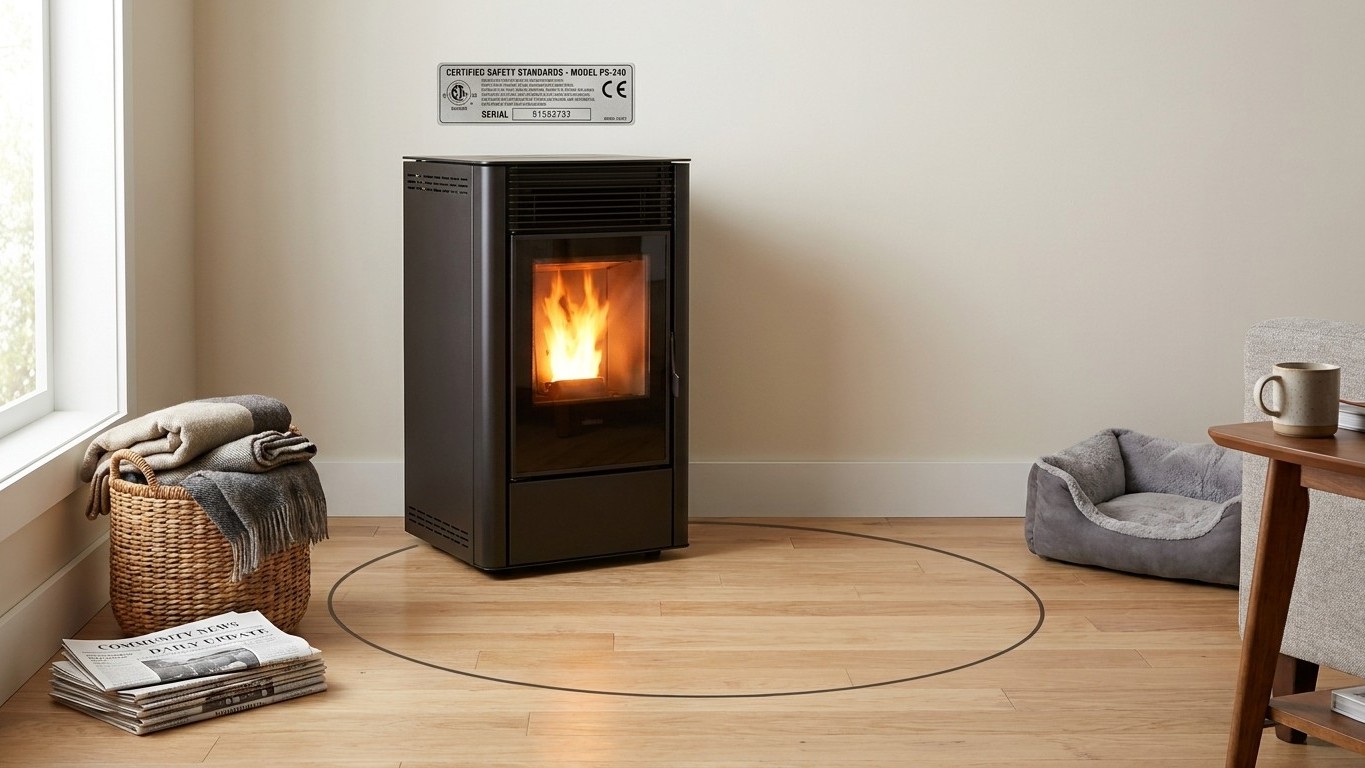

A pellet stove can go almost anywhere a wall outlet and a vent path can reach, as long as two separate clearance rules are both satisfied: the manufacturer’s certified distance from combustible walls, printed on the appliance’s own label, and the general fire-safety rule of keeping burnable stuff at least three feet away from the heat source itself. Get those two right and the room choice is mostly about convenience.
The rule that applies to the room

The U.S. Fire Administration puts it plainly: “Keep anything that can burn at least 3 feet from all heat sources including fireplaces, wood stoves, radiators, space heaters or candles.” That’s the rule for the room. It has nothing to do with the stove’s specs and everything to do with what a household leaves lying around the stove: a stack of newspapers, a laundry basket, a dog bed, a pile of firewood waiting to go somewhere else. Three feet of clear floor, on all sides where combustibles could end up, isn’t a suggestion. It’s the same standard fire departments apply to space heaters and radiators, because pellet stoves radiate heat the same way those do.
That’s a different number from the one that actually determines how close a stove can sit to a wall. Wall clearance is set by the appliance itself, tested and certified for that specific model, and it appears on the manufacturer’s label riveted or printed on the back of the unit. Two pellet stoves that look nearly identical can carry different clearance requirements depending on how their rear panel is shielded and how their heat exchanger is built. Some units are designed to sit close to a wall with almost no gap; others need considerably more air space behind them. There’s no universal figure to memorize here, and guessing is the wrong move.
People conflate these two numbers constantly. A homeowner reads that a stove “needs three feet of clearance” and assumes that applies to the wall behind it, when the three-foot rule is about combustible objects anywhere near the unit, not the structural wall clearance the manufacturer tested for UL or EPA certification. The fix is simple: check the appliance’s own label or owner’s manual for the wall number, then apply the three-foot rule separately to everything else in the room, from curtains to a couch that got pushed a little too close over the winter. The U.S. EPA notes that it “currently certifies over 90 different pellet stoves,” and each one of those models has its own tested clearance spec. There is no shortcut that works for all of them.
The pad underneath
A hearth pad exists for one job: protecting the floor beneath and immediately in front of the stove from radiant heat and from stray embers that can drop out when the hopper door or ash pan is opened. It is not a decorative accessory, and it is not interchangeable with a tile square bought because it looked nice at the flooring store. The pad’s required dimensions, front reach, side reach, and material rating, come from the stove manufacturer, the same way wall clearance does. A stove rated for a certain heat output needs a pad sized and rated to match; a smaller or thinner pad than specified isn’t a cosmetic shortcut, it’s a gap in protection.
This matters more with pellet stoves than people expect, because these units run hotter at the base than their compact size suggests. The U.S. EPA notes that “EPA-certified pellet stoves usually fall into the 70-83% efficiency range, while heating capacities range from 8,000-90,000 Btu per hour.” A stove at the upper end of that range puts real heat into the floor beneath it, and the pad has to be rated for that, not just for looking tidy under the appliance.
The single most common mistake homeowners make with hearth pads isn’t skipping one. It’s placing a rug in front of it. A decorative rug laid just past the edge of the hearth pad, close enough to catch ash when the door swings open or a bag gets refilled, defeats the entire purpose of having a rated pad in the first place. Rugs are exactly the kind of combustible material the three-foot rule is meant to keep away from the stove, and a pad’s edge is not a boundary that stops embers from traveling. If the room layout seems to call for a rug near the stove, the better fix is to extend the hearth pad itself rather than butt a rug against it. The pad protects; the rug ignites. Keeping that distinction clear during furniture placement avoids the single most preventable hazard in a pellet stove setup.
The constraints nobody mentions
Clearances get all the attention, but the practical siting decision usually comes down to four things that have nothing to do with fire codes. First: an electrical outlet within easy reach, because pellet stoves are not passive heaters. The EPA is direct about this: “Pellet stoves need an electrical supply to work because they use motorized components to feed the fire and blow out hot air.” No outlet nearby means an extension cord running across the floor, which is its own hazard and often against local code. Anyone weighing whether a stove can run through a power outage, and what backup options exist, should check the page on pellet stoves and power cuts before finalizing a location that’s far from an outlet.
Second: a wall the vent pipe Can Actually Reach without an awkward run through multiple rooms or ceiling joists. Pellet stove venting has its own set of requirements around pipe length, termination point, and horizontal runs, covered in detail on the venting page for this silo. A room that looks perfect for the stove itself sometimes turns out to be the worst spot in the house once the vent path is mapped out.
Third: physical clearance for the stove’s own operation, not just the fire-safety buffer. The EPA describes how “the pellets are poured into a hopper, which automatically feeds into the stove,” which means someone needs enough room to stand in front of the unit, lift the hopper lid, and pour bags in without straining over a side table or a wall corner. The same goes for pulling the ash pan for cleaning, which the EPA recommends doing regularly, on top of the professional service it calls for at least once a year: “Pellet stoves need to be regularly cleaned to ensure that the stove runs efficiently and safely. Additionally, you should have your stove professionally cleaned at least once a year.” A cramped alcove that technically meets wall clearance can still make routine maintenance a hassle every single week of the heating season.
Fourth, and most overlooked: a clear path from the door or garage to the stove for carrying forty-pound pellet bags all winter. A stove tucked in a finished basement corner might satisfy every clearance rule on paper while requiring an awkward carry down narrow stairs, bag after bag, week after week. Pellet quality also affects how often that carry happens, since the EPA notes that “pellets can differ significantly in how well they’re made and how well they burn. Lower quality pellets may provide less heat and create a fine dust. Higher quality pellets tend to burn cleaner and produce less ash.” A location close to storage and close to the door tends to matter more, in daily practice, than shaving a few inches off the wall clearance.
Common questions
Can a pellet stove sit flush against a wall?
No stove should be placed based on assumption. The certified clearance distance is specific to that model and printed on its label; some units allow a tighter gap than others, but the number always comes from the manufacturer’s testing, not from a general rule.
Does a hearth pad need to extend past the stove’s front loading area?
Yes, the required front and side reach of a hearth pad is set by the stove manufacturer to account for ash and embers escaping when the door or hopper is opened. That dimension is on the appliance’s installation manual, not a standard size sold at flooring stores.
Is a pellet stove safe to install without a nearby electrical outlet?
Not practically. Since pellet stoves rely on motorized feed systems and blowers to operate, as the EPA notes, they need a stable power source close by rather than a cord stretched across the room.
How often does a pellet stove installation need professional inspection?
The U.S. Fire Administration recommends having heating equipment and chimneys “cleaned and inspected each year by a professional,” a schedule that applies to pellet stove venting systems just as it does to wood stoves and fireplaces.