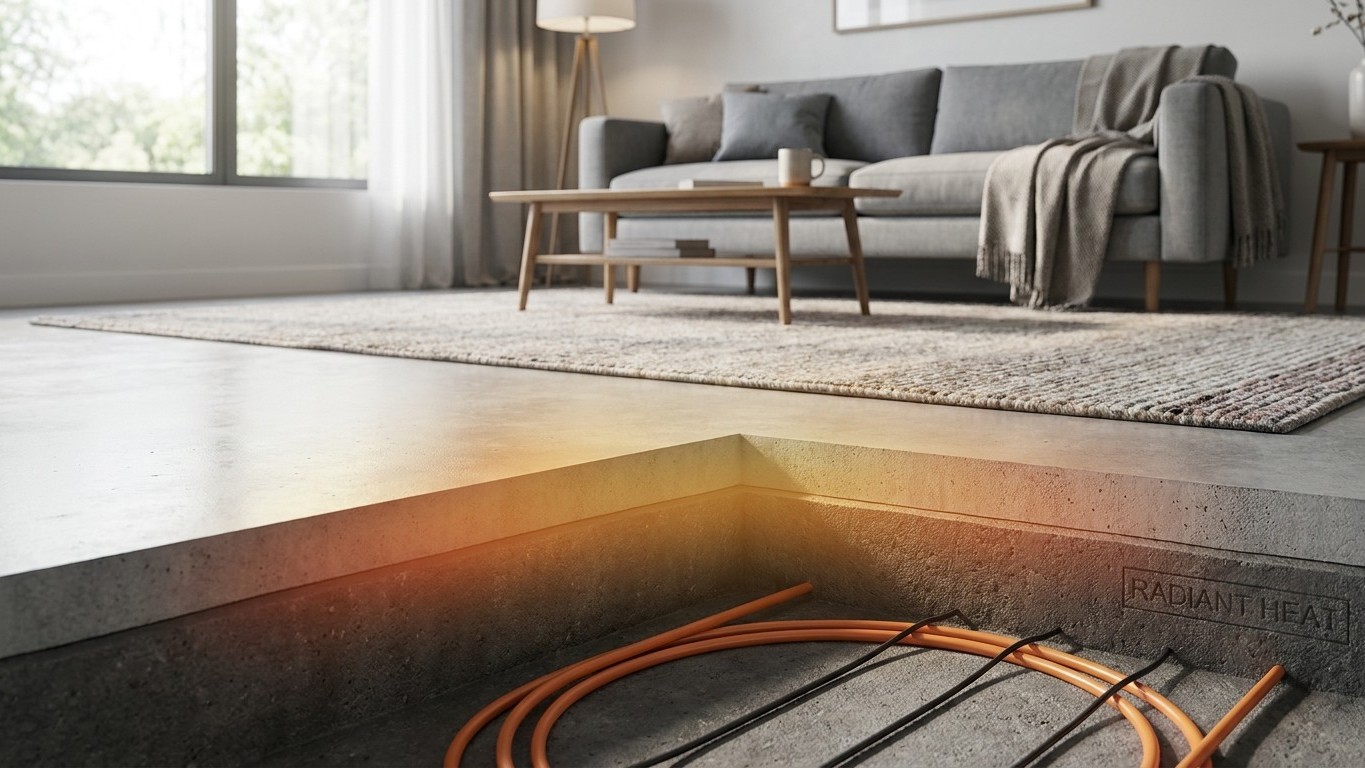

A radiant floor takes hours to respond because it isn’t heating air directly, it’s heating mass. The tubing or cable sits inside a slab, a mortar bed, or a subfloor assembly, and that assembly has to warm up before the room does. Raise the thermostat and you’re asking several hundred pounds of concrete or wood to change temperature, not a few cubic feet of air. That lag is built into the physics, not a flaw in your particular system.
You are heating a slab, not a room

Forced air moves heat by convection: a blower pushes warm air into a room, and you feel the difference in minutes. A radiant floor moves heat by conduction and radiation from a mass that has to be charged first. In a hydronic system, warm water circulates through tubing embedded in a concrete slab or a lightweight mortar pour. In an electric system, resistance cable or mats sit under the finish flooring, often with a thin layer of self-leveling compound on top. Either way, the heat source is buried inside something heavy, and that something has to absorb energy before it releases it to your feet and the air above.
This is why turning the thermostat up on a cold morning doesn’t produce warmth soon. The call for heat goes to the boiler or the cable, but the floor itself is still cold, and it takes time for that thermal mass to climb in temperature. The reverse is just as true: turn the thermostat down and the room stays warm for hours, because the slab keeps giving back the heat it already stored. You’re not Controlling the room in real time. You’re managing a reservoir with a long fill and drain cycle.
Electric versus hydronic: same lag, different scale
Both radiant systems share this delay, but the mass involved is different, which changes how sluggish the response feels.
| System | Heat source | Typical mass | Response character |
|---|---|---|---|
| Electric radiant floor | Resistance cable or mat under the finish | Thin mortar or subfloor layer | Faster to react, still measured in an hour or more, not minutes |
| Hydronic radiant floor | Warm water circulated through tubing | Concrete slab or thick mortar bed | Slowest to react, response measured in hours |
In a house occupied irregularly, a guest bedroom, a converted garage office, a weekend cabin, this lag matters more than in a room used every day. If nobody’s in the space until Friday evening, cranking the heat Friday afternoon doesn’t help; the slab needed to start charging Thursday. Rooms with intermittent use are the hardest case for radiant heat, and they’re exactly where thermostat setbacks cause the most frustration.
Run it steady, not in bursts
A thermostat schedule built for forced air assumes the system can catch up fast: setback overnight, recover by 6 a.m., no problem. Apply that same schedule to a radiant slab and the system spends most of the day just trying to recover from the setback, never quite reaching a steady state. The floor is always chasing a target instead of holding one, and the house feels colder than the thermostat setting suggests, even though the system is running constantly.
The better approach for a hydronic floor is to run it at a steady, moderate temperature rather than swinging it up and down. This is where an outdoor reset control earns its keep. Instead of the boiler firing to a single fixed water temperature regardless of outdoor conditions, a reset curve adjusts the supply water temperature based on how cold it is outside. On a mild 50-degree day, the boiler sends cooler water into the loops; on a 10-degree day, it sends hotter water. The floor stays close to a stable comfort temperature across a wide range of weather, without the boiler overshooting on mild days or falling short on cold ones.
Outdoor reset also protects the slab from being asked to do something it can’t do quickly. Because the reset curve adjusts gradually and continuously, the floor is nudged rather than shocked, and the whole house avoids the big swings that a bursty schedule produces. For more detail on how the reset curve itself is set up and tuned, see the boiler reset-curve guide in this collection.
None of this means the thermostat is useless on a radiant system, but it does mean the thermostat should be treated as a slow dial, not a switch. Small, early adjustments beat late, large ones. If you know guests are arriving Saturday, nudging the setpoint up Thursday will get you further than jacking it up Saturday morning ever will.
Overshoot on a sunny afternoon
Thermal mass cuts both ways. The same slab that keeps a room warm after the heat call ends can also keep adding heat when you don’t want it anymore. A common pattern in radiant homes: the system charges the floor overnight and through the cold morning hours, then the sun comes out in the afternoon and pours through south-facing windows. The room is now getting heat from two directions at once, solar gain plus a slab that’s still releasing the energy it stored hours earlier, and the house overshoots into uncomfortably warm territory.
This is a failure mode specific to systems with mass. A forced-air furnace would simply stop blowing air and the room would cool as the sun’s heat dissipated. A radiant floor can’t stop that fast. The slab keeps radiating whether or not the thermostat has already called for the heat to stop, because the heat is stored in the material itself, not in a stream of moving air that shuts off instantly.
What mitigates the overshoot
A few control choices reduce how often this happens and how severe it gets.
- A slab sensor paired with the thermostat lets the control system see the actual floor temperature, not just the air temperature, so it can throttle back the heat call before the slab overcharges on a morning that’s about to turn sunny.
- An outdoor reset curve helps here too, since it keeps supply water temperatures lower on milder days, meaning there’s less stored energy in the slab to release when the sun adds its own contribution.
- A lighter assembly, such as a thin mortar bed over a wood subfloor rather than a thick poured slab, stores less energy and responds faster in both directions, trading some of the steady comfort for quicker recovery from an overshoot.
Floor temperature itself is capped by what feet and finish materials can tolerate, and that cap limits how much heat any given square foot of floor can supply. In a poorly insulated room, especially one with large glass exposure, that ceiling can fall short of what’s needed on the coldest days, which is one more reason to size and insulate carefully rather than lean on the floor to make up the difference. The exact temperature limits and output figures come from the flooring manufacturer and the radiant system maker, and both should be consulted before choosing a covering for a heated floor.
Whatever heat source is in a room, general home safety guidance still applies. The U.S. Fire Administration advises: “Keep anything that can burn at least 3 feet from all heat sources including fireplaces, wood stoves, radiators, space heaters or candles.” A radiant floor doesn’t radiate the way a space heater does, but the same habit of keeping combustible clutter clear of any active heat source is worth carrying into every room, heated floor or not.
Common questions
How long does it actually take for a radiant floor to warm a room?
It depends on the assembly and the starting temperature, but hours rather than minutes is the realistic expectation for a cold slab, with electric systems generally responding somewhat faster than hydronic ones because they involve less mass.
Should I turn my radiant floor off when I leave for the day?
Turning it off and back on invites the same recovery lag described above; a steadier, moderated setting held throughout the day usually works better than an on/off cycle timed to occupancy.
Why does my room feel too warm hours after the thermostat said it was satisfied?
The slab is still releasing heat it absorbed earlier; this is normal for thermal-mass systems and is worsened when solar gain adds heat on top of what the floor is already giving off.
Does an outdoor reset control fix the slow response, or just the overshoot?
It mainly addresses overshoot and uneven comfort across changing weather by matching water temperature to conditions outside; it doesn’t eliminate the inherent lag of charging a slab, which is a property of the mass itself.