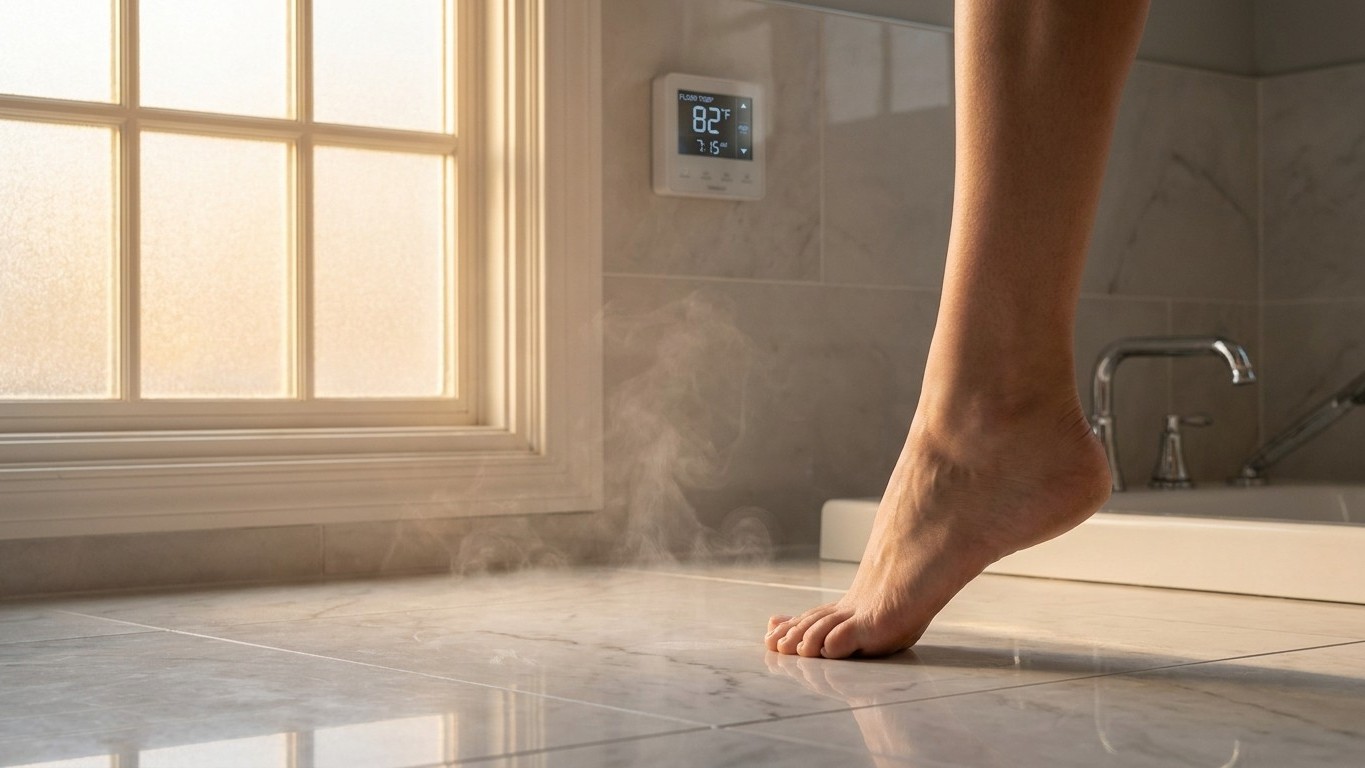

A radiant floor thermostat can be told to watch three different things: the floor itself, the air in the room, or both at once with the floor acting as a safety ceiling. Which setting works best depends on the room. Bathrooms usually want the floor held steady underfoot. Whole-house systems usually want the room held steady, with the floor sensor there only to prevent overheating. Getting this wrong is the most common reason people say their radiant heat “feels off.”
Floor temperature or room temperature

Every radiant floor thermostat has to decide what number it’s actually chasing. Some models read a sensor embedded in the slab or under the finish and hold that surface at a set point. Others read the air in the room, the way a standard thermostat does, and adjust the floor output until the room hits target. A third mode blends the two: the room sensor drives the call for heat, but a floor sensor caps how hot the surface is allowed to get, no matter what the room is asking for.
In a bathroom, floor-temperature mode almost always wins. Nobody cares what the thermostat display says the air is doing at 6 a.m.; they care whether the tile feels warm on bare feet. A floor sensor lets you dial in that exact sensation and keep it consistent, whether it’s January or a mild October morning. Because bathrooms are small and often used for short bursts, chasing a room temperature would mean long waits for the air to catch up, then overshoot once it does. Reading the floor directly skips that lag.
Whole-house systems behave differently
A living room or an entire house heated by hydronic tubing is a different problem. Here, comfort is really about air temperature, humidity, and how warm the walls and furniture feel after hours of steady radiant output. A thermostat locked onto floor temperature alone can’t tell if a sunny afternoon has already warmed the room past what’s needed, so it keeps pushing heat into a slab that doesn’t need it. That’s why most whole-house installers set the room sensor as the primary trigger and use the floor sensor purely as a limit, a backstop that prevents the assembly from climbing past what the flooring and the framing underneath can tolerate.
The practical takeaway: match the control mode to the room’s job. A bathroom, a mudroom, or a small tiled space where you touch the floor directly should be tuned to floor temperature. A great room, a bedroom wing, or a whole first floor should be tuned to room temperature with a floor limit riding shotgun. Two systems under one roof, two different jobs for the thermostat.
Why a floor limit exists
Whether the primary control is the room or the floor, almost every radiant setup includes a maximum floor temperature that the system is never allowed to exceed. That ceiling isn’t arbitrary. It exists because the assembly under your feet, the flooring material, the adhesive or mortar, the subfloor, and in electric systems the cable or mat itself, all have tolerances. Push past them and you’re not just wasting energy, you risk warping engineered wood, drying out grout lines prematurely, or shortening the life of the heating element buried in the floor.
This is also where electric and hydronic systems part ways in terms of risk. Electric radiant floor heat uses resistance cable or mats installed directly under the finish, and because the heating element sits so close to the surface, the floor limit is doing real protective work against localized hot spots. Hydronic radiant floor heat circulates warm water through tubing embedded deeper in a slab or a thin-pour layer, which spreads heat more evenly but still needs a ceiling to protect whatever finish sits on top. Different installation, different running cost, same underlying need for a cap.
What sets the actual number
The specific temperature that limit gets set to is not something a thermostat manufacturer invents on its own. It comes from the flooring manufacturer’s own guidance for that particular product, combined with recommendations from whoever engineered the heating system. Tile tolerates more heat than solid hardwood. Laminate and vinyl each have their own thresholds. That’s why anyone installing or resetting a radiant system should treat the flooring maker’s documentation as the final word, not a general rule of thumb picked up from a forum or a neighbor’s install.
The floor limit also protects against a less obvious failure mode: a poorly insulated room asking for more heat than the floor can physically deliver per square foot. If a space loses heat faster than the floor can replace it, the thermostat will keep calling for maximum output, pushing the surface toward its ceiling without ever actually warming the room. That’s usually a sign the problem isn’t the thermostat setting at all, it’s insulation, window performance, or slab coverage that needs attention before any control tweak will help.
Combustibles matter here too, regardless of how a floor is heated. As the U.S. Fire Administration puts it, “Keep anything that can burn at least 3 feet from all heat sources including fireplaces, wood stoves, radiators, space heaters or candles.” Thick rugs, stacked towels, or pet beds placed directly over a radiant zone can trap heat against the floor covering in ways the system wasn’t designed to handle, even when the thermostat itself is behaving exactly as programmed.
Scheduling a slow system
Radiant floors don’t respond to a thermostat command the way forced-air does. Because the system has to heat the slab or the assembly before that warmth ever reaches the room, the lag between a setting change and a felt change in temperature runs to hours, not minutes. That’s not a flaw to work around, it’s the defining property of thermal mass, and it should shape how the schedule gets built from the start. For a deeper look at exactly how long that lag runs and what drives it, the response time page breaks down the mechanics room by room.
Given that lag, the worst thing you can do to a radiant floor thermostat is treat it like a forced-air unit and program sharp setbacks, dropping the temperature ten degrees overnight and expecting a quick rebound by 7 a.m. The slab won’t cooperate. It’ll still be shedding stored heat into the room long after the setback kicked in, and then it’ll take hours to recover once the schedule calls for warmth again, often meaning you wake up to a cold floor and go to bed before it’s fully warmed back up.
Gentler curves, not cliffs
The better approach is a schedule built around long, gradual shifts rather than steep steps. A few degrees down overnight, held steady rather than dropped hard, keeps the slab close enough to its working temperature that recovery is quick and the room never swings far from comfortable. The same logic applies at the other end of the day: rather than jumping the target up right when you want warmth, shifting it earlier by an hour or two lets the mass catch up gradually instead of playing catch-up on demand.
Many modern radiant floor thermostats include an adaptive or “learning” start feature that handles this timing automatically. Instead of you guessing how far in advance to bump the schedule, the controller tracks how long recovery actually took on previous cycles and adjusts the start time on its own, aiming to hit the target temperature exactly when you’ve asked for it rather than an hour before or after. Where that feature exists, it’s worth turning on and leaving alone for a couple of weeks before judging it, since it needs a few cycles of real data to calibrate to your specific floor and room.
Common questions
Can one thermostat control both an electric mat in the bathroom and a hydronic loop in the rest of the house?
Not directly with a single unit in most cases, since electric and hydronic systems use different control signals and voltage requirements. Each zone typically needs its own compatible thermostat, though a home automation hub can tie multiple zones together for scheduling purposes.
Is it safe to place a floor sensor under a rug or thick mat?
The sensor itself will keep reading accurately, but heavy coverings over the heated area can trap warmth in ways the floor limit wasn’t calibrated for. Following the flooring manufacturer’s guidance on rugs and mats over radiant zones is the safer route than guessing.
Why does my floor still feel cool even though the thermostat says it reached its target?
This usually points to a room-temperature control mode rather than a problem with the floor limit. If the air has reached its set point before the slab has fully warmed, the system may cut back output even though the surface hasn’t caught up yet, which is common in larger rooms with high thermal mass.
Should I turn the system off completely when I’m away for a few days?
Given how slowly radiant floors respond, a full shutdown usually costs more comfort and recovery time than it saves in energy. A modest setback that keeps the slab from cooling all the way down tends to work better than an off/on cycle for short absences.