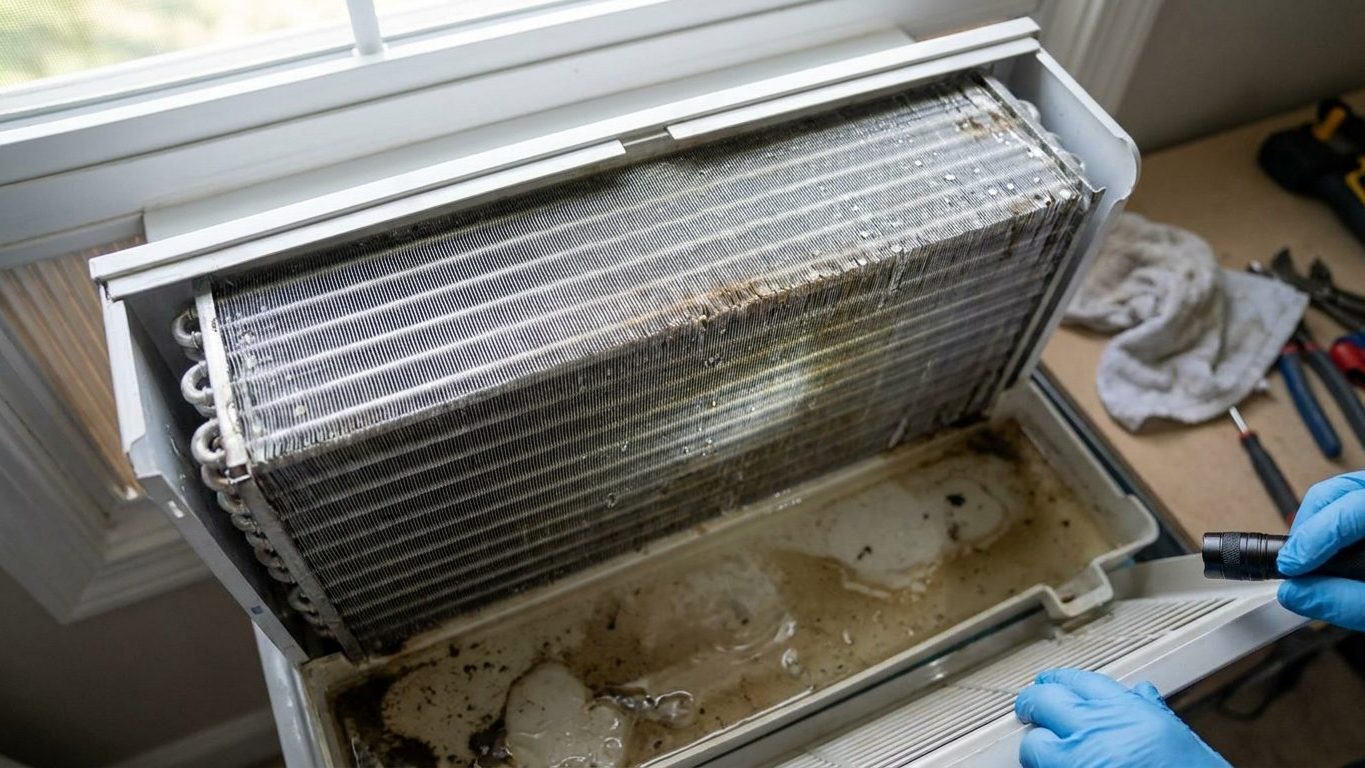

A musty or sour smell means moisture is sitting somewhere it shouldn’t, usually on the cooling coil or in the drain pan. A burning or hot-electrical smell means the machine itself needs attention right now, not later. A chemical or sweetish smell points at the sealed refrigerant system and calls for a technician. Knowing which one you’re smelling already tells you most of what you need to do next.
Each smell points somewhere different
Three smells, three separate causes, and almost no overlap between them. That’s the part people miss when they start searching for a fix: a musty smell and a burning smell don’t share a root cause, so a solution aimed at one won’t touch the other. The table below is the fastest way to sort out which situation you’re actually in before you do anything else.
| Smell | What it usually means | Where to look | Urgency |
|---|---|---|---|
| Musty or sour | Moisture sitting on a surface, feeding mold or bacteria | Coil face, filter, drain pan | Not urgent, but persistent |
| Burning or hot plastic/electrical | Something inside the unit is overheating | Wiring, motor, control board | Stop use immediately |
| Chemical or sweetish | Possible refrigerant or sealed-system issue | Inside the sealed system, not accessible | Call a technician |
The musty smell is by far the most common of the three, and it’s the one people live with for years because it’s unpleasant but not alarming. It comes and goes with the season, gets worse in humid weather, and tends to fade a little once the unit has been running for a while, only to return the next time it cycles off. That pattern alone is a clue: something wet is drying out slowly instead of draining or evaporating properly.
A burning smell behaves nothing like that. It shows up suddenly, doesn’t fade with use, and often comes with a change in sound, a unit that feels warmer than usual on the housing, or a faint haze near the vents. This is the smell that should stop you from troubleshooting on your own schedule.
The chemical smell is the rarest and the hardest to diagnose from the outside, because the sealed refrigerant system isn’t something a homeowner opens. If the smell is sweetish, faintly like nail polish remover, or just “off” in a way that doesn’t match mustiness or burning, that’s the category to flag for a professional rather than guess at.
The musty one, and why it comes back
Every window and portable air Conditioner pulls warm, humid air across a cold metal coil. Water condenses on that coil the same way it beads up on a cold glass of iced tea. Most of it drips into a small pan and drains away or evaporates. Some of it stays behind as a thin film on the coil fins, the filter, and the housing around them. Add household dust, and that damp surface has exactly what mold and bacteria need to grow. The smell is their byproduct, not the moisture itself, which is why air fresheners and spray cleaners never fix it for good. They mask the output without touching the source.
This is also why the smell is seasonal and repeating. A unit can run clean for weeks, then start smelling musty again after a stretch of humid days, a clogged filter, or a drain path that’s gotten dusty enough to slow drainage. Each time, the moisture sits a little longer than it should, and the smell shows up again. Nothing about the unit is broken. The habit around it is missing a step.
The fix, in order
- Unplug the unit before touching anything inside it.
- Take out the filter and wash it with plain water, letting it dry fully before putting it back.
- Clean the visible, accessible face of the coil, working gently so the thin metal fins don’t bend.
- Clear the drain path so water isn’t pooling where it shouldn’t be.
- Change the habit that let this happen: run the fan alone for a while after the compressor shuts off, so the coil has a chance to dry instead of sitting wet until the next cycle.
ENERGY STAR’s own guidance says to “Inspect, clean, or change air filters once a month in your central air Conditioner, furnace, and/or heat pump.” That sentence is written for central systems, not window or portable units, and it’s worth saying so plainly rather than stretching the quote to fit. But the idea behind it applies just as well here: a room unit has its own washable filter, and treating it to a similar monthly check is the same logic scaled down to a single room.
The burning one
A hot-plastic or electrical smell is not a smell to investigate while the unit keeps running. Switch it off, unplug it, and let it sit. That order matters more than anything else in this section, because the instinct to keep it going while you search for an explanation is exactly the instinct to override.
There’s one genuinely harmless version of this. A unit that’s been sitting unused for a season, or one with a heating function, can produce a faint burning smell the first time it runs, as dust that settled on a warm surface burns off. That smell is mild, fades within a few minutes, and doesn’t return on the next cycle. If what you’re smelling matches that description exactly, that’s the exception.
Anything else isn’t. A burning smell that lingers, that gets stronger, that comes with a burnt or acrid edge rather than a faint dusty one, or that shows up on a unit that’s been running fine for a while, is not the harmless case. Don’t try to identify which part is causing it. That’s a job for someone qualified to open the unit safely, not a guess to make from the outside.
Two things worth knowing here even though they’re not about the smell itself. A window unit is heavy enough that a poor mounting job can let it slip, so the support bracket and sash locks matter more than they look like they do. And a room air conditioner should run on its own outlet rather than through an extension cord, since the steady, heavy draw it pulls is exactly what extension cords aren’t built for. Both of those sit closer to “how the unit is installed” than to “why it smells,” but they’re the kind of detail that turns into a bigger problem if ignored.
If a burning smell doesn’t match the harmless dust-burn-off pattern, the safe move is to leave the unit unplugged and have it looked at, rather than plug it back in “just to see.”
Keeping it from coming back
The musty smell is the one that responds to a routine, and the routine is short enough that skipping it is really a choice, not an accident. None of the steps below require tools beyond what came with the unit, and none of them touch anything electrical.
- Wash the filter monthly through the cooling season, not just once at the start of summer.
- Run the fan alone for a while before switching the unit off completely, so the coil dries instead of sitting wet overnight.
- Keep the drain path clear of dust and debris so condensation actually leaves the unit instead of pooling.
- Clean the coil face at the start of each season, before the first hot stretch, rather than waiting until the smell shows up and cleaning at the end.
That last point is the one people get backwards. Cleaning after the smell appears treats a symptom that’s already established itself. Cleaning before the season starts means the coil never gets the chance to build up the film that feeds mold in the first place. It’s the difference between chasing a smell every July and never smelling it at all.
Common questions
Why does my window AC smell musty only when it first turns on?
That’s typically moisture that sat on the coil while the unit was off, then got pushed into the airflow the moment the fan restarts. Running the fan alone for a while after each cooling cycle, rather than shutting the whole unit off immediately, usually reduces this.
Can a musty smell mean mold I can’t see?
Yes. Mold and bacteria growing on the coil, in the filter, or in the drain pan don’t always look like visible mold, but they produce the same musty odor. Cleaning the accessible surfaces and keeping them dry addresses the growth even when nothing is visibly discolored.
Is it safe to keep running the unit if the burning smell is faint?
Only if it matches the harmless case: a brief burn-off of dust on first use after the unit sat idle, fading within minutes and not returning. Anything that lingers, strengthens, or shows up on a unit that’s been running normally calls for switching it off and having it checked rather than continuing to run it.
Does a chemical smell always mean a refrigerant leak?
Not necessarily, but it’s the category that points at the sealed system rather than something a homeowner can clean or fix directly. A sweetish or chemical smell that doesn’t match musty or burning is the signal to have a technician look at the unit rather than guess at the cause.