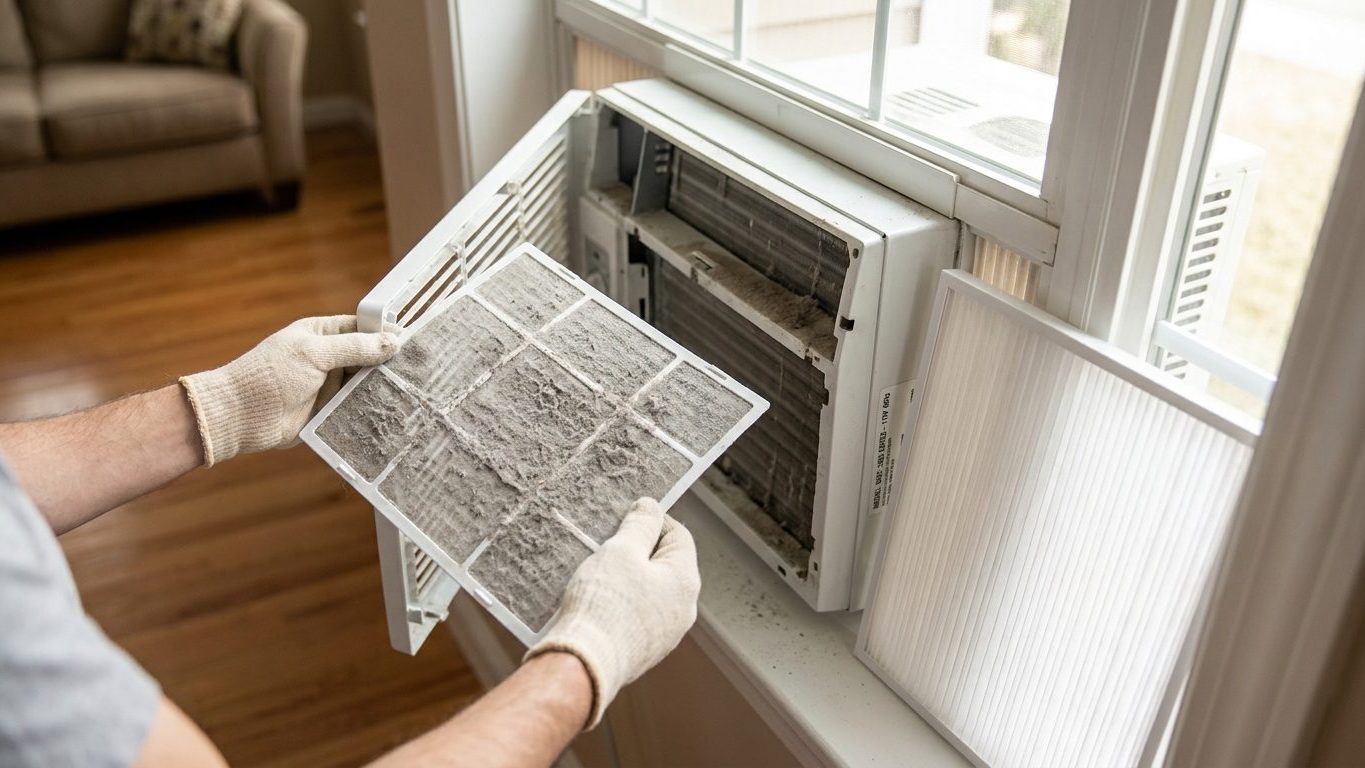

Unplug the unit, slide out the washable filter, and rinse it in lukewarm water. Let it dry fully before it goes back in. Wipe the front grille. On the outside, vacuum the coil fins with a soft brush, because they bend easily, and check that the drain area is clear. Repeat monthly during cooling season. A clean unit delivers the cooling it was built for, but only if it was the right size to begin with. That second question is where most people go wrong.
The chart, as published
ENERGY STAR publishes a sizing chart for room air conditioners. It has two columns: the area to be cooled, in square feet, and the capacity needed, in BTU per hour. The chart stops at 1,400 square feet. Past that, there is no row to read, and the right move is a professional load calculation rather than a bigger window unit.
Two things about how the chart works. First, the area comes in ranges, not single values, so you find the row your measured room falls into and read across. Second, the relationship between square footage and BTU is not a straight line. Doubling the room does not simply double the capacity, so dividing BTU by square feet and multiplying by your own room size will give you a number the chart never published. Skip that shortcut.
I have not retyped the figures here. A single wrong digit in a sizing table sends someone home with the wrong machine, so take the pairs directly from ENERGY STAR’s own published chart and check them against the capacity printed on any unit you are considering. Compare rows only. Do not interpolate between them.
Say plainly what the chart is. It is a starting point published by ENERGY STAR, built on area alone. It is not a load calculation, and it does not know anything about your particular room. Treat it as the first answer, then read the section on its limits before you buy.
Even the right size depends on upkeep. If you are shopping between formats first, Window Unit or Portable Air Conditioner? The Difference That Matters covers how the two types differ before size even comes into it.
Measuring the room properly
A tape measure and five minutes will do. The goal is the space the unit can actually reach, not the space on the real estate listing.
- Measure the length and width of the room in feet and multiply them. A bedroom 12 feet by 15 feet is 180 square feet.
- Do the same for every other space the unit is expected to cool. If you want the unit to serve a bedroom and its attached sitting nook, measure both.
- Add any connected space that has no door. A 10-foot by 4-foot hallway that opens straight into the room, with nothing to close, adds 40 square feet to the total.
- Decide honestly about open-plan areas. A kitchen, dining area, and living room that flow together may be one room or three, depending on whether cool air can travel between them. A unit at one end of a long space will not do much for the far end.
- Find the row on the chart that contains your total, and read across to the capacity.
The judgment that matters is about reach. A unit is asked to cool the volume of air it can move through. A doorway left open is part of the room. A closed door is a wall. If you plan to keep the bedroom door shut at night, measure the bedroom alone. If the door stays open all summer, count what lies beyond it.
Partial cases are where people talk themselves into a bigger number. A wide archway with no door counts. A door you close only when guests visit probably does not. If you are honestly torn, measure both ways and see whether the two totals land in the same row of the chart. Often they do, and the question settles itself.
Why bigger is worse, not safer
Choosing the next size up “to be safe” is the most common mistake on this purchase. ENERGY STAR’s own sizing guidance cautions against it. The instinct is understandable, since more capacity sounds like more margin. In practice, an oversized air conditioner does a worse job of the thing you bought it for.
Cooling and drying happen together, and drying takes time
An air conditioner does two jobs at once. It lowers the air temperature, and it pulls moisture out of the air as that air passes over the cold coil. The first job is fast. The second is slow, because water only comes out while air is actually moving across the coil, minute after minute.
An oversized unit reaches the thermostat setpoint quickly and shuts off. The air is cool, but the unit never ran long enough to remove much moisture. The room ends up cold and clammy: a temperature that looks right on the dial, and skin that feels damp. People often respond by turning the setting lower, which makes the room colder without making it more comfortable.
The wear you do not see
Short bursts of running followed by shutoffs, over and over, are called short cycling. A unit sized to the room runs in longer, steadier stretches. An oversized one starts and stops far more often, and starting is the hardest moment for a compressor. More cycling means more wear on the machine for a worse result in the room. You pay a higher purchase price for the privilege.
None of this means a unit should be squeezed to the minimum. A correctly sized unit will run for long stretches on the hottest afternoons, and that is normal, not a sign of failure. The goal is a machine matched to the space. A modest unit that runs steadily will usually leave the room drier and more comfortable than a bigger one that keeps shutting itself off.
If a spec sheet seems to land between two rows, look hard at your measurements before reaching for the larger option. And if you are weighing a portable model because a window will not take a unit, the same sizing logic applies. The comparison in Window Unit or Portable Air Conditioner? The Difference That Matters goes into how the formats differ in practice.
What the chart does not account for
The chart is built on area alone. It does not know whether the ceiling is eight feet or twelve, what sits above that ceiling, which way the windows face, or who is in the room. A bedroom under an uninsulated roof, a living room with a west-facing wall of glass, a kitchen with an oven running, and a room that regularly holds several people all behave differently from a plain room of the same square footage. This brief carries no published adjustment for any of them, so I am not going to hand you a percentage and pretend it came from somewhere. A made-up number is worse than none, because it looks authoritative.
What exists instead is a load calculation. It is a structured estimate of how much heat a specific space gains on a hot day, built from the walls, roof, windows and their orientation, insulation, air leakage, occupants, and heat-producing equipment. HVAC contractors do them, as do some energy auditors. The result is a capacity figure for your room, not a typical one.
Ask for one when the room is unusual: top-floor under a bare roof, heavy west or south glass, a kitchen, a home office full of equipment, or a space that lands near the top edge of the chart. It is also worth asking when you are about to spend real money on a larger unit and cannot tell if the chart is steering you right. For an ordinary bedroom, the chart and a careful tape measure are usually enough of a starting point.
The other variable you control is airflow. ENERGY STAR advises: “Inspect, clean, or change air filters once a month in your central air conditioner, furnace, and/or heat pump.” That sentence names central equipment, not window units. A room unit has its own washable filter, and the monthly habit is the same idea applied to it. ENERGY STAR also states: “Airflow problems can reduce your system’s efficiency by up to 15 percent.” That, too, refers to systems in general, and “up to” is doing real work in that sentence. It is a ceiling, not a typical loss. Still, a clogged filter or matted coil fins can make a correctly sized unit act undersized. Clean first, then judge the size.
Common questions
How often should I clean the filter on a window unit?
Monthly during cooling season is a sensible habit, borrowed from ENERGY STAR’s monthly advice for central equipment. Check it more often if the room is dusty or you have pets. Hold it up to the light: if you cannot see through it, wash it.
Do I need to take the unit out of the window to clean it?
Not for routine care. The filter and front grille are reachable from inside, and you can vacuum the back fins carefully from outside if you can reach them safely. If you do lift the unit out, these machines are heavy and awkward at an open window, so get a helper rather than leaning out with it alone. For the seasonal version of this job, see Taking Out a Window Air Conditioner for Winter, or Leaving It In.
Can I use an extension cord if the outlet is far from the window?
Avoid it. Air conditioners draw a lot of power, and a typical household extension cord is not built for that kind of continuous load. Plug the unit straight into a wall outlet, and if the outlet is not close enough or the circuit seems overloaded, have an electrician look at it. Larger units make this worse, which is one more reason not to oversize.
My unit seems too small. Should I buy a bigger one?
Clean it first. A clogged filter or dirty coil restricts airflow, and ENERGY STAR notes that airflow problems can reduce efficiency by up to 15 percent. Then re-measure the room, counting any open doorways. If the room still falls short and has a heavy heat source such as a west-facing glass wall, a load calculation will tell you more than jumping up a size.