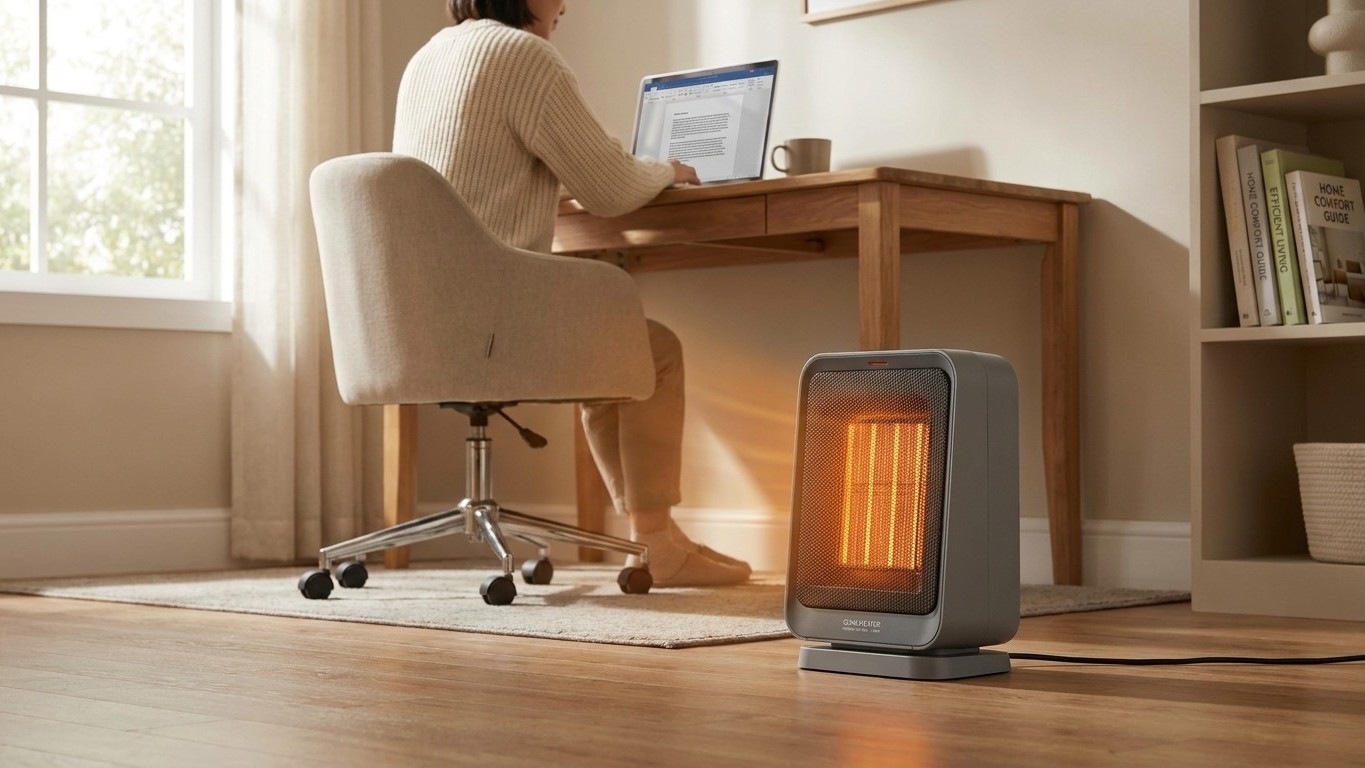

A space heater’s job is to warm one room or one person, not a whole house. Match the type to how fast you need heat and how long you’ll run it, size it to the room’s square footage and its quirks, and never leave it running unattended. Every electric model turns into heat at roughly the same rate, so the model itself won’t save you money. The real risk isn’t which heater you buy. It’s clearance around it and remembering to shut it off.
What a space heater is for
A furnace or a heat pump is built to hold an entire house at one temperature. A space heater does something narrower: it raises the temperature in a single room, or sometimes just around a single chair, while the rest of the house stays whatever temperature the central system left it at. That distinction matters more than most shoppers realize, because it decides whether a space heater is even the right purchase in the first place.
Three situations make a strong case for one. A converted garage, a sunroom, or a finished basement corner that the ductwork never quite reaches. A house where only one room, an office or a nursery, is occupied for hours while the rest sits empty and doesn’t need full heat. Or a short burst of warmth in a workshop or garage for an hour of work, where running the whole-house system for that long would be wasteful. In each case the heater is filling a specific gap, not replacing the furnace.
What a space heater is not built for is heating an entire home in place of a working furnace. Running several units around the house to make up for a central system that’s undersized, broken, or too expensive to run stretches the appliance well past its design and multiplies the fire risk discussed further down this page. The U.S. Fire Administration is direct about one version of this mistake, stating plainly: “Never use an oven to heat your home.” The same logic applies to stringing together multiple portable heaters as a furnace substitute.
Once you’ve confirmed a space heater fits the job, three more questions decide which one to buy and how to run it. Which type actually suits your room, convection or radiant, and their variants. What size unit that room calls for, based on its floor area and its particular flaws like drafts or high ceilings. And what it will actually cost you to run, in dollars per month rather than in the wattage printed on the box. The next section walks through each of those in order, and each links to a dedicated page with the full comparison.
Choosing: type, size, cost
Start with type. Convection heaters warm the air in a room and rely on that air circulating, which makes them a better fit for closed rooms you’ll sit in for a while, like a bedroom or a home office. Radiant heaters warm objects and people directly in their line of sight, which suits a quick burst of heat aimed at one spot, a desk, a workbench, a spot on the couch, rather than the whole room. Within each category there are variants (oil-filled radiators, ceramic convection heaters, quartz infrared panels) with different warm-up times and different feel. The type comparison page breaks down which variant suits which room.
Next comes size, and size means two things, not one. The first is straightforward: floor area in square feet, which determines the wattage a heater needs to bring a room to a comfortable temperature. The second is less obvious and more important in practice: the room’s faults. A room with a single-pane window, a drafty door, or a nine-foot ceiling needs more capacity than its square footage alone would suggest. The sizing page walks through how to adjust for those faults room by room.
Then there’s the question everyone actually cares about: what it costs to run. That comes down to three numbers multiplied together: the heater’s wattage, the number of hours it runs, and the electricity rate on your own utility bill. Here’s the fact that governs the entire category and makes shopping simpler than it looks: every electric resistance heater, whether it’s labeled ceramic, ceramic-oil, infrared, or radiator-style, converts essentially all the electricity it draws into heat. There is no electric space heater type that produces more heat per dollar than another. The marketing language on the box (energy-efficient, advanced heating technology) describes how the heat is distributed in a room, not how cheaply it’s produced. The running-cost page shows how to calculate your own number using your own rate.
The safety picture, in two numbers
Two figures from the U.S. Fire Administration sum up the risk profile of portable heaters better than any single warning label could. In its report covering 2017-2019, the agency found that portable heaters caused an estimated annual average of 1,100 home fires, 65 deaths, 150 injuries, and $51 million in property loss. Portable heaters accounted for roughly 3% of home heating fires overall, but roughly 41% of the fatal ones. That gap between 3% and 41% is the whole story: these fires are rare compared to other heating equipment, but when they happen, they’re disproportionately likely to kill someone. Reporting one of those numbers without the other tells only half the truth, in opposite directions.
The gap traces back to how people actually use these heaters, not to some defect in the appliances themselves. Space heaters get placed close to beds, couches, curtains, and stacks of papers because that’s exactly where people want the heat. They also get left running while everyone falls asleep or leaves for the day, because switching them off feels like an unnecessary extra step. The U.S. Fire Administration’s guidance addresses both of those habits directly, and it’s worth quoting exactly rather than paraphrasing: “Keep anything that can burn at least 3 feet from all heat sources including fireplaces, wood stoves, radiators, space heaters or candles.” Note that space heaters sit on that list alongside fireplaces and wood stoves, appliances most people already treat with real caution.
The second instruction is just as direct: “Turn space heaters off when leaving the room or going to bed.” Both halves matter. Not just at bedtime, but every time the room empties out, even for a few minutes to answer the door or grab something from another room. The agency adds one more piece of standing advice that applies to any heating equipment in the house, portable or fixed: “Maintain heating equipment and chimneys by having them cleaned and inspected each year by a professional.”
The full safety page covers placement, flooring, and what to do if a heater trips a breaker or smells hot. If you’re running a space heater on an extension cord, or considering it, the extension-cord page covers the gauge and length limits that matter for this specific type of appliance, since an undersized cord is one of the more common causes of overheating that never makes it into the fire statistics until something goes wrong.
The fuel-burning exception
Everything above assumes an electric heater, plugged into a wall outlet, converting electricity into heat with no combustion involved. Kerosene and propane heaters work on an entirely different principle: they burn fuel indoors to produce heat, and that single fact changes the list of questions a buyer needs to ask.
An electric heater’s worst-case failure is a fire from clearance or wiring. A fuel-burning heater adds a second, invisible failure mode: incomplete combustion producing carbon monoxide in a closed room. That means questions about combustion air (whether the room has enough fresh air exchange to support the flame safely), about carbon monoxide exposure, about moisture the combustion process adds to indoor air, and about using the correct fuel grade for the unit, none of which have any equivalent on the electric side of this category.
These aren’t small differences, and they aren’t covered by anything in the sections above. The dedicated fuel-burning heater page walks through combustion air requirements, ventilation, and fuel grade in the detail the topic actually requires. If you’re weighing a fuel-burning heater specifically because of concerns about carbon monoxide from a furnace or other combustion appliance already in the house, the furnace carbon monoxide page addresses that risk directly, including where detectors should be placed relative to any fuel-burning equipment you add.
Common questions
Can a space heater replace a furnace for a whole winter? No. It’s built to warm one room, not to carry the heating load of an entire house for months at a time, and using several units that way multiplies both the fire risk and the electric bill far beyond what a properly sized central system would cost.
Is one type of electric space heater cheaper to run than another? Not per unit of heat. Every electric resistance heater converts essentially all its electricity into heat, so the running cost comes down to wattage, hours of use, and your own electricity rate, not the type printed on the box.
How far should furniture and bedding be kept from a space heater? At least 3 feet, per U.S. Fire Administration guidance that groups space heaters with fireplaces, wood stoves, and radiators as heat sources needing that same clearance from anything that can burn.
Do fuel-burning space heaters need different safety precautions than electric ones? Yes. Kerosene and propane heaters burn fuel indoors and introduce carbon monoxide risk, ventilation requirements, and fuel grade considerations that don’t apply to a plug-in electric heater at all.