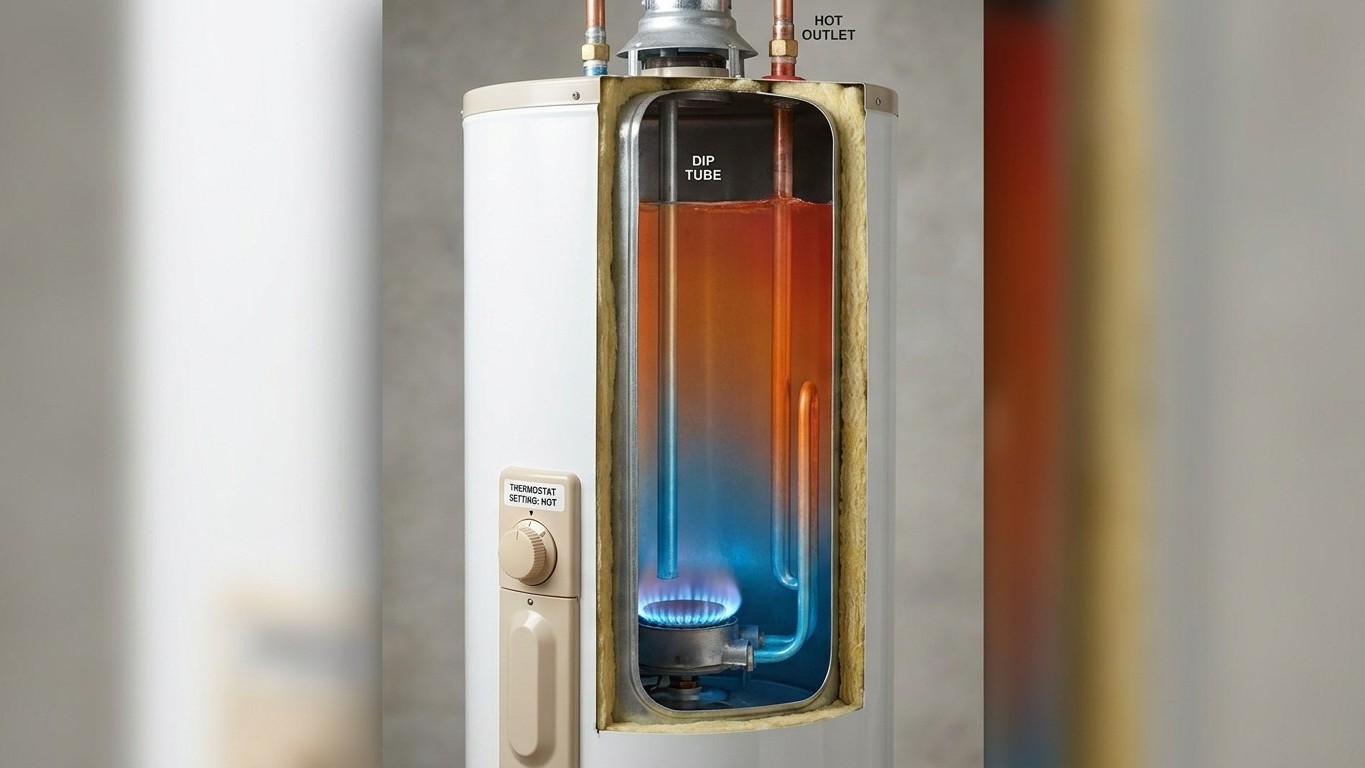

A storage Water Heater Is essentially an insulated tank that keeps a supply of water hot around the clock, ready the moment someone opens a tap. Cold water enters, gets heated by a burner or electric elements, and rises to the top, where it exits toward the faucet or shower. A thermostat repeats this cycle automatically. That loop explains why the first minutes of a shower run hottest, why sediment collects at the bottom, and why some parts fail long before others.
Cold in the bottom, hot out the top
Every symptom a homeowner notices, from lukewarm showers to a rumbling tank, traces back to one simple arrangement. Incoming cold water doesn’t just pour into the tank and mix around. It travels down a plastic or metal tube, called the dip tube, that reaches near the bottom of the tank. That placement matters: because cold water is denser than hot, it naturally sinks and stays low while the water above it, already heated, stays near the top. The outlet pipe draws from up there, so the water leaving the tank for a shower or a sink has typically had the most time to heat and hasn’t just mixed with the incoming cold supply.
Heating itself comes from one of two sources. Gas and propane units burn fuel at a burner beneath the tank, sending hot combustion gases up through a flue that runs through the center of the tank before venting outside. Electric units skip combustion entirely and instead use one or two electric heating elements submerged directly in the water, usually one near the middle and one near the bottom. A thermostat monitors water Temperature and switches the burner or elements on and off to hold that temperature steady, which is also the control point where a homeowner sets the target, commonly around 120°F.
Two more parts quietly protect the tank and the house. The anode rod is a sacrificial metal rod, usually magnesium or aluminum, that corrodes on purpose so the steel tank itself doesn’t. It’s a wear item, not a permanent fixture, and it’s one of the few internal components a homeowner can inspect and replace without full tank replacement. At the bottom, a drain valve allows the tank to be emptied for flushing or servicing, since sediment from hard water settles there over time and can reduce efficiency or cause noise.
Finally, every storage water heater carries a temperature and pressure relief valve, known as the T&P valve, mounted near the top. Its job is safety: if internal pressure or temperature climbs beyond safe limits, it opens and releases water to prevent tank rupture. On gas models, the flue or vent pipe carrying combustion byproducts outside is just as important as the tank itself, since it’s the pathway that keeps exhaust gases from accumulating indoors.
What it costs the household
Heating water isn’t a minor line item on the energy bill. According to the U.S. Department of Energy, water heating typically accounts for somewhere between 14% and 25% of the energy consumed in an average home, second only to space heating and cooling in most households. That’s a wide range, and the width itself tells a story: this isn’t a fixed cost baked into the appliance, it’s a cost shaped heavily by how a household lives.
Why the range swings so wide
Household size is the most obvious factor. A single person showering once a day draws a fraction of the hot water that a family of five uses across overlapping showers, laundry loads, and dishwashing cycles. More draws mean the tank refills with cold water more often, which means the burner or elements cycle on more often to bring that fresh water back up to temperature.
Distance from the tank to the fixtures matters more than most people realize. Water heaters are often installed in a basement, garage, or utility closet, sometimes far from the kitchen or the upstairs bathrooms. Hot water sitting in a long run of pipe loses heat to the surrounding air before it ever reaches the faucet, so longer pipe runs waste energy twice: once heating water that cools in transit, and again when the tap runs longer waiting for actual hot water to arrive.
Where the tank itself sits changes the equation too. A tank installed in an unheated garage in a cold climate has to work harder to maintain temperature than an identical tank installed in a heated basement or closet, since it’s constantly losing heat to a colder surrounding space. This is part of why the same water heater can post noticeably different energy use in two different houses.
The thermostat setting closes the loop. The Department of Energy recommends setting a water heater to 120°F, describing that setting as comfortable for most household uses. It’s presented as a compromise rather than a rule: a lower setting reduces both energy use and the risk of scalding, while a higher setting increases both. There’s a competing concern worth naming honestly. Stored water held too cool is a recognized concern for bacterial growth, including legionella, so the trade-off runs in both directions. Households with infants, elderly residents, or anyone with a weakened immune system should raise this with their doctor or their local water utility rather than guessing at a number.
The other layouts
Everything described above describes one specific design: the storage tank, with its dip tube, thermostat, and standing reserve of hot water. It’s the most common setup in American homes, but it’s far from the only one, and the differences aren’t cosmetic. They change how hot water is produced, how much space the equipment takes up, and how the household’s energy bill behaves month to month.
Tankless water heaters skip the standing reserve entirely, heating water on demand as it flows through the unit rather than storing dozens of gallons at temperature all day. Heat pump water heaters take a different approach again, moving heat from the surrounding air into the water rather than generating heat directly, which is markedly more efficient in the right setting. Solar water heaters use the sun as the primary heat source, typically paired with a conventional backup for cloudy stretches. amended federal efficiency standards now bring common electric storage water heaters, of the kind found in many existing homes, up to the efficiency level of an entry-level heat pump water heater, narrowing a gap that used to be much wider between older tank technology and newer alternatives.
One distinction cuts across all of these layouts and deserves to be named plainly: fuel-burning versus electric. A gas or propane water heater, tank or tankless, is a combustion appliance. It produces carbon monoxide, a colorless, odorless gas, and it requires a working CO alarm in the home along with proper venting. An electric storage unit, a heat pump water heater, or a solar system with electric backup burns nothing and carries no combustion byproducts at all. That single difference shapes venting requirements, installation location, and safety equipment far more than any efficiency rating does.
Choosing between these layouts depends on household size, available space, climate, and upfront budget, factors that go well beyond what a single component-by-component explanation can cover. A dedicated comparison of Tankless, Heat Pump, and solar systems against the standard storage tank lays out those trade-offs side by side.
Common questions
Why does hot water run out faster with more people showering?
Each draw pulls hot water from the top of the tank and pulls in cold water through the dip tube to replace it. With enough simultaneous or back-to-back draws, the incoming cold water reaches the outlet before the burner or elements can reheat the tank, and the water coming out cools noticeably.
Does the location of the tank in the house really affect the bill?
Yes. A tank in an unheated garage loses heat to a colder surrounding space and has to run more to hold its set temperature, while one in a heated basement or closet loses less heat and cycles less often for the same water use.
Is 120°F a safety requirement?
No. It’s a recommendation from the Department of Energy, offered as a comfortable balance between energy savings, scald risk, and the concern around bacterial growth in water held too cool. It isn’t a code requirement, and local plumbing codes or the manufacturer’s manual govern any mandatory settings.
Do electric water heaters need a carbon monoxide alarm?
Not because of the water heater itself. Electric and heat pump water heaters burn no fuel and produce no carbon monoxide. A CO alarm is still good practice in most homes, but it’s a response to gas or propane appliances elsewhere in the house, not to an electric water heater.