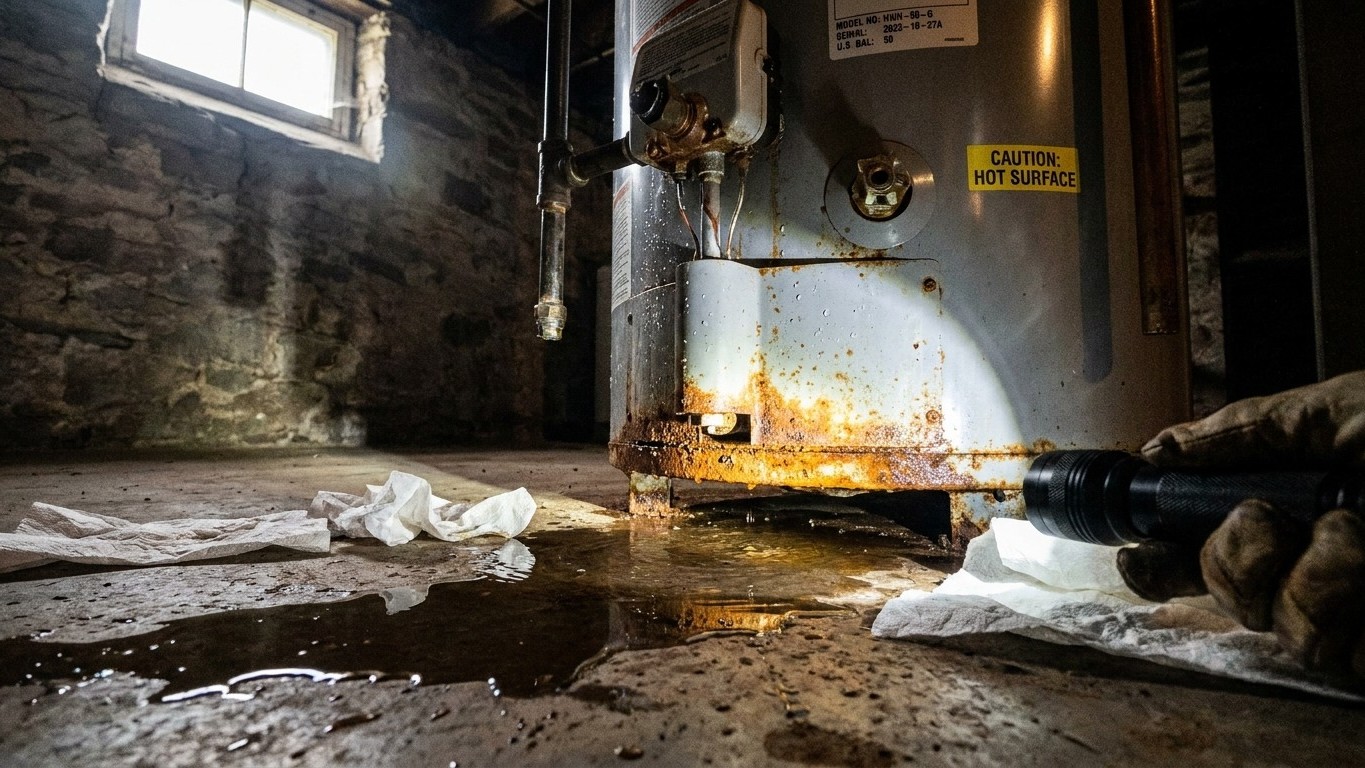

A water heater leak can mean anything from a loose fitting you can fix with a wrench to a dying tank that needs full replacement. The location of the water tells you which one you’re dealing with. A drip from a valve or connection is usually manageable. Water pooling under the tank itself, coming from the bottom, is a different story: that’s corrosion, and it doesn’t get better on its own.
Where it leaks decides everything

Before calling a plumber, spend five minutes tracing the water back to its source. Grab a flashlight, some paper towels, and get down at floor level. The location changes the entire diagnosis, so don’t skip this step.
Start at the top
Wipe every connection dry first: the cold water inlet, the hot water outlet, and the discharge pipe coming off the Temperature and pressure relief valve. Wait a few minutes, then look again. If water reappears at a threaded fitting, that’s often just a loose connection or a worn washer, something a plumber (or a confident DIYer) can fix in under an hour. If the water is dripping steadily from the end of the discharge pipe near the floor, that’s the T&P valve doing something, and that’s a separate issue covered below.
Check the drain valve near the base too, the small spigot used for flushing sediment. These plastic valves crack or fail to seat properly over time, and a slow weep there is common and usually cheap to replace.
Water under the tank itself
This is the one that matters most. If the water is coming from underneath the tank, not from a pipe or valve but from the actual steel shell, the tank has corroded through. Storage water heaters are lined, but that lining eventually fails, usually where the tank was welded or where sediment sat for years. Once the steel itself is breached, there’s no patch, no sealant, no repair that holds. Water heater tanks are not built to be repaired this way. The unit needs replacement.
One thing that fools people: condensation. In cold weather, a gas water heater can sweat on the outside of the tank, especially right after the burner runs, and that moisture drips down and looks exactly like a leak. Feel the tank itself. If it’s damp all over rather than wet at one specific point, condensation is the more likely explanation, especially in an unheated basement or garage during winter.
The T&P valve is not the fault
The temperature and pressure relief valve sits near the top of the tank, and its entire job is to open and release water if pressure or temperature inside the tank climbs too high. When it discharges, that valve is not broken. It’s working exactly as designed, releasing pressure before something worse happens, like the tank rupturing.
This matters because the instinct for a lot of homeowners is to plug the valve or the discharge pipe to stop the drip. Don’t ever cap or plug a T&P valve. That valve exists specifically to prevent a buildup of pressure that a tank isn’t built to contain. Blocking it removes the one safety mechanism standing between a normal tank and a genuinely dangerous failure.
So what’s actually causing it to open
A discharging T&P valve means something upstream is pushing the tank past its safe operating range. Thermal expansion is the most common culprit: as water heats, it expands, and in a closed plumbing system (one with a check valve or pressure-reducing valve on the supply line) that expanding water has nowhere to go except back into the tank, raising pressure until the valve releases it. The fix there is usually an expansion tank, a small add-on that gives that extra volume somewhere to sit.
A thermostat set too high is another common cause, and it connects directly to how the Water Heater Is supposed to be run. The Department of Energy recommends setting a water heater’s thermostat to 120°F, a level it describes as comfortable for most household needs. That number is a compromise, not an arbitrary suggestion. Lower settings save energy and reduce the risk of scalding, particularly for households with young kids or older adults. Higher settings do the opposite on both counts, and they push the tank closer to the range where the T&P valve starts working overtime.
There’s a real tension worth naming honestly here. Water heating accounts for roughly 14% to 25% of the energy consumed in a typical home, according to the Department of Energy, so dialing the temperature down is a genuine way to cut a utility bill. But stored water held too cool is a recognized concern for bacterial growth, including legionella. Households with infants, elderly residents, or anyone with a compromised immune system should talk to their doctor or their local water utility before running a tank cooler than usual. It’s not a settled question with one right answer for every home; it’s a trade-off each household should weigh with actual guidance, not guesswork.
Worth knowing if you’re shopping for a replacement anyway: amended federal efficiency standards have pushed common electric storage water heaters, the kind found in most single-family homes, up to the efficiency level of an entry-level heat pump water heater. That’s a meaningful jump for anyone whose current unit is aging out and due for replacement regardless of whether it’s leaking now.
What to do immediately
Once you’ve found a leak, and especially once you’ve confirmed it’s coming from the tank body rather than a fitting, act fast. Corrosion is not something that pauses or reverses. A pinhole leak today is a bigger hole next week, and tank failures rarely announce themselves with a polite trickle before they get worse.
The shutoff sequence
First, cut the water supply. There’s a shutoff valve on the cold water inlet line, usually right at the top of the tank; turn it clockwise until it stops. This keeps more water from feeding into an already compromised tank.
Next, cut power or fuel to the unit. For an electric water heater, switch off the dedicated breaker at the electrical panel; don’t just flip a switch on the unit itself. For a gas or propane water heater, turn the gas control valve to “off” or “pilot,” and if you smell gas at any point, leave the shutoff to the gas line itself and get out of the house before calling your gas utility.
Gas and propane water heaters burn fuel, which means the same carbon monoxide precautions that apply to any combustion appliance apply here in full. Carbon monoxide has no color and no smell, so a working CO alarm near the unit isn’t optional. Electric and heat pump water heaters don’t burn anything, so this particular risk doesn’t apply to them, but the electrical shutoff still matters to stop the unit from cycling against a tank that’s failing.
Contain the water
With the supply and power or gas off, deal with what’s already on the floor. Towels, a wet vac, and a bucket under any active drip buy time. If the unit sits on a finished floor or near drywall, moving it onto a pan or tarp, or moving nearby stored items away from the water, prevents a plumbing problem from turning into a flooring or mold problem. None of this fixes the underlying tank, but it limits the damage while you arrange for a replacement or a repair visit.
Common questions
Can a leaking water heater cause a fire?
Not directly from the water itself, but a gas water heater with water pooling near its base creates a genuine hazard if that water reaches electrical connections or if the leak is paired with a gas smell. Cutting power and gas immediately removes that risk while you sort out the source.
Is it safe to keep using a water heater that’s leaking a little?
It depends entirely on where the leak is. A slow drip from a fitting or drain valve can often wait a day or two for a repair. A leak from the tank body itself should not be ignored, since the corrosion causing it only worsens over time and the tank can fail without much additional warning.
Why is water coming out of the overflow pipe on the side of my water heater?
That pipe runs from the temperature and pressure relief valve, and water there means the valve is releasing pressure or overheated water from inside the tank. The valve itself isn’t the problem; something is pushing the tank’s pressure or temperature past its normal range, and that cause needs to be identified rather than the discharge pipe being blocked.
Should I turn off my water heater if I’m not sure where the leak is coming from?
Yes. Shutting off the water supply and the power or gas costs nothing and buys time to trace the source without the tank continuing to fill, heat, or pressurize. Once the unit is off, it’s much easier to dry everything down and watch for where water actually reappears.