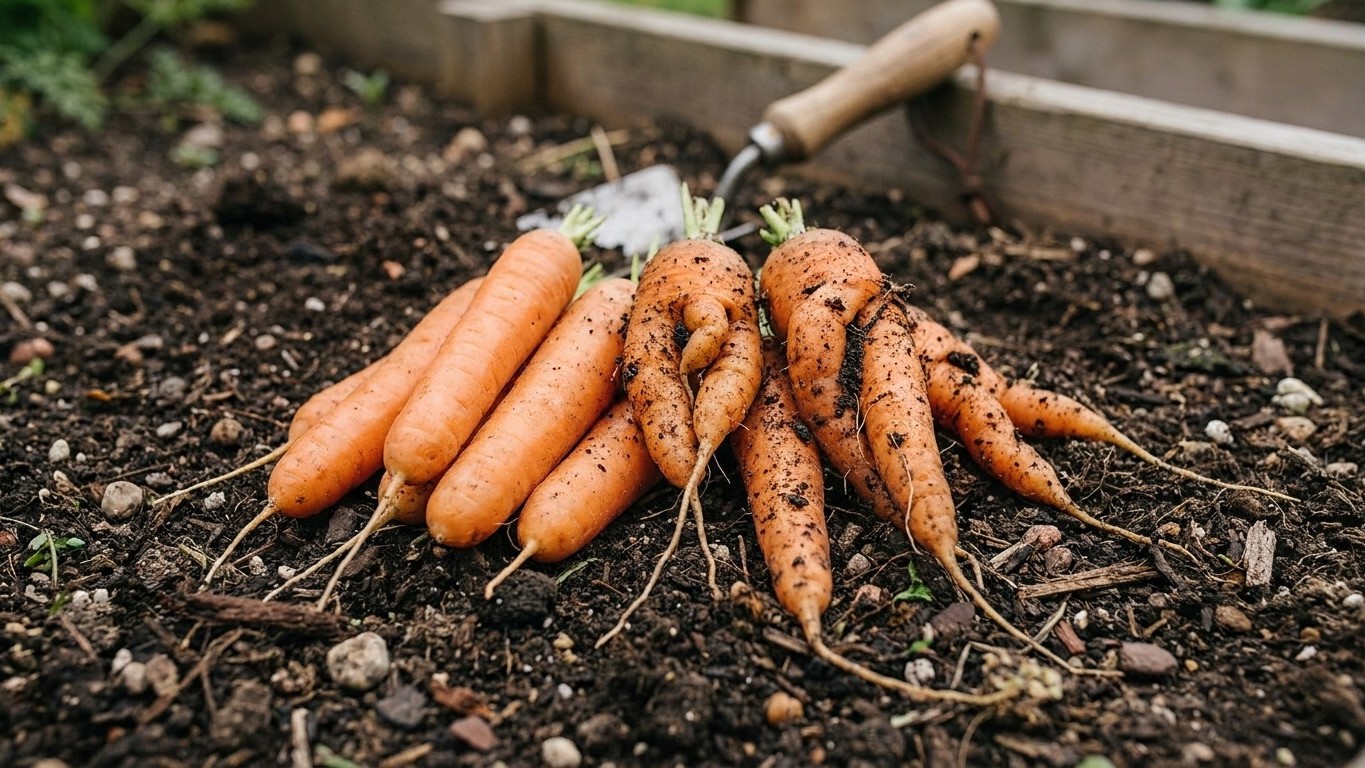

Florida carrots tell you they’re ready with their shoulders, not a calendar. Once the top of the root pushes up out of the soil to somewhere around three-quarters of an inch across and shows solid, even orange color, pull one and check it. That usually lines up with somewhere between 65 and 100 days counted from the day the seed went into the ground, since carrots are never transplanted, only sown in place.
When carrots are ready in Florida
The clearest signal sits right at soil level. Brush back a little dirt at the base of the healthiest-looking tops and look at the shoulder, the top inch of the root. Once it’s grown to roughly three-quarters of an inch to an inch across and turned a solid, even orange with no green cast showing, the root underneath has finished sizing up. Pull one test carrot from each end of the row and slice it open: a core that reads pale and woody rather than blended smoothly into the surrounding flesh means the bed’s been left a little long, while thin, washed-out color means it needs another week.
Because carrots go straight into the bed rather than starting somewhere else and getting transplanted, every day-count starts from the seeding date, never from a transplant date. Utah State University Extension puts the full stretch at 70 to 100 days from seeding to harvest, and Clemson Cooperative Extension narrows a typical crop to 65 to 75 days after planting. The gap between those two figures comes down mostly to variety and mostly to weather: a mild, even fall run pushes roots toward the shorter end of the range, while a season that swings warm and dry between planting and harvest stretches it out.
A specific frost-date figure for this state isn’t part of the numbers behind this article, so treat that day-count as the working guide rather than a mark on the calendar. What matters more here is what’s happening under the row. The Myakka series, Florida’s official state soil, runs about 97 percent sand with a strongly acid surface and poor drainage in low spots, according to USDA soil survey data. That describes the ground mapped across the state, not a reading from any one yard, and a garden near a river bottom, in hill country, or sitting on ground a builder has filled can behave nothing like it. Pulling a soil test on the actual bed remains the only way to know what’s really underneath the row before the next seeding.
Keeping them, and for how long
Cut the tops off before anything else happens. Clemson Cooperative Extension is specific about why: a carrot’s leaves keep pulling moisture and sugar out of the root as long as they’re attached, which is exactly why a bunched carrot, one still wearing its greens, has such a short clock. Clemson lists that window at about 10 to 14 days before the root turns limp.
Trim that green top down close to the shoulder and the outlook changes. Clemson’s figure for the trimmed root is to store it at 33 °F and high humidity, and that combination buys noticeably more time than a bunched carrot manages, though the sheet doesn’t put a specific week or month count on that longer window, so don’t read any number past the stated 10 to 14 days as a promise. Whatever stretch a stored carrot reaches, it’s a ceiling hit only when the temperature and humidity actually hold steady, not a guarantee that arrives no matter how the roots were handled beforehand.
That 33°F figure sits just above freezing, not at a cool-room reading. A carrot held at 50°F instead loses crispness and starts sprouting or going soft in a fraction of the time the colder number buys, since the chemical activity inside a stored root roughly doubles for every 18°F it warms up. High humidity carries just as much weight as the cold does: dry air moving across an exposed root pulls moisture out the same way bare leaves do, so cold and damp have to happen together, not one substituting for the other.
None of this holds if the handling slips beforehand. A root nicked at harvest, left sitting on a warm porch for an afternoon before it goes into storage, or packed touching produce that’s already starting to spoil falls well short of any of these windows, regardless of what the thermometer says once it’s finally put away. Skipping a wash before long storage and simply brushing loose soil off the roots also helps, since a wet skin going into cold storage invites rot faster than a dry one does.
Where in the house that actually is
A standard kitchen refrigerator is the only spot in most Florida homes that gets close to Clemson’s 33°F figure, and even then it takes a little work. Home fridges typically run somewhere in the mid-30s to low 40s depending on where the shelf sits and how full it is, so the number on the display isn’t necessarily the number the carrots actually feel.
The crisper drawer set to high humidity is the closest match available in an ordinary kitchen, since it holds moisture in rather than letting the fridge’s main circulating air dry the roots out the way an open shelf will. Wrapping trimmed carrots loosely in a damp paper towel or setting them in a perforated bag before they go into that drawer adds back some of the humidity a bare shelf tends to strip away. Keep the drawer away from apples or ripening tomatoes, too, since the ethylene gas those give off speeds up the softening and sprouting the cold-and-damp storage is meant to slow down.
A garage, a shed, or an unheated Florida room isn’t a real substitute here, unlike in a colder state where a root cellar or an unheated closed porch can sit near freezing for months at a stretch. Florida’s mild winters rarely hold an outbuilding anywhere close to 33°F for long, and the long warm season pushes those same spaces into the 70s and 80s, well past the range Clemson’s figures describe. The cheap fix worth doing before the first harvest lands is to check the actual fridge temperature with a separate thermometer rather than trust the dial, since a display reading 40°F can be running several degrees warmer in the back of the drawer, and that gap alone is enough to cut a stored carrot’s good weeks down to a handful of days.
What goes wrong here
Sandy ground that drains fast also suits root-knot nematodes, one of the pests UF/IFAS Extension documents for this state, and they attack the root directly, leaving small knotted galls that show up as bumps and forking on an otherwise healthy-looking carrot. Rotating the bed away from carrots and other root crops for a season, along with working in organic matter, is the standard response. Above ground, aphids and whiteflies, also on UF/IFAS Extension’s list, build up fast during Florida’s warm, humid stretches and are worth checking for early with a strong water spray or insecticidal soap before numbers climb out of hand.
Forking is the second common failure, and it’s a soil problem rather than a seed problem. Utah State University Extension is clear that carrots want deep, sandy, well-drained ground rich in organic matter, and that heavy or rocky soil makes the root fork instead of running straight down. Florida’s state soil complicates that only a little: the Myakka series runs about 97 percent sand, so a straightforward clay-driven fork is less of a statewide risk than in a heavier claypan region, but that same series is mapped as poorly drained, and any bed sitting on a compacted or clay-heavy pocket, common enough near newer construction, can produce the same problem. Utah State’s answer is to work in plenty of compost and double-dig the bed, not to switch varieties.
The third failure shows up after harvest, not before it. A row sown all at once tends to cross that 65-to-75-day mark together, and Florida’s climate doesn’t offer the extended outdoor root-cellar season that lets a colder state stretch a single harvest across months. A gardener who lets every root in a full row finish at the same time can end up with a refrigerator that a household plainly can’t work through before the batch starts softening. Staggering the sowing dates by two or three weeks, so shoulders reach harvest size in smaller waves, spreads that same total harvest across a stretch a kitchen can actually manage.
Common questions
Can carrots stay in the ground through a Florida frost?
A specific frost-date figure for this state isn’t part of the numbers behind this article, so there’s no calendar answer to give here. What holds up better is the day-count and the shoulder-and-color check described above: judge readiness by the root itself rather than by waiting for a particular date on the wall calendar.
What’s the real difference between bunched and trimmed storage?
Clemson Cooperative Extension lists bunched carrots (tops still on) at about 10 to 14 days before they turn limp, because the leaves keep drawing moisture out of the root. Trimmed roots stored at 33°F and high humidity last noticeably longer, though the sheet doesn’t attach an exact week or month figure to that longer stretch, so treat it as a ceiling under good conditions rather than a set number.
Why does a carrot fork instead of growing straight down?
Utah State University Extension points to heavy or rocky soil as the usual cause. The fix is working in compost and double-digging the bed, not choosing a different variety, and it’s worth checking whether the specific spot in the row sits on a compacted or clay-heavy pocket rather than assuming the whole bed is at fault.
Which pests actually turn up on Florida carrots?
UF/IFAS Extension documents root-knot nematodes, aphids, and whiteflies as pests relevant to garden crops in this state, and all three show up on carrots specifically: nematodes attacking the root itself, aphids and whiteflies building up on the foliage during warm, humid stretches.