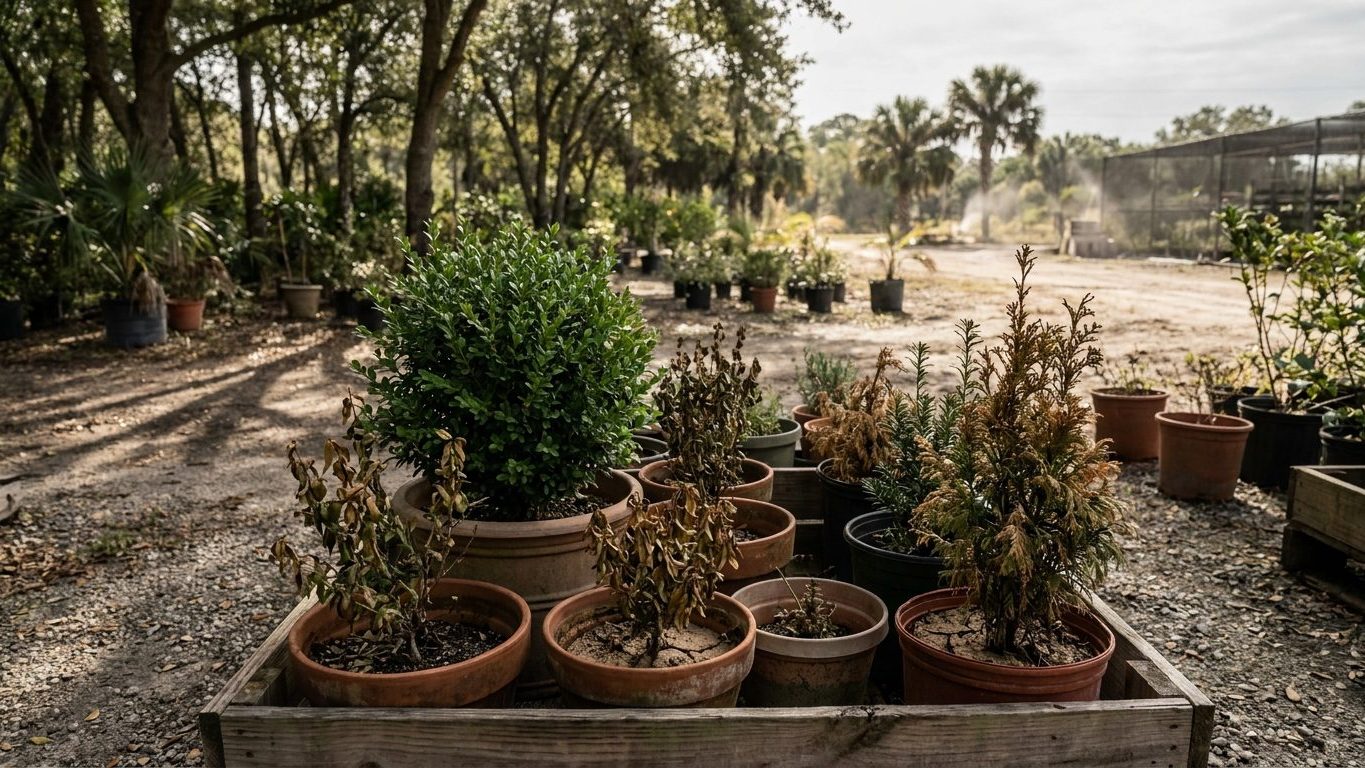

Four of the twelve hedge species tracked across this site’s regional guides won’t survive anywhere in Florida. Eight hold, but only in part of the state, and two of those eight can never be cut back hard once they get away from you. None of the twelve covers the state’s full range. Which matters more, cold or heat, flips depending on where you’re standing on the map.
What actually holds in Florida
Start with the plants that fail outright, because that’s the mistake that costs the most money. Ligustrum vulgare (European privet), Taxus x media (yew), Thuja occidentalis (American arborvitae), and Tsuga canadensis (Canadian hemlock) don’t survive in any part of Florida. These are the shrubs stacked by the pallet at national garden centers, sold as the default hedge for any yard in the country. Florida isn’t any yard. None of these four tolerate the state’s climate at either end of its range.
That range is unusually wide. The USDA Plant Hardiness Zone Map, last updated in 2023, ranks a location on a single measurement: the average annual extreme minimum temperature. Florida spans zones 8b through 11b, a gap that runs from Panhandle freezes to a Keys winter that barely dips below room temperature. Cross that spread against the twelve species this site tracks and the count is blunt: zero hold statewide. Eight hold in part of the state. Four hold nowhere.
Even the eight survivors don’t split neatly by cold tolerance. Boxwood (Buxus sempervirens) is only listed as hardy in zone 8b, a single slice at the northern edge of the state’s range. Push it into 9a and cold isn’t what kills it; the plant just can’t take the extended heat and humidity that keep its soil wet through a Florida summer. That’s the pattern worth remembering: the upper number on a hardiness range is often a heat ceiling, not a cold floor, and Florida is one of the few states where that ceiling matters more than the freeze.
| Common name | Holds in zones | Height as a hedge | Growth rate | Regrows from old wood |
|---|---|---|---|---|
| Boxwood | 8b | 2 to 6 feet | 3 to 6 inches/year | Yes |
| American hornbeam | 8b, 9a, 9b | 6 to 15 feet | 12 inches/year | Yes |
| Leyland cypress | 8b, 9a, 9b, 10a, 10b | 15 to 25 feet | 3 to 4 feet/year | No |
| Holly (Ilex glabra) | 8b, 9a, 9b | 5 to 15 feet | 6 to 12 inches/year | Yes |
| Holly (Ilex verticillata) | 8b, 9a, 9b | 5 to 15 feet | 6 to 12 inches/year | Yes |
| Eastern red cedar | 8b, 9a, 9b | 8 to 20 feet | 12 to 24 inches/year | No |
| Cherry laurel | 8b | 6 to 15 feet | 1 to 2 feet/year | Yes |
| Arrowwood viburnum | 8b | 6 to 10 feet | 1 to 2 feet/year | Yes |
Note the gap at the bottom of that table: not one species holds in zone 11a or 11b. That’s Miami-Dade and the Keys, and it means the whole shortlist above belongs to north and central Florida. Gardeners south of roughly Lake Okeechobee are working outside every range in this list.
The hedges you can never cut back down
Two entries in that table carry a flag worth reading before you plant, not after: Leyland cypress and Eastern red cedar don’t regrow from old wood. Cut either one back into the brown, leafless interior and that spot stays bare for good. There’s no dormant bud waiting under the bark to push new growth, the way there is on a boxwood or a holly. Once you’ve cut past the green, that branch is done.
That single fact should shape how you plant them, not just how you prune them. Leyland cypress grows 3 to 4 feet a year and can reach a 15 to 25 foot screen, which means a young hedge can outgrow its footprint within a couple of seasons if it’s planted too close to a fence or a walkway. The prune window is late spring to midsummer, and it needs to happen while the plant is still small enough that a light shearing keeps everything inside the green. Wait until the hedge has swallowed its space and the only fix left is a cut that leaves a permanent brown gap.
Eastern red cedar carries the same restriction with an even tighter margin. Its own prune guidance says “light cuts only,” done in late winter. That’s not a stylistic preference; it’s the only kind of cut this tree tolerates without leaving dead wood exposed for years. Left unpruned for a few seasons and then hit hard, a red cedar hedge doesn’t bounce back the way a broadleaf shrub would. It just shows the cut.
Compare that to the other six species in the table. Boxwood, American hornbeam, both hollies, cherry laurel, and arrowwood viburnum all regrow from old wood. That means a hedge of any of these six can be neglected for a couple of years and then renovated hard, cut back near the base, and it will fill back in. It’s the difference between a hedge that forgives a missed season and one that punishes it permanently. If you know pruning isn’t going to happen on schedule every year, that’s the more useful thing to check before buying than height or growth rate.
Matching the plant to the job
Once the range and the pruning risk are sorted, the choice usually comes down to what the hedge is actually for. A fast privacy screen and a clipped formal edge aren’t the same project, and the eight species that hold in part of Florida split fairly cleanly between them.
For height and speed, Leyland cypress is the outlier of the group: 3 to 4 feet of growth a year, up to 25 feet at maturity, and it holds across zones 8b through 10b, the broadest range of anything on this list. That range advantage comes with the old-wood restriction covered above, so it rewards planning the mature width from day one rather than correcting it later.
For a small, tightly clipped edge, boxwood is the classic answer everywhere else in the country, but here it’s the narrowest option available: hardy only in 8b, growing just 3 to 6 inches a year to a 2 to 6 foot hedge. That’s a north Florida plant and nothing further south.
American hornbeam sits between those two: a foot of growth a year, up to 15 feet, holding across 8b, 9a, and 9b, which covers most of north and central Florida rather than a single sliver of it. The two hollies do similar work at a slightly slower pace, 6 to 12 inches a year to as much as 15 feet, with the advantage that both regrow from old wood if a hard reset is ever needed. Cherry laurel and arrowwood viburnum round out the list, both confined to zone 8b, both useful where a flowering or berrying hedge matters more than raw speed.
What none of them solve is south Florida. Miami-Dade, Broward, and the Keys sit in zones 10b through 11b, and not one of the eight species above is listed as hardy that far south. A hedge project in that part of the state is working from a different plant list entirely.
The ground you are planting into
Florida’s official state soil, the Myakka series, tells you something about how hedge roots behave here even though it won’t match every yard. Its surface horizon runs 97 percent sand, 2 percent clay, and 1 percent silt, with a pH around 5.1, strongly acid, and organic matter around 2.0 percent. It’s also classified as poorly drained, which sounds like a contradiction for a soil that’s almost pure sand. The explanation is a hardpan layer beneath the surface that perches water instead of letting it pass through, so roots can sit in standing moisture during Florida’s wet season even in ground that looks bone-dry on top.
That’s a description of a representative soil mapped across the state, not a measurement of any one garden bed. A yard on fill dirt, a river bottom, or hill country soil in the Panhandle can look nothing like it. The only way to know what a specific planting site is actually doing is a soil test through the local UF/IFAS Extension office at sfyl.ifas.ufl.edu, which can also flag whether a hardpan layer needs breaking up before a hedge goes in.
Timing runs on a separate track from soil, and it splits the state just as sharply. At the Jacksonville station used for this region’s climate normals, the last spring frost falls between February 16 and March 7, and the first fall frost lands between November 26 and December 13, based on NOAA’s 1991-2020 climate normals. Even there the record isn’t fully consistent: three of the thirty falls in that dataset saw no freeze at all. That window applies to north Florida, inland sites near Jacksonville specifically, and nowhere further south. Central and south Florida run effectively frost-free, which flips the whole planting calendar: the growing season runs through the cool months, and summer heat and heavy rain become the harder stretch for a young hedge rather than any frost date.
Common questions
Can I grow a boxwood hedge in South Florida?
No. Boxwood is only listed as hardy in zone 8b, and south Florida runs 10b to 11b. It isn’t cold that ends a boxwood hedge that far south; it’s the extended heat and humidity.
What’s the fastest-growing hedge that still holds up in Florida?
Leyland cypress, at 3 to 4 feet a year, growing to 15 to 25 feet, and hardy across zones 8b through 10b, the widest range of any species covered here. It can’t be cut back into old wood, so its mature width needs planning from the start.
My soil test doesn’t match the numbers for Florida’s state soil. Why not?
Because the Myakka series figures describe a representative soil mapped across the state, not any single yard. Fill dirt, river-bottom ground, and Panhandle hill soil can all differ completely. A local soil test through UF/IFAS Extension gives the actual number for a given site.
When should I prune my hedge in Florida?
It depends on the species and the region. Each plant in this guide has its own prune window tied to its growth habit. The frost dates cited here (late February to early March for last frost, late November to mid-December for first frost) apply to the Jacksonville area only; central and south Florida are essentially frost-free and run on an inverted calendar.