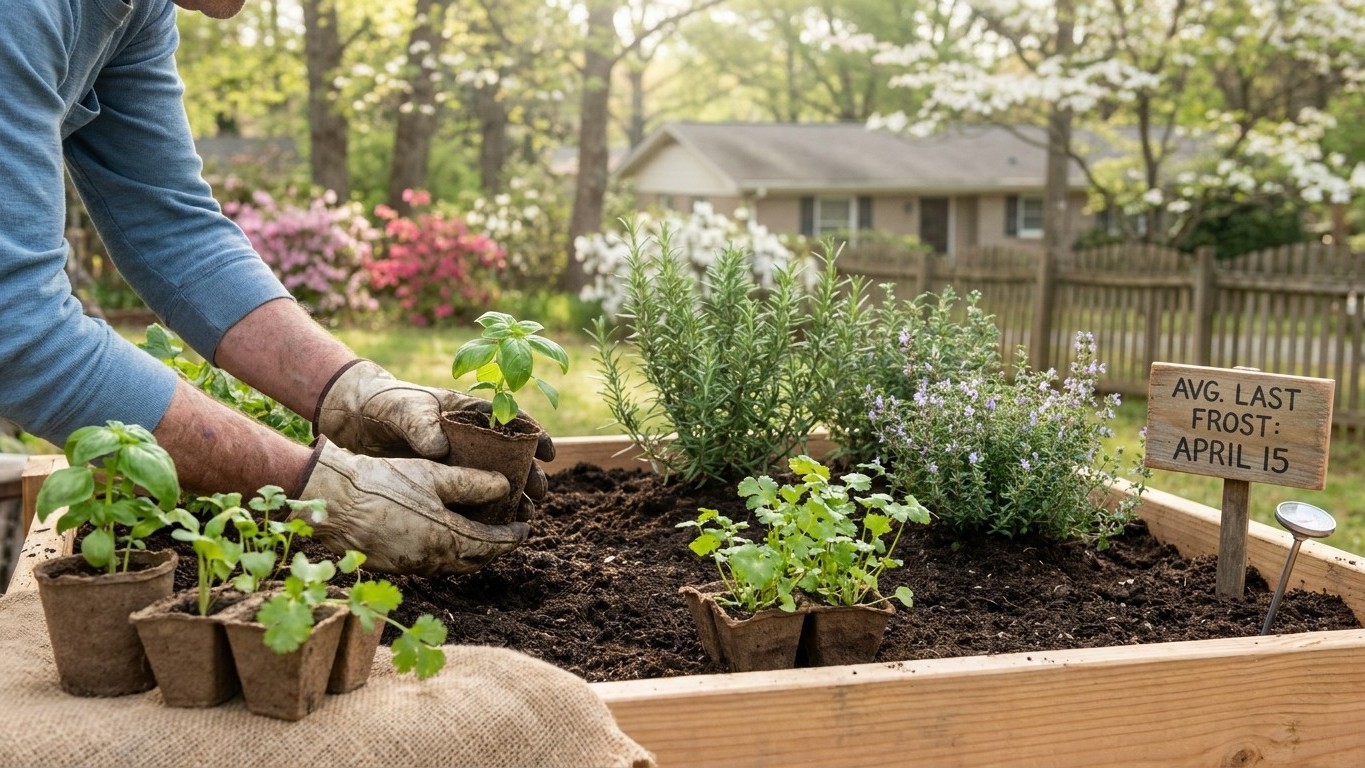

Herbs go in the ground in north Florida between February 16 and March 7, once the last spring frost clears, and the season runs until frost returns between November 26 and December 13. That’s the Jacksonville answer. Farther south, in Orlando or Miami, there’s effectively no frost to wait out, and the whole calendar works differently.
The short answer for Florida
Those dates, February 16 to March 7 for the last spring frost and November 26 to December 13 for the first fall frost, come from NOAA’s 1991-2020 climate normals at station USW00013889, the Jacksonville reference site. They mark what’s called the 30-70% probability band for a 32°F freeze, not a guaranteed date. In plain terms: by the early end of that spring window there’s still a real chance of frost, and by the late end the odds have dropped low but haven’t hit zero. Three of the last thirty falls at that station saw no freeze at all, which tells you how much this number wobbles year to year even at one spot.
For cold-tolerant herbs like parsley, cilantro, dill, and chives, that window is a soft edge. They shrug off a light frost, so gardeners around Jacksonville often start them a few weeks before the early end of the spring band and let them ride out any late chill. Tender herbs, basil above all, need the frost risk fully gone. The coldest month at the Jacksonville reference station averages a daily minimum of 42.9°F, and basil starts sulking well before that. Wait until you’re past the late end of the spring window, not the early one, if basil is the plan.
Here’s the catch: those frost dates belong to north Florida. Central and south Florida don’t have a comparable frost dataset because they’re effectively frost-free, and the whole logic of a spring-to-fall growing season stops applying once you cross into that territory. There, the main herb season runs through the cooler months, and summer heat becomes the thing you’re planning around instead of frost. This page has the Jacksonville numbers because that’s what the state-level data actually supports. It doesn’t have an equivalent set for Orlando or Miami, and it shouldn’t pretend to.
What will not work here
Planting basil, or any tropical herb, right at the early edge of that spring frost window is the most common misstep. The coldest month’s average low of 42.9°F at the Jacksonville reference station is close enough to basil’s chill threshold that a normal winter, not even an unusual one, can stunt or blacken young plants set out too early. Waiting until the frost probability has clearly dropped, toward the later end of the February 16 to March 7 range, costs you a couple of weeks but saves the whole tray.
On the other end of the season, cilantro and parsley planted too close to the November 26 to December 13 fall frost window often don’t have enough warm days left to bulk up before growth stalls. They’ll survive the cold fine. What they won’t do is produce much, since the plant needs a run of mild weeks to establish roots before the freeze risk climbs back into that 30-70% band.
Humidity, not drought, is the real threat
North Florida summers pair heat with heavy humidity, and that combination punishes anything planted the way a drier climate would recommend. Basil, mint, and oregano set at tight spacing to save bed space often develop fungal issues by midsummer because the air between plants never fully dries out. Wider spacing than a seed packet suggests, plus morning watering instead of evening, does more for disease control here than any spray.
Mediterranean herbs like rosemary and thyme run into the opposite problem. They’re bred for lean, fast-draining soil and infrequent water, and a rigid once-a-week watering schedule, the kind that works fine for basil, tends to leave their roots sitting wet through a humid Jacksonville August. Root rot, not cold, is usually what kills rosemary here, and it shows up in summer, not winter.
What changes across Florida
Florida’s USDA hardiness zone range runs from 8b up to 11b, according to the 2023 USDA Plant Hardiness Zone Map built on 1991-2020 normals. That’s not a narrow band. It’s one of the widest zone spreads of any state in the country, built on the average annual extreme minimum temperature, and it means a planting calendar written for one part of Florida can be close to useless in another.
Jacksonville, the reference point for the frost dates on this page, sits at the cooler end of that range, in zone 8b to 9a territory where a real winter, however mild by national standards, still shows up most years. Move south toward Orlando and you’re into 9b to 10a, where hard freezes are rare enough that many gardeners plant tender herbs through the winter instead of protecting them from it. Push further south to Miami or the Keys, into 10b through 11b, and frost becomes a non-event most years. The growing calendar doesn’t just shift there, it flips: cool-season and Mediterranean herbs do their best growing from fall through spring, and the punishing months are July and August, when heat and rain, not cold, cause the failures.
Because that spread runs the length of the state, this page can’t tell an individual reader which zone applies to their yard. The USDA hardiness zone map is the tool for that, and it’s worth five minutes to look up a specific address rather than assume from a city name on a map. A gardener an hour inland from Jacksonville can sit in a noticeably different zone than the coastal reference station, and that difference is exactly what decides whether the frost dates above are useful or beside the point.
Where to check this for your own county
The state-level numbers here come from a single Jacksonville weather station, and Florida has 67 counties spread across roughly five hardiness zones. That gap is exactly why UF/IFAS Extension exists at the county level, and it’s the next stop for anyone who wants a calendar built for their own backyard rather than for a station near the Georgia line.
Start at the University of Florida’s Extension portal and find the office for your own county. What you’re looking for there is twofold: a local planting calendar that reflects your county’s actual frost pattern, or lack of one, and a list of herb varieties that county agents have specifically trialed in local soil and humidity conditions. A basil variety that resists downy mildew in a humid Panhandle county, for instance, may not even be the same recommendation an inland central Florida office makes for a drier microclimate.
A county recommendation will beat this page every time, and that’s by design, not a flaw in what’s written here. This is the state-level view, built on one reference station and the broad hardiness zone range that covers everywhere from Jacksonville to Key West. It’s a starting point for understanding the mechanism, the freeze probabilities, the zone spread, the north-south inversion, not a substitute for the office that knows your specific county’s soil and microclimate. If the two disagree, trust the county office.
If you follow the almanac, here is when to plant herbs by the moon. It is a tradition, not a proven method.
Checking this against your own garden
Every date on this page is a probability drawn from thirty years of station data. Your own garden, on a given week, can be running ahead of or behind that average, and three simple checks tell you more than any calendar.
Press a bare hand into the soil a couple of inches down, mid-morning, before you plant anything tender. If it still feels cool and damp rather than mildly warm, the ground hasn’t caught up to the air temperature yet, and seeds like basil will sit and rot rather than germinate, even if the frost-date math says you’re clear.
Watch for the first true leaves on anything you’ve direct-sown. The two leaves that pop up first aren’t the plant’s real foliage, they’re stored energy from the seed. The second set, the ones that actually look like the herb you planted, mean the roots have taken hold in your specific bed, with your specific drainage and sun exposure, not the average conditions a weather station fifty miles away recorded.
For herbs that flower, like basil left too long or cilantro heading into summer, an early flush of blooms is useful information rather than a failure. It usually means the plant hit a heat or day-length trigger sooner in your yard than the general calendar predicted, which is a sign your particular spot runs warmer or gets more direct sun than the county average. That’s worth noting for next season’s timing, more than any date printed here.