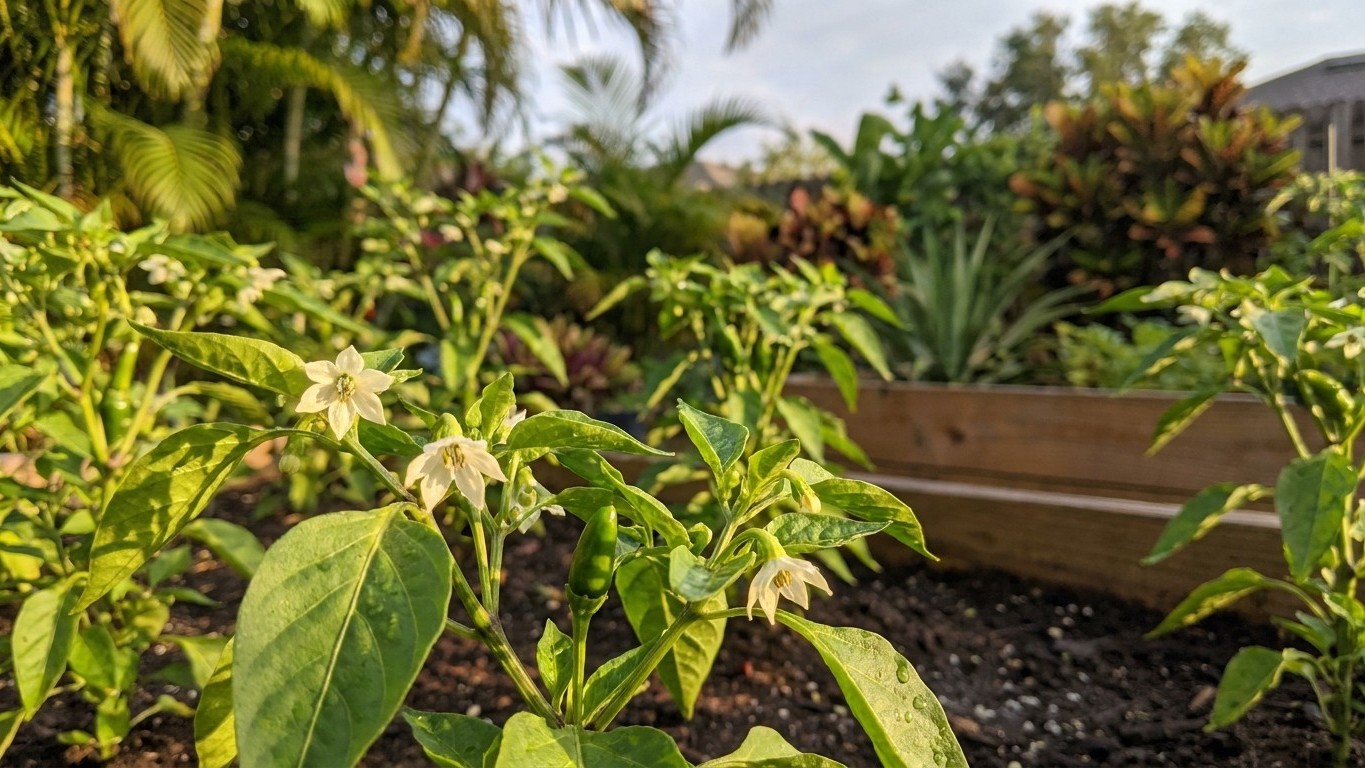

Florida pepper growers face a narrower window than most gardeners assume. Plants stop setting fruit once nights drop below 55°F or days climb past 90°F, and Florida summers push well into that upper limit for weeks running. Getting the transplant timing right, and reading your own local heat and cold, matters more here than surviving a hard freeze. Handle the sequence correctly and pepper plants will keep producing through the shoulder months even where summer shuts fruit set down entirely.
The short answer

The reference station for this state, Jacksonville, logs an average of 73.2 days a year at 90°F or higher, according to NOAA NCEI Climate Normals covering 1991 to 2020. That’s not a handful of scorching afternoons scattered through July. It’s the equivalent of two and a half months when daytime highs can sit at or above the threshold where pepper flowers stop turning into fruit. Utah State University Extension’s guidance on peppers is direct on this point: fruit set fails once days push past 90°F, no matter how healthy the plant looks otherwise. A pepper plant can keep growing, keep flowering even, and still drop every bloom before it becomes a fruit, because pollen itself loses viability in that kind of heat.
Seventy-three days a year at or above 90°F doesn’t mean two and a half straight months of zero production. Real heat runs in spells, some years hotter than others, and a cooler stretch in June or a rainy week in August can bring fruit set back online for a while. But it does mean any schedule built purely around seasonal averages will run into a stall somewhere between late spring and early fall. Growers who leave peppers in full, unbroken sun through that stretch often watch blossoms fall for weeks and blame disease or a feeding problem, when the cause is simply heat.
The other end of the fruit-set window matters just as much, and it gets ignored more often. Nights under 55°F stop pepper flowers from setting fruit in exactly the same way heat does, just from the opposite direction. This is where most gardeners run into a data gap. This site tracks days at or above 90°F for Florida locations, but it does not carry summer overnight lows, which is the figure that actually decides whether a spring or fall pepper crop escapes the cold-set problem, a topic covered in more depth in Why Peppers Fail to Set Fruit in Florida. That gap can’t be filled by guessing from latitude. Overnight lows depend on elevation, cloud cover, distance from the coast and how cold air drains at night, none of which track cleanly with how far south a county sits on a map. A county at one latitude can run several degrees colder after dark than a spot twenty miles away at the same latitude but closer to the coast. Anyone growing peppers here needs to check their own overnight temperatures directly and consult a guide on When to Start Pepper Seed in Florida, and pair that data with Pepper Varieties That Ripen in a Florida Season to match plant choice to the actual window available, through a local weather station or a thermometer on the property, rather than assuming a number based on region.
When to start seed here
Utah State University Extension’s rule for pepper transplants is simple: start seed 8 to 10 weeks before setting plants outside, and don’t transplant until the soil has warmed to 60°F and the last frost has passed. Here’s how that plays out using this state’s own frost data.
- Know which part of Florida you’re in. Frost timing here isn’t uniform across the state. North Florida, including the Jacksonville area, gets real frost events most years. Central and south Florida are effectively frost-free, which changes the whole calendar (more on that below).
- Pin down the last spring frost window for north Florida. For the Jacksonville station, NOAA NCEI’s 1991-2020 climate normals put the 32°F freeze probability window between February 16 and March 7. That’s drawn from the 30 to 70 percent probability band, not a hard cutoff, and three of the thirty years in that record saw no freeze at all. Treat it as a likely range to plan around, not a guaranteed date.
- Count backward 8 to 10 weeks to find a seed-starting window. Eight weeks before February 16 lands around December 22; ten weeks before lands around December 8. Eight weeks before March 7 lands around January 10; ten weeks before lands around December 27. Put together, a north Florida grower aiming for a spring transplant is looking at starting seed indoors sometime between early December and mid-January, depending on which end of the frost window they’re planning around.
- Wait on soil temperature, not just the calendar. Even after the frost risk has passed, hold off transplanting until soil temperature actually reaches 60°F. A warm afternoon air temperature doesn’t mean the soil has caught up, especially early in the window.
- Flip the whole approach for central and south Florida. Where frost essentially doesn’t happen, the growing calendar inverts. Peppers are best grown through the cooler months, fall into winter into spring, while summer becomes the dead zone because of heat rather than cold. The 8-to-10-week backward count from transplant to seed start still applies, but the anchor point isn’t a frost date at all. It’s the point where summer heat starts pushing past the 90°F fruit-set threshold, which a grower has to track locally rather than borrow from a frost calendar built for Jacksonville.
What goes wrong here
- Blossom drop from heat or cold snaps. Flowers form, then fall off without setting fruit, whenever days climb above 90°F or nights drop below 55°F. There’s no fixing this after the fact for a given flush of blooms, but afternoon shade cloth during the hottest stretch of the day can pull temperatures around the plant down enough to save later flushes, and holding off on high-nitrogen feeding during a heat spell keeps the plant from pouring energy into leaf growth instead of fruit.
- Sunscald on exposed fruit. Florida’s sun intensity leaves fruit with pale, leathery, sunken patches wherever foliage has thinned out, whether from disease, wind damage or over-pruning. The fix is keeping a full leaf canopy over developing fruit rather than stripping leaves for airflow, and adding shade cloth over the row during the most intense midday hours in peak summer.
- Blossom-end rot on developing fruit. Dark, sunken patches at the blossom end of the fruit usually trace back to inconsistent watering during hot stretches, not a straightforward calcium deficiency in the soil. Deep, even watering on a set schedule, plus a layer of mulch to keep soil moisture steadier between waterings, does more to prevent it than calcium sprays applied after the fact.
Checking this against your own county
Everything above is built on one reference station, Jacksonville, and a statewide average for days above 90°F. Florida is a long state, and conditions in the Panhandle, the peninsula’s interior and the coasts don’t match each other closely enough to treat one set of numbers as universal. The most reliable next step is checking with the University of Florida IFAS Extension office for your own county, reachable through sfyl.ifas.ufl.edu. County extension agents track local frost history, soil temperature trends and pest pressure specific to their area, and can tell a grower whether their county behaves more like the north Florida frost pattern or the frost-free pattern further south. That local check matters more for peppers than for most vegetables, given how tightly fruit set depends on both ends of the temperature range this article covers.
Common questions
Can peppers survive a light frost in Florida?
Pepper plants are frost-tender and typically don’t survive direct freezing temperatures without protection. The frost data here reflects the 32°F freeze probability window for north Florida; it isn’t a measure of how much cold the plant itself can tolerate.
Why are my pepper plants flowering but not setting fruit in summer?
The most likely cause is heat. Once daytime highs push above 90°F, pollen viability drops and flowers fall without setting fruit, according to Utah State University Extension. This is common enough in Florida summers that it’s worth tracking your own local highs during flowering rather than assuming disease.
Do peppers grow year-round in south Florida?
Frost risk is minimal there, but summer heat replaces it as the limiting factor. The main growing season runs through the cooler months instead, with summer treated as the off-season for fruit set rather than winter.
How do I know my soil has reached 60°F for transplanting?
A soil thermometer pushed a few inches into the bed, checked in the morning before the sun warms the surface, gives the most reliable reading. Air temperature alone isn’t a good substitute, since soil lags behind it by days or weeks depending on how much sun the bed gets.