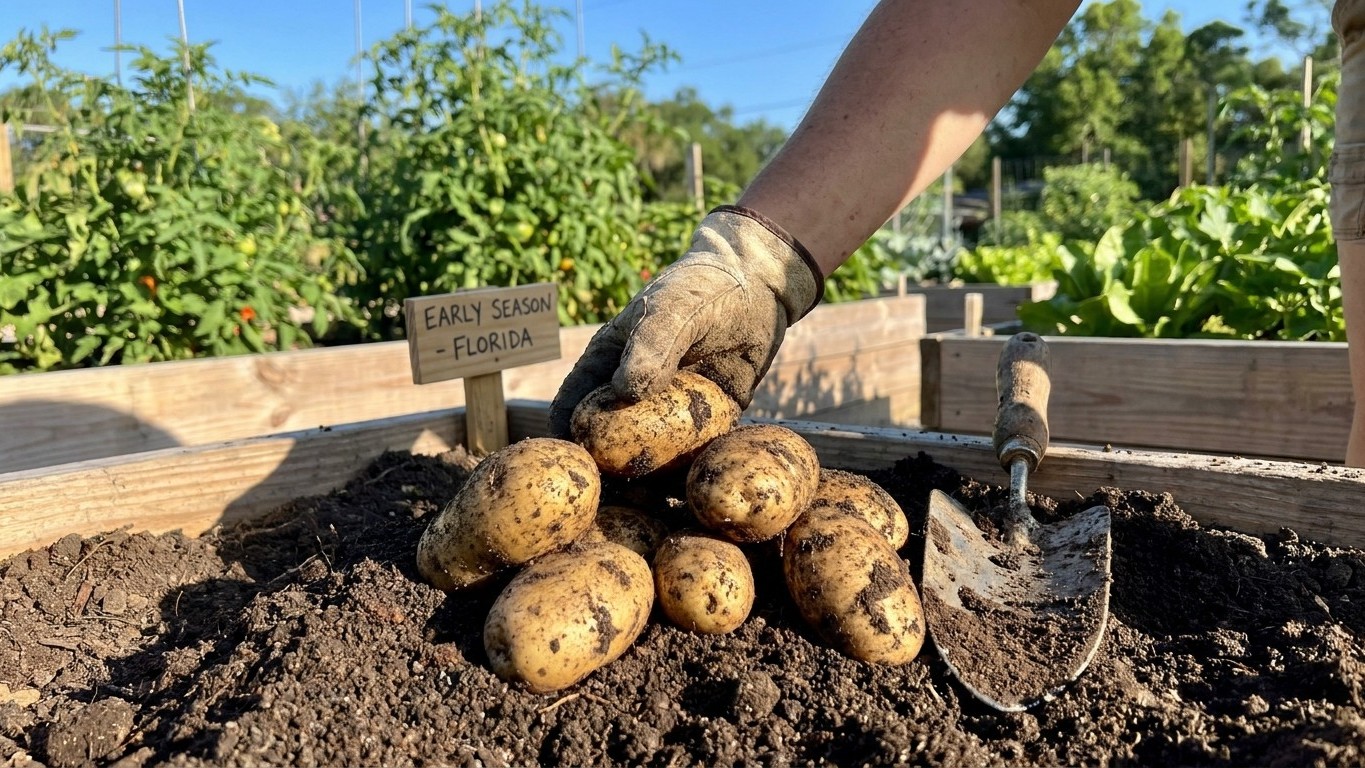

Florida gardeners get the best results from early-season and mid-season potato varieties, planted for a spring harvest rather than a summer one. That’s because Florida soil crosses the temperature where tubers stop sizing well before a full-length season could ever finish. In north Florida, that means racing a frost window that closes by early March. In central and south Florida, there’s no frost to race at all, so the whole calendar flips and winter becomes the main growing season.
The short answer
In Jacksonville, the last spring frost falls somewhere between February 16 and March 7, according to NOAA’s National Centers for Environmental Information, drawing on 1991-2020 Climate Normals recorded at station USW00013889. That’s a real, measured window for one specific place, and it’s the kind of number a north Florida gardener needs before touching a shovel.
What that window means for variety choice is simple once you see the other half of the equation. Utah State University Extension and the University of Maine Cooperative Extension both publish the same governing fact: soils above 90 F inhibit tuber set and fill, and irrigation does not reverse that. Potatoes are planted as soon as soil reaches 50 F, which lands 14 to 21 days before the last frost date, not after it. Put those two facts together and the growing season in north Florida is short by design. It opens in mid-to-late winter and has to finish before soil temperatures climb into the 90s, which in a state this warm doesn’t take long once spring turns to early summer.
That’s why early-season and mid-season varieties are the ones that fit. A late-season variety needs more time in the ground than this window allows, and pushing it past the point where soil crosses 90 F won’t produce bigger tubers, it just stalls them. Neither Utah State nor the University of Maine publishes a days-to-maturity figure for any variety, so the honest way to plan is by season class, not by counting days on a calendar.
The Jacksonville window itself needs a caveat before anyone in Orlando or Miami tries to use it. The station sits at an inland airport, and three of the thirty years in that record saw no freeze at all. Central and south Florida are effectively frost-free, and there the growing calendar inverts entirely: the workable season runs through winter, and summer heat becomes the constraint instead of a spring frost. Applying a north Florida frost date to a south Florida garden would misfire the whole plan.
What actually decides it
The heat ceiling that ends the season
The single mechanism that decides everything on this page is the 90 F soil threshold documented by Utah State University Extension and the University of Maine Cooperative Extension. Above that temperature, tuber set and fill are inhibited, and watering doesn’t fix it. That’s the part gardeners tend to miss, because the plant above ground can look green and healthy while the tubers underground have effectively stopped growing. This is why the planting date matters so much more than most people assume: you’re not choosing a start date, you’re working backward from a heat deadline that soil temperature, not the plant’s appearance, will announce.
The frost window that opens the season
On the other end, planting happens once soil hits 50 F, which the same extension sources place 14 to 21 days before the last frost date. That’s a counterintuitive detail: the safe planting window actually starts before the frost date most people circle on a calendar, not after it. For a reference city like Jacksonville, where NOAA NCEI’s 1991-2020 Climate Normals put the last spring frost between February 16 and March 7, that means the useful planting window can open in late January or early February, well ahead of what a casual glance at “last frost” would suggest.
The regional inversion
Move south, and the frost mechanism drops out almost entirely. Central and south Florida don’t have a meaningful freeze to plan around, so the constraint that matters is the same 90 F heat ceiling, just applied on the other side of the calendar. Instead of racing spring heat, gardeners there are avoiding summer heat altogether by growing through the cooler months. Anyone reasoning about a city this page doesn’t name, say Tampa or Fort Myers, should ask two questions: does this location get a real frost, and when does its soil reliably cross 90 F? Those two answers, not the Jacksonville dates, are what actually decide the local season.
How to do it
- Locate your reference city and pull its own frost and soil-temperature data rather than borrowing Jacksonville’s, since a state-wide figure is never true for the whole state.
- Decide whether you’re in the north Florida pattern (a real spring frost window) or the central/south pattern (frost-free, winter-season growing) before picking a planting date.
- Choose an early-season or mid-season variety class; skip late-season classes, since neither the north Florida spring window nor the central/south winter window gives them enough time before soil crosses 90 F.
- Buy certified seed potatoes. Uncertified seed carries virus forward into the crop, and that single choice does more for a season’s outcome than almost anything else on this list.
- Cut seed pieces if needed and let the cut surfaces cure before planting.
- Check soil temperature directly with a soil thermometer rather than relying on the calendar date; plant once it reads 50 F.
- Time that planting to fall 14 to 21 days before your reference city’s expected last frost, using the local NOAA Climate Normals for that station.
- Hill soil around the stems as plants grow to protect developing tubers.
- Track soil temperature through the season and plan the harvest before it climbs past 90 F, since that threshold, not a fixed number of days, is what ends productive tuber growth.
- Dig, then cure the harvested potatoes before storage.
What goes wrong
- Planting a late-season variety in a short window. Neither the north Florida spring window nor the central/south winter window gives a late-season class enough time before soil crosses 90 F. Stick to early-season or mid-season varieties, the two classes both extension sources actually publish guidance for.
- Using uncertified seed potatoes. Uncertified seed carries virus into the crop, and there’s no fix once it’s in the ground. Buy certified seed every time; it’s the single cheapest insurance in the whole process.
- Applying the Jacksonville frost dates to central or south Florida. That window comes from an inland north Florida station, and three of thirty years there saw no freeze at all. Further south, frost isn’t the limiting factor, summer heat is, so the calendar needs to run through winter instead.
- Planting by calendar date instead of soil temperature. The 50 F soil threshold is the real trigger, and it can arrive earlier or later than the general date range suggests. Use a soil thermometer rather than guessing from the frost window alone.
- Trying to water through heat stress near season’s end. Once soil passes 90 F, irrigation doesn’t restart tuber sizing. The remedy is timing the harvest earlier, not adding more water later.
Common questions
Can you grow potatoes year-round in Florida?
Not in one continuous stretch. North Florida works around a defined spring window bounded by frost on one side and the 90 F soil threshold on the other. Central and south Florida shift the whole effort to the cooler months, since summer heat there does the same job frost’s absence removed.
What’s the difference between a boiling potato and a baking potato?
That distinction is about how a variety performs in the kitchen, not its season class. Extension sources describe what a variety is suited for, boiling or baking, rather than labeling it by texture terms like waxy or floury.
Why does uncertified seed matter for Florida growers?
Uncertified seed potatoes can carry virus into the planting, and once that’s in the soil there’s no correcting it mid-season. Certified seed is the one input worth paying for without shortcuts.
Does the Jacksonville frost date apply to the rest of north Florida?
Not automatically. It’s specific to an inland airport station under NOAA’s 1991-2020 Climate Normals. Other north Florida locations can run earlier or later, and central and south Florida don’t follow this pattern at all since they’re effectively frost-free.