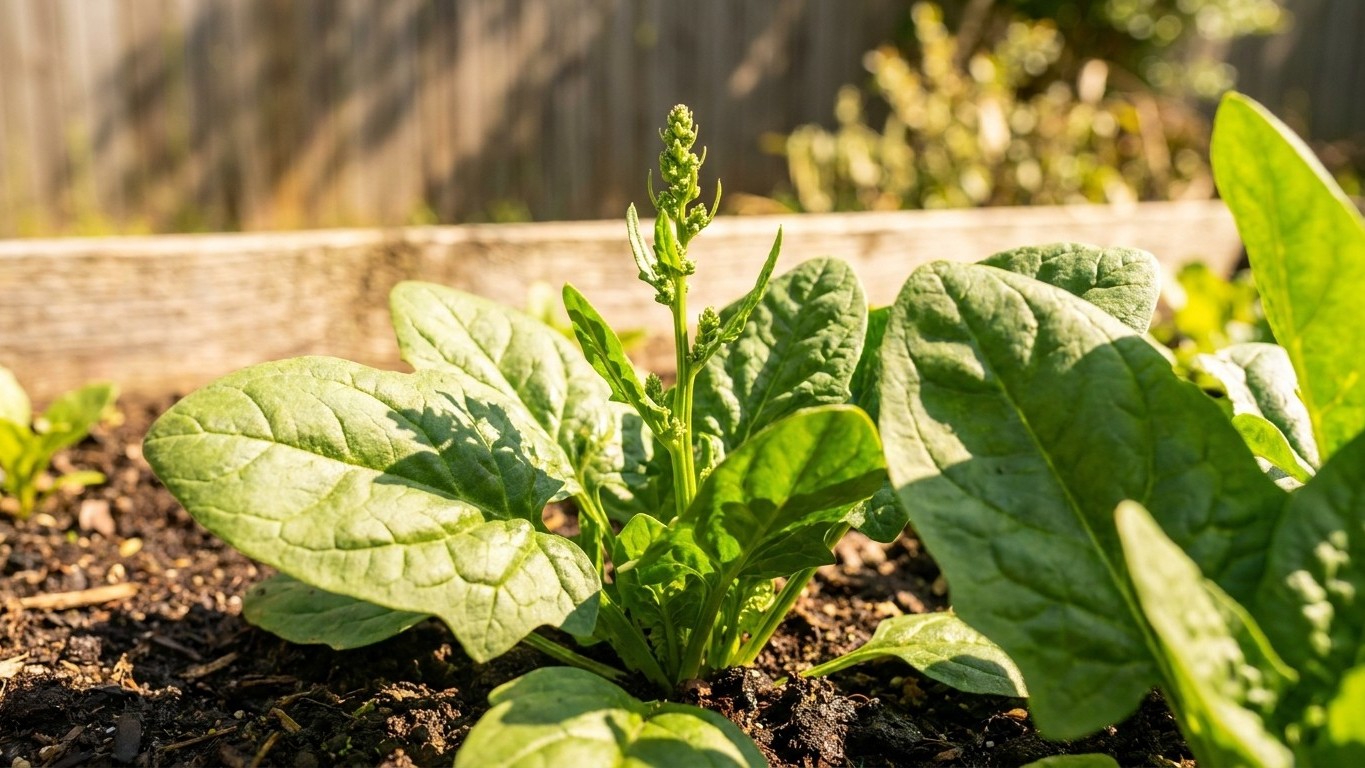

Spinach will bolt early almost everywhere in north Florida, and the reason is a one-two punch: the days get long enough to trigger flowering right around the same weeks the heat arrives. In Jacksonville, the reference city for this region’s climate data, neither problem waits for the other to finish. That leaves a narrow spring window and a fall crop that depends on timing the soil, not the calendar, correctly.
The short answer
On the longest day of the year, Jacksonville gets 13 hours and 58 minutes of daylight. That number matters here for a completely different reason than it does for onions grown three states north. Spinach bolts, meaning it sends up a flower stalk and turns bitter, in response to long days combined with warm temperatures. A day length approaching 14 hours is squarely inside the range that pushes spinach toward flowering, and in north Florida that stretch of long days arrives at the same time the thermometer climbs past the point where spinach even wants to grow.
Spinach performs best where temperatures stay at or below 75 degrees. Above that, growth slows and the plant starts prioritizing seed production over leaf production. Jacksonville averages 73.2 days a year at 90 degrees or hotter, and that heat load doesn’t show up all at once in July. Highs start creeping past the 75-degree comfort zone well before the calendar says summer has arrived, often by mid-spring. So by the time the days are long enough to flip spinach’s flowering switch, the region is usually already too warm for the plant to be thriving anyway.
So which one is doing the damage: the day length or the heat? Here, it’s both, and they arrive close enough together that treating them as separate problems doesn’t help much in practice. The heat tends to get there first, softening leaf quality and slowing growth even before the days reach their longest point, and the extended daylight then finishes the job by triggering the bolt. A gardener who plants late in spring, hoping cooler-than-usual weather will buy extra time, is fighting a losing battle. Cooler air doesn’t shorten the day. The clock keeps ticking regardless of what the thermometer says, which is exactly the trap spinach falls into in a region where summer daylight runs this long.
This pattern applies specifically to north Florida conditions like Jacksonville’s. Central and south Florida operate on an entirely different calendar. Those regions are effectively frost-free, and their growing season inverts: cool-season crops like spinach get planted through fall and winter, and summer becomes the season to avoid altogether rather than the season to race against. A planting plan built around Jacksonville’s frost dates and heat pattern won’t transfer to Orlando or Miami.
How long the spring window really is
Figuring out how many usable weeks of spring actually exist means working backward and forward from a few fixed points rather than guessing at a start date.
- Start with the last frost. The 30 to 70 percent freeze-probability window for the last spring frost at the Jacksonville station runs from February 16 to March 7, based on NOAA’s 1991-2020 climate normals. That’s the anchor for when it’s safe to have seedlings in the ground.
- Back up two to three weeks for sowing. Spinach seed goes in the ground before the last frost, not after it, so the practical sowing window falls somewhere between late January and mid-February, depending on how the season is shaping up in a given year.
- Mark the point where growth stops being good. Once daytime highs push consistently above 75 degrees, spinach quality declines even if the plant hasn’t bolted yet. In north Florida, that threshold typically arrives sometime in April, well before the days reach their longest point in June.
- Count the gap. From an early-to-mid February sowing to a mid-to-late April cutoff leaves roughly nine to eleven weeks of usable growing time, and that’s an optimistic estimate. A late frost or an early warm spell can shrink it in either direction.
- Compare that to the day-length trigger. By the time April arrives, the day is already lengthening toward that 13-hour-58-minute peak in June, adding pressure to bolt on top of the heat that’s already working against the plant.
Nine to eleven weeks isn’t nothing, but it’s a tight target for a crop this sensitive to timing. Miss the sowing window by even a couple of weeks on either end, planting too early into lingering frost risk or too late into rising heat, and the usable stretch shrinks fast. This is the arithmetic behind why so many spinach crops in this region get harvested small rather than full-grown: the plant simply runs out of cool weather before it runs out of growing time.
The autumn crop, and when the soil lets you sow
Fall spinach tends to work better than spring spinach in this region, mostly because the day length is shrinking instead of growing as the season goes on. But two separate obstacles still bracket the fall window, and they don’t move in sync with each other.
Soil still too warm to germinate
Seed germination drops off once soil temperatures climb above 80 degrees, according to Utah State University Extension. In north Florida, soil holds onto summer heat well past the point where the air feels like fall has arrived. Sowing too early into still-warm ground means poor or spotty germination, regardless of how mild the daytime air temperature feels. The practical fix is to wait for soil to actually cool, not to sow by a fixed date on the calendar. Because the source material doesn’t publish a specific soil-temperature date for this region, the safest approach is to track soil temperature directly rather than guessing from air temperature alone.
The frost that ends the season
On the other end of the fall window sits the first frost. At the Jacksonville station, the 30 to 70 percent probability window for the first fall frost runs from November 26 to December 13, per the same NOAA climate normals. That gives a rough outer boundary for when a fall spinach crop needs to be finished, or at least well established enough to tolerate a light frost.
The source material for fall spinach doesn’t publish a fixed days-to-maturity number. What it does say is to plant 50 to 75 days before the date a harvest is wanted. Working backward from a realistic harvest target in early-to-mid November, ahead of that late-November frost window, puts the sowing date somewhere in the range of late August through late September, depending on which end of the 50-to-75-day range applies. That window also happens to line up with when soil temperatures in north Florida are finally dropping out of that above-80-degree danger zone for germination, which is exactly why fall sowing here tends to land in September rather than earlier.
A handful of spinach varieties, including Bloomsdale, Melody, Teton, and Olympia, show up repeatedly in extension guidance for home gardens. The source material names these varieties without publishing specific data on days to maturity, bolt resistance, or yield for any of them, so no comparison can be made here beyond noting they exist as options.
Common questions
Can a shade cloth delay bolting in north Florida?
Shade cloth can lower leaf temperature and reduce some heat stress, but it doesn’t change how many hours of daylight the plant is receiving. Since bolting responds to day length as well as heat, shade alone won’t fully prevent it once the days get long enough.
Is fall sowing more reliable than spring sowing here?
Fall generally offers a more forgiving window because day length is shrinking rather than growing through the season, removing one of the two triggers for bolting. The main risk in fall is sowing into soil that’s still too warm for good germination, which is a timing problem rather than a climate limitation.
Does watering more help slow down bolting?
Consistent watering supports healthy growth and can reduce some heat stress, but it doesn’t override the day-length trigger. A well-watered spinach plant in long, warm days will still bolt, just possibly a little later than a stressed, underwatered one.
Do central and south Florida follow this same spring and fall pattern?
No. Central and south Florida are essentially frost-free, and their cool-season growing calendar shifts to run through fall and winter, with summer becoming the season to avoid. The frost dates and heat pattern described here apply specifically to north Florida conditions like those at the Jacksonville reference station.