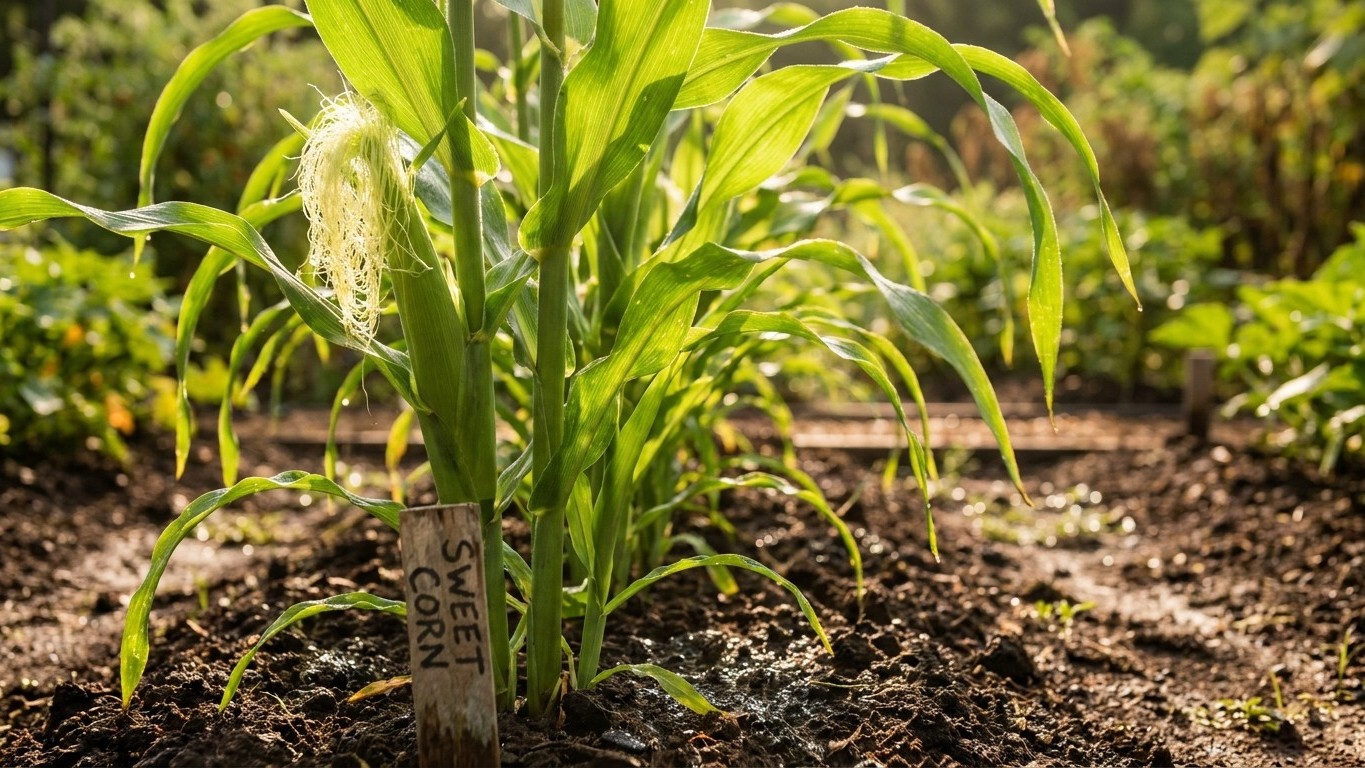

Yes, sweet corn can ripen in Florida, but the answer changes depending on where in the state you’re standing. In the Jacksonville area, the growing calendar follows a familiar frost-to-frost pattern, and the window turns out to be wide enough for almost any sweet corn variety. Farther south, the whole calendar flips, and that changes everything.
The short answer
Soil temperature, not the calendar date of the last frost, is what actually decides when sweet corn seed can go in the ground. In the Jacksonville area, the last spring frost typically falls somewhere between February 16 and March 7, based on NOAA’s 1991-2020 climate normals for freeze probability at station USW00013889. That date matters for tender transplants and tomatoes. It does not matter much for sweet corn, because sweet corn needs soil above 60°F before germination even starts, according to Utah State University Extension. Soil warms far more slowly than air, so that 60°F threshold arrives noticeably later than the last frost, sometimes weeks later. Gardeners who plant the day after the last frost, expecting corn to behave, are often just planting into cold, slow-germinating soil.
That delay matters less than it sounds like it should, because the other end of the season is generous here. The first fall frost in this area doesn’t typically arrive until November 26 to December 13, again per NOAA’s normals for the same station. So even after waiting for soil to catch up to that 60°F mark in spring, there’s still a long stretch of frost-free growing time before autumn closes the door. Sweet corn needs 60 to 90 days from planting to reach harvest. Stack that against a frost-free stretch running from sometime in spring well into early winter, and the math works comfortably in this area’s favor.
One heat factor deserves attention here. The Jacksonville area averages 73.2 days a year at or above 90°F, based on NOAA’s 1991-2020 climate normals. That’s not a frost concern, it’s a pollination and water-stress concern. Sweet corn silks and pollen don’t perform well in extreme heat, so timing a planting to avoid the hottest weeks of summer is worth more thought than the frost dates themselves.
Everything above applies to north Florida, where an inland airport station still sees real winter cold. Central and south Florida run on an inverted calendar: those regions are effectively frost-free, the main growing season runs through the cooler winter months, and summer becomes the season to avoid rather than the season to use. None of the frost dates in this article should be applied to Orlando or Miami gardens.
Does a late variety fit here?
Once soil clears 60°F and the frost-free stretch is confirmed, the next question is whether a given sweet corn maturity length actually fits inside that window, or whether it gets squeezed at either end.
A 60-day variety
A variety maturing in roughly 60 days from planting has an easy path here. Planted once soil is reliably warm, it reaches harvest well before the heaviest run of 90°F-plus days builds up, and it finishes with months to spare before the first fall frost arrives in late November or December. This length also allows for succession plantings, staggering two or three sowings a few weeks apart to spread the harvest rather than getting one large flush all at once.
A 90-day variety
A 90-day type also fits inside the frost-to-frost window in this area, with room left over. The bigger consideration is heat rather than frost. Given that the area logs an average of 73.2 days a year at 90°F or above, a 90-day variety planted late in spring can end up silking during the hottest stretch of summer, which is when pollination problems and stress-related ear gaps tend to show up. The fix isn’t avoiding the variety, it’s timing the planting so silking lands outside the peak of that heat run rather than in the middle of it.
| Factor | 60-day variety | 90-day variety |
|---|---|---|
| Fits frost-to-frost window | Yes, comfortably | Yes, comfortably |
| Succession planting possible | Yes, easily | Limited by season length |
| Heat risk at silking | Lower, shorter exposure | Higher if timed into peak summer |
What goes wrong here
- Soil sown too cold. Planting right after the last frost date, rather than waiting for soil to actually clear 60°F, leads to slow, uneven germination and weak stands. The remedy is checking soil temperature directly rather than relying on the frost calendar as a proxy for planting readiness.
- A variety too late for the season, or timed into the wrong stretch of it. Even though this area’s window is long, a late planting that pushes silking into the peak of the area’s 73.2 annual days above 90°F can still fail at pollination, ear fill, or both. The remedy is planting early enough in the window that maturity and silking land outside that heat stretch, not just fitting inside frost dates on paper.
- Sweetness lost because two types tasseled together. This one has nothing to do with climate. Su, se, and sh2 sweet corn types cross-pollinate if they tassel at the same time, and the result is starchy, disappointing ears regardless of how well the season treated the plants. Utah State University Extension gives no isolation distance for this, so don’t plant by a rule of feet or rows. Plant by timing instead: stagger sowings, or choose types that won’t tassel in the same week, and grow each planting in its own block of three or more rows rather than a single thin line, since sweet corn depends on block planting for reliable pollination regardless of variety.
Common questions
Can sweet corn be planted right after the last frost in this area?
It can be planted then, but germination is likely to be slow and uneven, because soil hasn’t yet warmed to the 60°F sweet corn needs. Waiting for soil temperature, rather than the frost date alone, gives a more even stand.
How many sweet corn plantings fit in one season here?
Given the frost-free stretch running from spring well into late November or December, a 60-day variety allows for two or more staggered sowings, spreading harvest over several weeks instead of one flush.
Does this frost calendar apply to central and south Florida too?
No. These frost dates come from an inland station in north Florida. Central and south Florida are effectively frost-free, and their growing calendar runs opposite to this one, with winter as the main season and summer heat as the limiting factor instead.
How is corn’s ripeness actually confirmed at harvest?
Three signs together, not one alone: dry, browned silks, husks that are still moist and green, and milky juice from a punctured kernel. Any one sign by itself can be misleading.