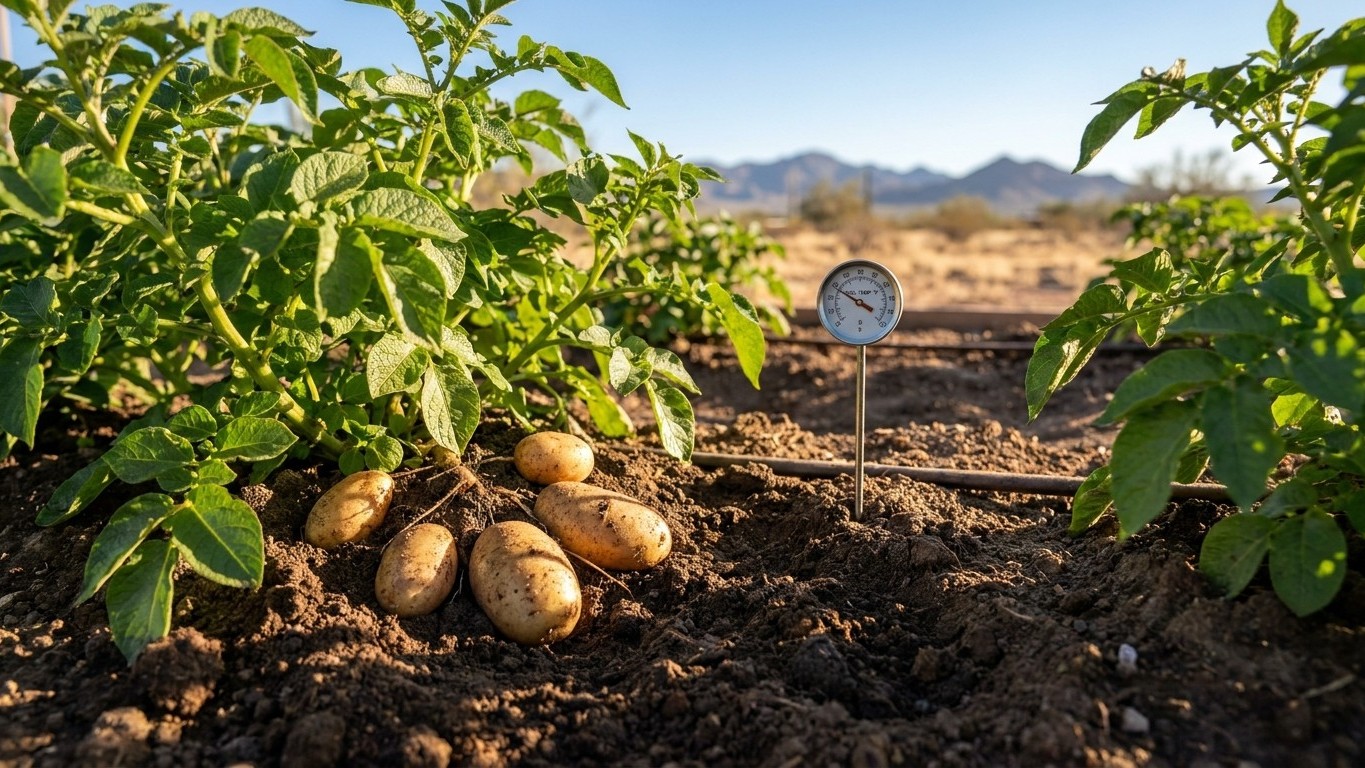

No sweet potato variety is proven for open-ground growing in Nunavut, so the best choice is a type rather than a name. Look for the earliest-maturing, compact-vined kind, grown in a container under cover with a heat source. At Rankin Inlet A, the reference station, the thirty-year record shows 0.03 days a year above 30 °C. Outdoor summers there do not supply the warmth this crop wants.
The short answer for Nunavut
Choose the fastest, most compact type you can find, and grow it in a pot or grow bag in a greenhouse, a sunroom or a sunny window. Open ground is the wrong place to bet. The page has no Nunavut variety trial to point to, so it will not hand you a cultivar name and pretend it has been proven. For the wider picture of the crop, start with Growing Sweet Potatoes in Nunavut.
The season in numbers
At Rankin Inlet A, the average last spring frost is June 19 and the average first fall frost is September 13 (Environment and Climate Change Canada, 1981-2010 normals). Those are mean dates, the midpoint of a window and not a safe date. In about one year out of two, the last spring frost comes after June 19, and in about one year out of two the first fall frost arrives before September 13. Between the two averages sit roughly 12 weeks. That is a thin margin for a crop of tropical origin, and it describes one airport station, not the whole territory.
Heat is the second limit. Over 1981-2010, Rankin Inlet A recorded 0.0 days a year reaching 32 °C, and only 0.03 days a year above 30 °C. Heat of that order simply does not occur at that station.
The decision by type
| Type | Fit for Nunavut | Reason |
|---|---|---|
| Long-season, vigorous trailing vines | Poor | They need more warm weeks than the frost-free window offers, plus heat the station never records |
| Early, short-season types | Best choice | Shortest wait for a usable root, so they use a protected season fully |
| Compact, bush-habit types | Best choice for containers | They fit a pot or grow bag and can be moved to the warmest spot |
| Any type in open ground | Poor | Cold soil and a short window defeat even the quick ones |
What will not work here
Open ground and long-season vines
The slowest sweet potatoes fail first. A long-season vine sold for the American South is built around months of warm nights, and here the span between the two mean frost dates is about 12 weeks, counting from a spring date that is only the midpoint. Plant on June 19 and you have even odds that a frost has not yet finished. Plant in cold soil and the slips sulk, stall and rot rather than root.
A hot spell will not rescue the season either. A station that logs 0.0 days at 32 °C in thirty years is not going to deliver the July heat wave a southern grower leans on to bulk up the roots. Waiting for warmth outdoors is a plan that depends on weather this record does not contain.
Dates and rain that mislead
Treating June 19 as a planting date is the most tempting mistake, and it is wrong in both directions. It is an average, so half of years run later, and a station reading from the Hudson Bay coast says little about communities farther north or inland. The normals also cover 1981-2010, so they are older than the 1991-2020 figures used elsewhere on this site.
Rain is the quieter trap. The reference station averages about 127 mm (5.0 inches) of rain from June through August, out of 310 mm (12.2 inches) for the year. June is the driest month at 27 mm (1.05 inches), then July at about 42 mm (1.65 inches) and August at about 57 mm (2.26 inches). That is modest, and a pot under glass or plastic gets none of it anyway. A container crop depends on your watering can, not the sky, and a bucket of cold tap water poured on cold roots does harm of its own. Let it sit to warm up first. How fast a pot dries out depends on its soil and its spot, and only your own gauge or finger settles that.
What changes across Nunavut
Nunavut is not one garden. It runs from the Hudson Bay coast to the Arctic islands, and the page has one zone figure to offer: Rankin Inlet is Canadian hardiness zone 0a (Natural Resources Canada, 1991-2020 normals). That is the Canadian system, built on seven climate variables, and it does not convert to a USDA zone. Natural Resources Canada says as much itself.
Because that number belongs to one reference city, there is no single answer for the territory. The page does not carry zone figures for other communities, and it will not borrow a neighbor’s. What can be said is the direction of the shift. A reader farther north, or in a community where sea ice lingers late, should expect a later start and an earlier end than the Rankin Inlet dates, which means less time for slips to establish and more reliance on heat from a greenhouse or a heated room.
Shelter from wind and a south-facing wall change the picture inside a single community, sometimes by more than the distance between two towns. To find the zone for your own community, use the Canada’s Plant Hardiness Site map rather than guessing from this page.
Where to check this for your own county
Nunavut has no counties, so the local unit is your community. The nearest thing to a state extension service for this page is Agriculture and Agri-Food Canada, the federal department. The territorial department’s own site refuses automated link checks, so the federal one is given because it demonstrably works.
Once there, look for two things: a planting calendar for your region, and any variety trials run in a climate close to yours. A calendar tells you when the frost window really opens and closes where you live. A trial tells you what has actually been grown and harvested, which is worth more than any list of names. Community greenhouse groups, where one exists near you, are another source of tested local knowledge.
A recommendation written for your community beats one written for the territory, every time. This page is the territorial version, drawn from a single reference station, and it is a starting point rather than a verdict.
Checking this against your own garden
Your own observations outrank every date above. Three are worth watching, and none needs equipment.
- Soil warmth by feel. Push your hand into the container or bed at midday. If it feels cool, the slips are not ready to go in, and that tells you how well your spot holds heat compared with the station averages.
- The first true leaves. When new leaves unfurl on a rooted slip, the plant is growing rather than just surviving. How long that takes shows how warm your window or greenhouse really is.
- Frost on the cover. A white morning on the glazing or the leaves marks the real edge of your season, which may sit well away from June 19 or September 13.
If you are weighing when to start slips, When to Plant Sweet Potatoes in Nunavut sets out the frost dates in more detail.
Common questions
Can I grow sweet potatoes outdoors in Nunavut?
The records on this page do not support it. About 12 weeks separate the mean frost dates at Rankin Inlet A, and heat above 30 °C is almost unknown there. Containers under cover are the realistic route.
Is there one best named variety?
The page has no Nunavut trial data, so it names none. Choose by type: early, short-season and compact. Then confirm with local growers or federal guidance.
Does the Canadian zone 0a match a USDA zone?
No. Natural Resources Canada states that the two systems have no simple conversion. Canadian zone 0a is the figure for Rankin Inlet only.
Should I plant on June 19?
Treat it as the midpoint of a window, not a safe date. Frost lands after it in about half of years, and communities farther north run later still.