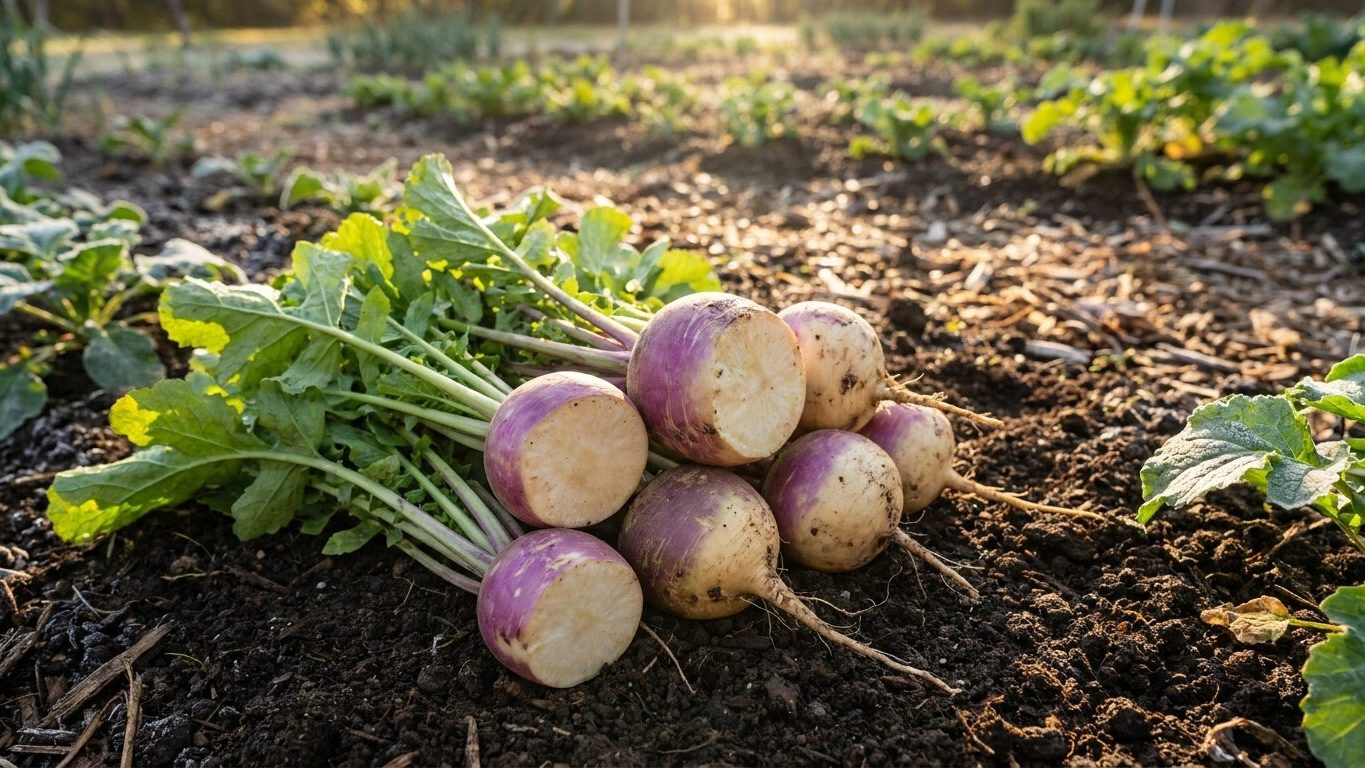

Turnips and rutabaga are mostly an autumn crop in Idaho, sown late enough that the roots swell in cool weather and ripen into the first frosts. The dates below come from Boise, a low valley, so gardeners in the mountains and on the high plateaus should count on a later spring, an earlier fall and a shorter window.
When the soil is warm enough in Idaho
At the Boise station (USW00024131), NOAA’s 1991-2020 Climate Normals put the last spring 32°F freeze between April 23 and May 7, using the 30-70% probability band. That is a probability, not a promise, so a late cold snap after May 7 is always possible. Treat the range as a starting point for your own calendar.
Frost is a proxy, though, and the crop cares about something else. Turnips and rutabaga wait for warm soil, and soil lags the air. It warms after the frost risk ends, not at the same moment. A bed can be frost-free on paper and still be cold, wet and slow underneath. Seed sown into that bed sits, or germinates unevenly.
Reading the soil, not the calendar
A soil thermometer pushed two inches into the bed is worth more than any date. Take readings in the morning for several days running. If the numbers climb steadily and the bed crumbles in your hand instead of smearing, it is ready. The extension service can give you a local threshold for the crop, and that beats a number from a stranger’s website.
Spring sowing has a catch, too. A root that is sown in April or May and still sizing up in July meets the hottest part of the year, which tends to produce tough, strong-flavored roots, or plants that run to seed. That is why most of the planting effort in Idaho belongs in late summer, counted backward from the first fall frost (October 7 to October 21 at the Boise station). Check the seed packet for its days to maturity, then subtract. Rutabaga is the slower, bigger root, so it goes in earlier than turnips, and the packet will say how much earlier.
Idaho’s USDA Plant Hardiness Zone Map (2023 edition, built on 1991-2020 normals) runs from zone 3b to 7b. That one state holds both a valley orchard country and some of the coldest gardening in the lower 48. Boise sits at the milder end of that spread. If you garden above the valley floors, push every spring date later and every fall date earlier, and rely on your own frost records.
On varieties, this page names none. Idaho has too many growing environments for a single list to mean anything, and the roots that suit a Treasure Valley garden may not suit a high valley near the Tetons. Types are the useful level here: quick, small, tender turnips for the shortest windows, and slower, larger rutabaga where the fall is long enough. For named varieties tested in your region, go to University of Idaho Extension.
How long the season lasts here
Both frost dates come from the same Boise station, so the subtraction is legitimate. From the last spring freeze (April 23 to May 7) to the first fall freeze (October 7 to October 21), the span between dates ranges from 153 days to 181 days. Where the two dates fall in their bands decides where you land.
| Last spring freeze | First fall freeze | Days between |
|---|---|---|
| April 23 | October 21 | 181 |
| April 23 | October 7 | 167 |
| May 7 | October 21 | 167 |
| May 7 | October 7 | 153 |
Those are spans between frost dates, not days of growth. Turnips and rutabaga can be sown before the last spring frost in some years and can keep growing after the first fall frost, because they tolerate light freezes. The numbers describe the frost-free window, not the crop’s limits.
What does 153 to 181 days allow? A second sowing, for one thing. A window that long leaves room for an early crop, if you want one, and a separate late-summer sowing for fall harvest. Staggering two or three sowings a couple of weeks apart in late summer also spreads the harvest, so you are not pulling a whole bed in one weekend. The succession sowing guide in this series covers spacing and timing for that.
A shorter window changes the arithmetic. Once you leave the Boise valley, the frost-free span shrinks, and in the colder zones the first sowing may be the only one. There the question becomes whether you can afford any lost time. Transplanting is the usual casualty. Turnip and rutabaga taproots dislike disturbance, and a transplant can fork or stunt the root. In a long window you can absorb that setback or simply direct-sow again. In a short one, direct sowing is almost always the better bet, and you should inspect any transplant’s roots before it goes in the ground.
The main guide, Growing Turnips and Rutabaga: An Autumn Crop, Sweetened by Frost, covers the crop itself. For comparison with other northern gardens, see Growing Turnips and Rutabaga in South Dakota and Growing Turnips and Rutabaga in Ontario.
Heat and water in Idaho
The verified figures for this page do not include a count of days above 90°F or a summer rainfall total, so none are quoted here. A count at one reference station would not describe the whole state anyway. What can be said is qualitative. Hot, dry summers in the low valleys mean most gardens there depend on irrigation. Turnips and rutabaga sown in that heat can turn woody or strong-tasting, and flea beetles tend to find the seedlings. Shade at the root, even moisture and row cover over young plants help. In cooler, damper mountain sites the trouble is different: slow ripening, mildew and rot.
Both the heat and water facts matter less than the cold ones for this crop. Two numbers govern the autumn: how cold the coldest month gets, and how hard the winter low pushes.
What the coldest month decides
At the Boise reference station, the mean daily minimum of the coldest month is 25.4°F (NOAA 1991-2020 Climate Normals). That is an average of nightly lows, not the record, so some nights run colder. A figure in the mid-20s means regular hard frost nights but not a deeply frozen bed, and in that kind of climate roots can stay in the ground under a thick mulch and be dug as needed. Higher and colder places, in the 3b end of the zone range, freeze harder and deeper. There the roots are better lifted before the ground locks up.
The same cold governs flavor. Frost nights in the 20s push these roots to turn starch into sugar, which is why the crop is called sweetened by frost. A mild fall with few hard nights gives you less of that, and a hard freeze arriving before the roots are sized gives you the sweetness with nothing to harvest.
Storage is where food safety enters. If you lift roots, inspect each one: the shoulder, the crown and the taproot tip. Skip any root with a soft patch, a weeping spot or a moldy crown. Do not trust a root just because the outside looks sound, and do not count on a fixed storage period. The extension service can advise on conditions for your area.
Turnips and rutabaga are brassicas, which means they share pests and diseases with cabbage, kale and mustard. Rotating them into a bed that held any of those rotates nothing. Keep them at least a year or more away from the whole family, and put another crop between.
Which turnips and rutabaga suit Idaho
The honest answer starts with what this page cannot do. It has no list of varieties trialled in Idaho, so it names none. A variety that thrives in a Treasure Valley summer may fail in the Wood River Valley, and any recommendation that ignores that is a guess. University of Idaho Extension and its county offices know which varieties have been grown and tested near you. That is the recommendation worth acting on.
What the facts do support is a way of choosing by type. Think of the criteria in order:
- Season length. In short-season, high-elevation gardens, favor the earliest-maturing types, and use the packet’s days to maturity against your own frost dates.
- Heat. In hot valley summers, favor types that tolerate warm spells, and give them airflow, mulch and some shade at the root.
- Damp. In cooler, wetter sites, put disease resistance first. Mildew and root rot do the most harm there.
Rutabaga asks more of the season than turnip does, so it suits the long end of the range, with the Boise valley’s 153 to 181 days between frosts. At higher elevations, a quick turnip is the safer choice, and rutabaga is a gamble worth taking only where fall stays open.
Before you buy seed, work through your own numbers: your local last and first frost dates, the soil in your bed and the amount of water you can supply. Then ask the extension office what has done well locally. Seed catalogs describe an average gardener who does not exist, and your garden is a specific place.
Common questions
When should I plant turnips in Idaho?
Sow once the soil has warmed, which is after the last spring frost. At the Boise station that frost falls between April 23 and May 7, but high-elevation gardens run later. For fall roots, sow in late summer, counting back from the first fall frost (October 7 to October 21 at Boise) using the days to maturity on the seed packet.
Can rutabaga stay in the ground over winter in Idaho?
It depends on how cold your site gets. At Boise, the coldest month’s mean daily minimum is 25.4°F, so roots under heavy mulch can often be left in place. Colder zones, up to the 3b end of Idaho’s range, freeze deeper, and the roots should be lifted. Inspect anything you store, and discard any root with soft spots, weeping or a moldy crown.
Does elevation change these dates?
Yes, a lot. The frost dates here are from Boise, a low valley, and most of Idaho is higher and colder with shorter seasons. Expect a later last spring frost and an earlier first fall frost the higher you go, and check local records or ask your extension office.
Can I plant turnips where cabbage grew last year?
No. Turnips and rutabaga are brassicas, like cabbage, kale and mustard, and they share the same pests and diseases. Plant them in a bed that has been free of the whole family for a few seasons, not just the one crop.