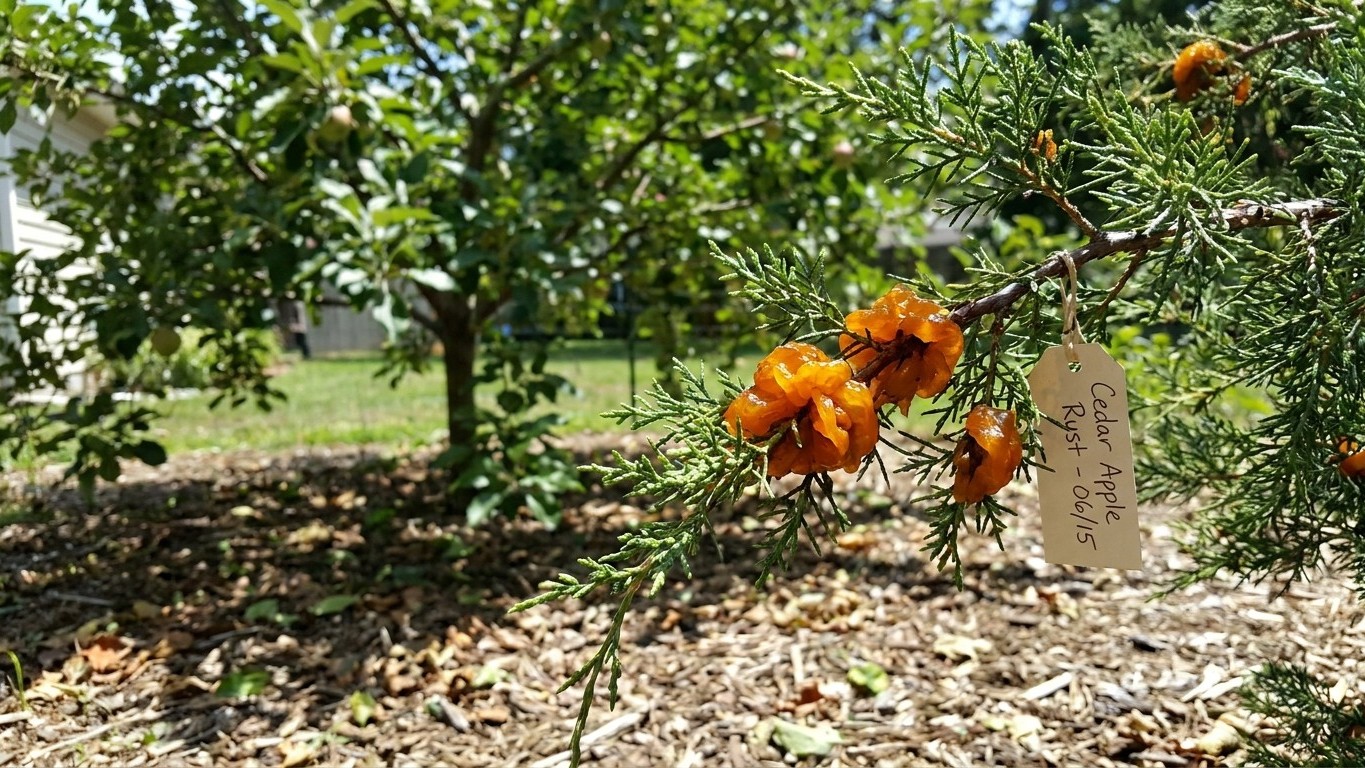

Cedar apple rust shows up as bright orange-yellow spots on apple leaves in spring, spreading from spores carried on the wind from a juniper or eastern redcedar growing somewhere within reach. There’s no fungicide that reaches back and clears an already-spotted leaf, so the useful move this week is to walk out to any juniper within a few hundred feet and look for small orange, jelly-like horns swelling out of the branches after rain. Find those and you’ve found where the infection is coming from.
What you are looking at

The first sign usually turns up on the upper surface of young leaves a few weeks after bloom: small, pale yellow spots that thicken and deepen into a bright orange-yellow, almost fluorescent color as they age. Look closely at the center of each spot and you’ll often see a tiny black dot, which is the fungus fruiting inside the leaf tissue. As the season moves on, the underside of the leaf, directly below each orange spot, develops small cup-shaped or tube-like structures with a fringed edge. These push out in wet weather and release a fine dusting of spores, which is the stage most growers actually notice, since the leaf looks like it’s grown tiny orange fingers.
Fruit infection follows a similar pattern but shows up closer to the calyx end, the end opposite the stem, as slightly raised orange-yellow lesions that can distort the fruit surface if the infection is heavy. Young twigs can carry lesions too, though this is less common and usually lighter than what shows on the leaves.
Where to look, and in what order
- Upper leaf surface: pale yellow spots turning bright orange, present within a few weeks of bloom
- Leaf underside: fringed, tube-like structures directly beneath the orange spots, most visible after rain
- Fruit: raised orange-yellow lesions near the calyx end
- Nearby juniper or eastern redcedar: brown woody galls that swell into orange gelatinous horns in wet spring weather
Severely spotted leaves tend to yellow and drop early, which thins out the canopy well before autumn and can weaken the tree’s vigor going into next year if the infection repeats for several seasons running. This disease is one entry in a broader set of problems covered on our Apple Diseases page, and it’s worth reading that page’s overview if you’re new to growing apples and still learning to tell one leaf spot from another.
What it is not
A grower who has never seen cedar apple rust before often assumes any spotted leaf is scab, and the two are easy to separate once you know what to check. Apple scab produces olive-green to black spots with a velvety texture, never the bright orange of rust, and scab lesions tend to concentrate along the leaf veins and on the fruit skin as corky, dark scars rather than raised orange bumps.
Look-alikes on the leaf and fruit
Fire blight is a different problem entirely: it blackens shoot tips and blossom clusters, curling them into a shape often described as a shepherd’s crook, and it moves fast in warm wet weather during bloom rather than showing up as leaf spots weeks later. Sooty blotch produces smudgy, dark gray-green blotches on the fruit skin that wipe or scrub off without damaging the flesh underneath, a very different look from the raised orange lesions of rust; if the fruit otherwise looks and tastes sound under a dark smudge, read our Sooty Blotch and Flyspeck: Ugly Skin, Sound Apple page rather than treating for rust.
Bitter rot is the one that costs a grower the most if mistaken for rust, because it destroys the fruit rather than just marking it. It starts as a small brown spot that sinks inward and expands into a sunken, concentric-ringed circle, often with a point of orange or salmon-colored spore mass at the center in warm rain, and it will continue rotting the apple from that point outward. The one detail that separates it from rust is texture: rust lesions stay flat to slightly raised and firm, bitter rot sinks and softens. Our Bitter Rot: Sunken Circles That Spread in Warm Rain page covers what to do once that sunken texture shows up.
The conditions that bring it on
Cedar apple rust needs two hosts to complete its life cycle, and a bad year on the apple tree almost always traces back to conditions that favored the fungus on the juniper side first. The fungus overwinters as a gall on juniper or eastern redcedar branches. A wet spring, especially rain that falls repeatedly around the time the apple tree is moving through green tip, pink, and bloom, triggers those galls to swell and push out the orange, gelatinous spore horns. Wind then carries the spores from the juniper to the apple tree, and it does not take much distance. A juniper standing within a couple hundred feet of an apple tree is close enough for a heavy spore load to arrive on a windy, wet day.
What makes one season worse than another
Once the spores land on a young, expanding apple leaf, infection depends on the leaf surface staying wet for an extended stretch, which is why a spring with frequent rain and slow-drying, humid mornings produces far more spotting than a dry spring with the same total rainfall spread thinner. Warm nights during that wet stretch push the infection along faster, since the fungus germinates and penetrates the leaf tissue more quickly in warmer, humid air. A season with a late, cool, dry spring generally shows very little rust even on a property with a juniper standing right next to the orchard, while a warm, wet spring can produce heavy spotting even from a juniper that never caused trouble in past years.
Because the spore travels on wind and rain rather than needing direct contact, removing every juniper within sight of the tree is rarely realistic in a neighborhood setting. Knowing that a wet, warm bloom-to-petal-fall stretch is the actual trigger, rather than the tree’s age or variety, helps explain why the same orchard can look clean one year and heavily spotted the next.
What to do now
Once orange spots have already appeared on the leaves, there is no product that will clear them. The fungus is inside the leaf tissue at that point, and the visible spot is the outward sign of an infection that has already run its course on that leaf. What you can still do is limit how much worse the season gets and protect the parts of the tree that haven’t been hit yet.
What still helps this season
Pick off and dispose of heavily spotted leaves and fruit where practical, since removing them reduces the amount of fungal tissue sitting in the canopy, though this is a minor gain rather than a cure. If the source juniper is on your own property and within reach, cutting out the galls before they swell and release spores again next spring keeps that particular source from reinfecting the tree, though a juniper on a neighbor’s land is out of your control and worth a friendly conversation rather than a unilateral fix. Rake and remove fallen, spotted leaves through the rest of the season rather than letting them sit under the tree, since reducing leftover fungal material in the yard is one of the few sanitation steps that pays off across seasons rather than just this one.
Do not reach for a fungicide once spots are visible: any product effective against cedar apple rust works preventively, applied before infection takes hold during the wet stretch from green tip through petal fall, and it will do nothing for a spot that has already formed. If you want a preventive program worked out for next spring, your state’s cooperative extension service is the right source for a product and rate suited to your area, since registration and recommended active ingredients differ from one state to the next. Treat this season as one to observe and record: note how heavy the spotting got and roughly when the wet weather fell, since that record is what tells you whether next year needs a preventive program at all.
Preventing it next season
The most durable fix is distance and airflow rather than a spray schedule, since the fungus depends on a wet leaf surface and a nearby host to complete its cycle every year. If you’re planning a new planting and know a juniper or eastern redcedar stands nearby and isn’t going anywhere, choosing a more open canopy and a rootstock that keeps the tree smaller makes the whole canopy dry out faster after rain, which cuts down on how long spores sit on a wet leaf.
Rootstock and airflow
Rootstock choice has nothing to do with resistance itself, since the disease has nothing to do with rootstock genetics, but a smaller, better-spaced tree is easier to prune for airflow and easier to spray evenly if a preventive program turns out to be worth running. USU Extension’s figures for mature height by rootstock give a sense of the range available:
| Rootstock | Mature height (USU Extension) |
|---|---|
| M.9 | 8-12 feet |
| M.26 | 12-15 feet |
| G.11 | 12-15 feet |
| G.30 | 18-20 feet |
| M.7 | 18-20 feet |
| M.106 | 25-30 feet |
| MM.111 | 30-35 feet |
| Seedling | 35-40 feet |
A smaller tree on M.9 or M.26 stays low enough that you can reach every branch to prune out crowded interior growth every winter, which opens the canopy to sun and wind and shortens how long leaves stay wet after a rain. Prune out water sprouts and crossing branches during dormancy, before green tip, so the canopy carries less dense growth going into the wet part of spring.
Rake up and remove fallen leaves in autumn rather than leaving them to break down under the tree, since this is general sanitation that helps against several apple problems, not just this one, and it’s covered in more depth on the Apple Diseases overview page. Beyond sanitation and spacing, the honest answer is that if a juniper stands close enough and stays there, some level of rust pressure returns most wet springs regardless of what’s done to the apple tree itself.
Common questions
Will cedar apple rust kill my apple tree?
No, it’s rarely fatal on its own. Repeated heavy infections over several years can weaken the tree by causing early leaf drop and reduced vigor, but a single bad spring is a cosmetic and yield problem, not a death sentence for the tree.
Can I just cut down the juniper next door to fix it?
Only if it’s on your own property, and even then spores can travel a fair distance on wind, so a juniper a few properties away can still be enough of a source. If the tree is on a neighbor’s land, that’s a conversation, not something you can act on unilaterally.
Is the fruit safe to eat if it has orange spots?
Yes, the lesions are a surface and cosmetic problem. Cutting away the affected patch of skin leaves sound fruit underneath, though heavily lesioned fruit may be smaller or misshapen if the infection was severe early in fruit development.
Do all apple varieties get cedar apple rust equally badly?
Susceptibility does vary by variety, so don’t rely on a variety name alone to skip prevention. Ask your state’s cooperative extension service which cultivars they’ve observed holding up better in your specific region before assuming any one variety is safe to plant near a juniper.