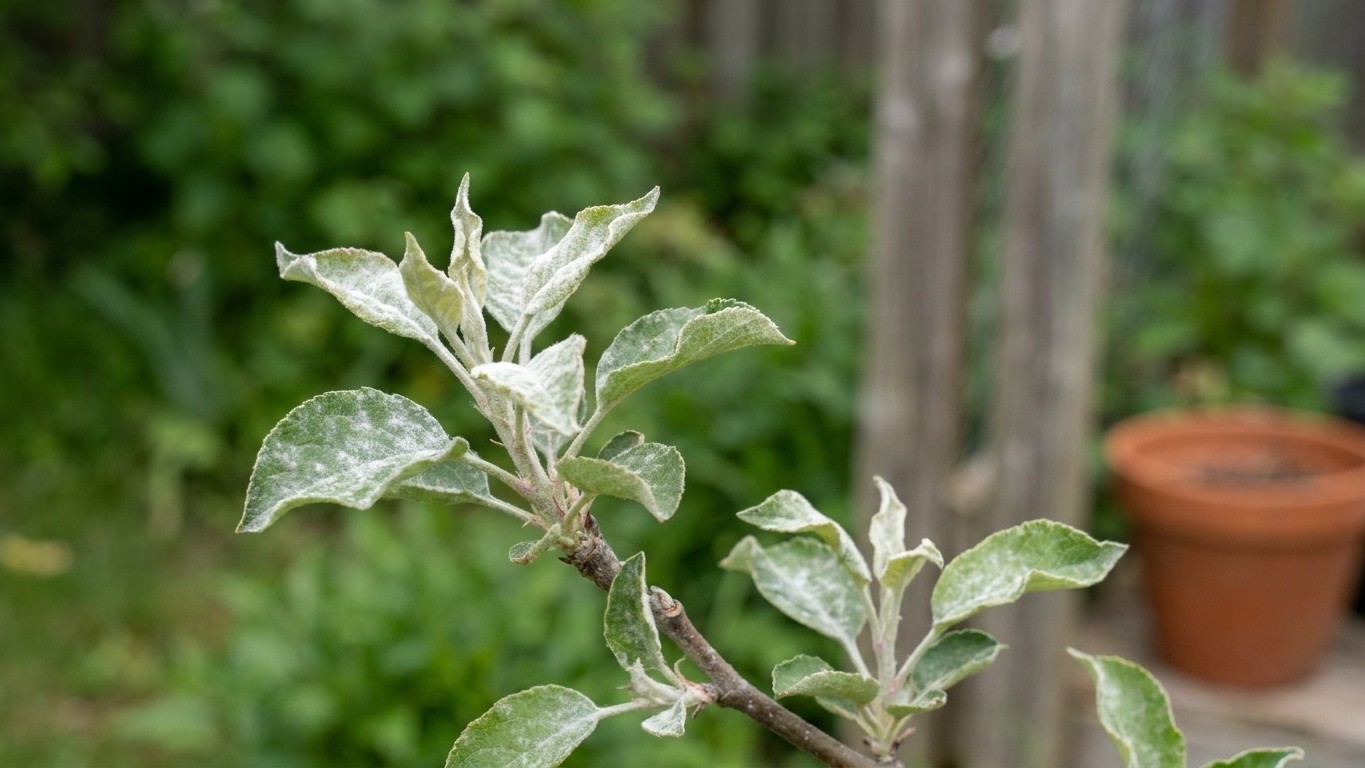

Powdery mildew on apple looks like a white to grayish felt covering new leaves, shoot tips, and sometimes blossom clusters, and it shows up as soon as growth pushes out in spring. Unlike dust or spray residue, this coating stays put through a hard rain and the leaf beneath it is often curled, undersized, or tinged purple. Walk the tree at green tip and pink stage and pinch off any shoot that’s coated white before it has a chance to spread spores to the flush behind it.
What you are looking at

The first sign usually shows on the newest leaves at the shoot tip, the ones that unfolded in the last week or two. They carry a white to pale gray felt-like coating across the upper and lower surface, thicker along the veins than in between. Rub a finger across it and some of the powder lifts, but a layer stays behind, matted into the leaf hairs. Dust wipes off clean, this doesn’t, and that’s the single detail that separates the two at a glance.
The leaves under the coating rarely look normal. They curl upward along the edges, stay narrower and more pointed than a healthy leaf of the same age, and often carry a faint purplish or reddish cast before they eventually turn brown at the margin and drop early. On a bad shoot the whole terminal several inches can be affected, and the growing point itself may die back, leaving a short stub where a foot of new wood should be.
Blossom clusters catch it too, in years when infection carries over from the previous season’s buds. Petals on an infected cluster look narrow and cupped, sometimes tinged green, and the cluster sets fewer fruit than an unaffected one nearby. Any fruit that does form can carry a faint russet netting on the skin, most visible on the shoulder, though this is a minor cosmetic mark rather than a rot.
Watersprouts and root suckers, the vigorous upright shoots that grow fastest and stay softest, tend to carry the heaviest coating on the tree. Where the felt shows up first tells you something useful:
- Shoot tips and new leaves, within the first flush of spring growth
- Blossom clusters, on wood that carried infected buds through winter
- Watersprouts and vigorous suckers, at any point in the season
- The upper canopy before the lower, since spores travel on air currents
What it is not
Cedar apple rust produces orange spots on the upper leaf surface, not a white coating, and the felt-like texture never appears with it. If what you’re looking at has any orange, yellow-orange, or rust color instead of white or gray, check the color first: you’re dealing with cedar apple rust instead, a disease that needs a nearby juniper or cedar host to complete its cycle. The two can show up in the same orchard the same week.
Woolly apple aphid leaves a white, cottony mass that looks similar from a distance, but it clusters at pruning wounds, branch crotches, and around the root collar rather than spreading evenly across new leaves. Pull a bit apart and you’ll find small purplish-brown aphids underneath, something powdery mildew never has. Location settles it fast: mildew colonizes the leaf surface itself, woolly aphid colonizes wounds and joints.
Spray residue, especially kaolin clay or a copper product applied for another problem, can leave a pale film on new growth that gets mistaken for mildew after a light rain. It rinses off with a wet thumb and leaves no matting in the leaf hairs. If the coating disappears with a firm wipe and the leaf underneath looks otherwise healthy, that’s residue, not disease.
Dieback that starts at the trunk base rather than the shoot tips points somewhere else entirely. That pattern, with a sunken, discolored area at the soil line, is the signature of collar rot, a completely different disease with a different cause and a different fix.
The conditions that bring it on
Powdery mildew overwinters inside dormant buds that were infected the previous season, so the fungus is already on the tree before growth starts. When those buds break at green tip, the fungus grows out along with the new leaf and shoot tissue, coated in spores within days. This is why a bad year often traces straight back to a bad year before it: the inoculum carried over rather than blowing in fresh.
Weather that favors a flare-up
Unlike most fungal apple diseases, powdery mildew does not need standing water on the leaf to infect. It spreads fastest with warm days and high humidity at night, conditions that let spores germinate on a dry leaf surface. A spring that alternates mild days with cool, damp nights, common wherever fog or dew sets in overnight, gives the fungus exactly what it needs without a drop of rain falling. Heavy rain can actually knock spores off the leaf and slow the disease down, which is part of why growers sometimes see it worse in a dry spring than a wet one.
Dense growth compounds the problem. A canopy that hasn’t been thinned traps humid air around the shoots overnight and shades the lower leaves, keeping them softer and more susceptible than leaves that get full sun and moving air. Heavy nitrogen fertilizing has the same effect from a different direction: it pushes soft, succulent new growth that mildew colonizes far more readily than firm, slow-grown wood. An orchard that got a late nitrogen application right before a warm, humid week is set up for a flare.
Young trees and watersprouts are hit hardest for the same reason, since both produce the soft, fast-growing tissue the fungus prefers. Once the tree slows its growth rate in summer and shoots begin to harden off, new infections drop off even if the weather stays humid, because there’s less susceptible tissue left for spores to land on.
What to do now
Once a leaf or shoot is coated, that tissue stays infected. There’s no rinsing or spraying that returns it to clean growth, so the goal from here is to stop the flush you’re looking at from seeding the one behind it.
Prune it out
Cut infected shoot tips back into clean wood, several inches past where the white coating stops, and set the cuttings aside rather than dropping them straight into a compost pile that won’t heat up enough to break everything down. Watersprouts are usually the most heavily coated growth on the tree and the easiest to remove without touching the fruiting wood, so start there. Remove them now rather than waiting for the winter prune, since every week they stay on the tree is another week producing spores.
Pull off any obviously infected blossom clusters you can reach without stripping the tree of its crop. This won’t save those clusters, which were compromised before you saw them, but it reduces the spore load blowing onto the clusters and shoots nearby.
Ease off nitrogen
If you fertilized heavily this spring, hold off on a second round. Soft new growth from a nitrogen push is exactly the tissue the fungus prefers, and cutting fertilizer back won’t reverse existing infection but slows how fast new tissue becomes available to it.
Fungicides
Products and rates for powdery mildew are registered differently from one state to the next, and timing matters as much as the material. Your state’s cooperative extension service is the right place to check both, since they can point you to products, if any, suited to your disease pressure and the growth stage you’re at right now, whether that’s still green tip or already past petal fall. If you’re also seeing symptoms of other apple diseases at the same time, mention that when you call, since a spray decision for mildew alone can look different from one that has to cover two problems at once.
Preventing it next season
Sanitation matters more for powdery mildew than for diseases that survive mainly in fallen leaves, because this one overwinters inside the buds themselves. Prune out any shoot that showed heavy infection this year during the dormant prune, cutting back into wood that looks clean, and you remove a meaningful share of next spring’s starting inoculum before it ever gets the chance to break bud.
Prune for airflow, not just size
An open canopy dries out faster after dew and holds less still, humid air overnight, both of which work against the fungus. Thin out crossing branches and any second flush of watersprouts through the growing season rather than leaving them for winter. How much canopy you’re managing depends on the rootstock underneath the variety: the rootstock sets the mature size, not the scion, so a tree on M.9 tops out at 8 to 12 feet according to USU Extension, while the same variety grafted onto MM.111 can reach 30 to 35 feet. A smaller tree on a dwarfing rootstock like M.26 or G.11, both listed by USU Extension at 12 to 15 feet, is easier to keep thinned and airy by hand than a full-size tree on seedling rootstock, which USU Extension puts at 35 to 40 feet and which usually needs a ladder to reach the upper canopy at all.
Spacing at planting follows from the same numbers. A tree that’s going to reach 18 to 20 feet on G.30 or M.7 rootstock, per USU Extension, needs room on all sides to let air move through, where a hedgerow of trees crowded on a small rootstock defeats the purpose of choosing dwarfing stock in the first place.
Resistance varies by variety, but published disease ratings are something to pull from a current nursery catalogue or your local extension office rather than guess at, since breeding programs update resistance codes and older varieties get reassessed over time. Ask specifically about powdery mildew resistance when comparing varieties for a new planting, not just scab or fire blight resistance, since a tree can carry good marks on one disease and be susceptible to another.
Common questions
Does powdery mildew kill an apple tree?
Rarely on its own. It stunts shoots, reduces fruit set on infected clusters, and weakens the tree’s vigor over repeated bad years, but a mature tree usually survives even a heavy infection. Young trees and newly grafted whips are more at risk, since a heavily infected leader can lose enough growth to set the tree back a full season.
Can I still eat apples from a tree with powdery mildew?
Yes, if the fruit itself only shows the faint russet netting sometimes associated with early infection, the apple is fine to eat, since the mark is cosmetic and sits on the skin. Cut into any fruit that looks distorted or has soft spots before assuming it’s just mildew, since other problems can look similar.
Why does mildew keep coming back on the same tree every year?
Because the fungus overwinters inside the buds that formed on infected shoots the season before, not just in fallen leaves or soil. A tree that isn’t pruned to remove those infected shoots going into winter carries its own inoculum straight through to the next spring’s growth.
Is powdery mildew on apple the same fungus that affects my squash or roses?
No. Powdery mildew is a group of related but host-specific fungi, and the species that infects apple does not spread to squash, roses, or other unrelated plants in the garden, and the reverse is also true. A mildew problem on nearby roses is not the source of a mildew problem on the apple tree.