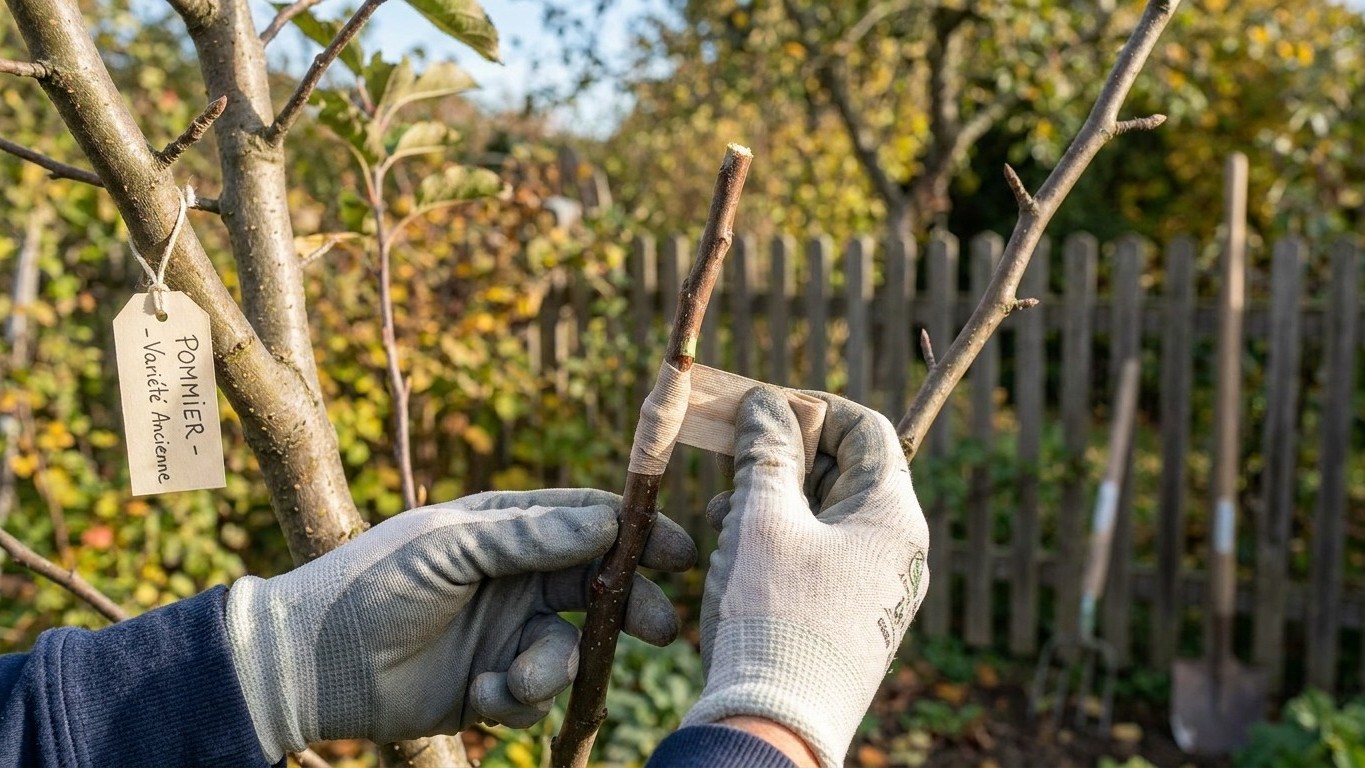

Grafting adds a new apple variety onto a tree’s existing rootstock and trunk. You cut a piece of dormant scion wood from the variety you want, fit it against a cut on the host tree so the two cambium layers touch, and the tissue fuses into one plant that grows as the new variety from that point on. It doesn’t touch the rootstock, so the tree’s eventual size stays whatever the rootstock already set, per USU Extension’s size chart. Collect scion wood while the tree is still fully dormant, before any bud has swollen, and hold it cold and slightly moist until the graft goes in.
Why it matters
Anyone who has spent a few seasons growing apples eventually runs into a tree that blooms heavily every spring and sets almost no fruit. Often the cause isn’t disease or weather, it’s that the tree has no partner blooming at the same time to pollinate it. Grafting a branch of a compatible variety onto the trunk solves that without planting, staking, and waiting on a whole second tree.
Clemson Cooperative Extension’s HGIC 1350 groups apple varieties by bloom timing: group A (Anna, Dorsett Golden), group B (Fuji, Gala, Ginger Gold, Granny Smith, Jerseymac, Mollie’s Delicious, Mutsu, Red Delicious, Yates), and group C (Arkansas Black, Golden Delicious, Jonagold, Ozark Gold, Priscilla, Rome Beauty, Stayman). Varieties in the same group, or in adjacent groups, overlap enough in bloom to pollinate each other. If your tree’s only neighbor blooms in a different group with no overlap, a grafted branch from the right group closes that gap in one season instead of several.
There’s a second trap worth knowing before you pick a scion: Jonagold, Mutsu, Stayman, and Winesap all carry sterile pollen, a fact confirmed by Clemson HGIC, the University of Georgia’s Circular 740, and USU Extension. Sterility runs one way. Any of these four can be pollinated by another variety, but none of them can pollinate anything, including each other. A yard holding only two of these four sets no fruit no matter how well they bloom together, and grafting one onto the other doesn’t fix it. You need a fertile variety in the mix, whether grafted in or already planted, and the same logic is why some growers turn to using a crabapple as a pollinator instead of a second full-size tree.
This all happens at one stage of the tree’s year: full dormancy, before the buds show any green. Do the diagnosis and the variety selection over winter, so the scion is ready the moment the graft window opens.
When to do it
Timing a graft is a matter of matching two things: the wood you’re grafting onto, and the wood you’re grafting in. Both start the season fully asleep, but they wake up at different rates once you cut into them, and the graft type you choose depends on which stage each one is in.
Reading the stages
Collect scion wood during dormancy, the stretch of winter when no bud on the tree has begun to swell. This is also when whip-and-tongue grafts go in best, while both the scion and the host branch are still asleep and the cuts you make heal slowly and cleanly. Wait past this point and the wood starts drawing on stored sugars for spring growth, which competes with healing the graft union instead of feeding it.
Bark grafting works on the opposite pairing: it’s done once the host tree has moved into bud break, when the bark on the stock has loosened enough to peel back cleanly, while the scion wood itself is kept dormant in cold storage until the moment you use it. That gap between an actively growing stock and dormant scion wood is exactly what a bark graft is built for, and it’s the more forgiving technique for a beginner working on a thick branch or a cut stub.
A third option, chip or T-budding, uses a single bud rather than a length of scion, and is done in summer on that year’s actively growing wood, when the host’s bark still slips easily. What moves all three windows from one year to the next is winter temperature and how quickly the tree accumulates chilling and then warms up, which is a local question. Your state extension service tracks these stages for your area, and the correct move is to watch the buds on your own tree rather than count days on a calendar.
How to do it

Start with scion wood cut during dormancy: look for pencil-diameter growth from the previous season, straight, with several healthy buds and no soft or shriveled spots. Wrap it in a barely damp paper towel, seal it in a plastic bag, and hold it in the refrigerator, away from any fruit, until you’re ready to graft.
Choosing the graft
Which technique to use comes down to how the diameters of your scion and your host wood compare, and what stage each is in when you’re ready to work:
| Graft type | Best when stock and scion are | Stage to do it | Skill needed |
|---|---|---|---|
| Whip-and-tongue | similar diameter, both pencil-thick | Dormancy through early bud swell | Moderate, needs a steady angled cut |
| Bark graft | stock noticeably thicker than scion | Bud break, once bark slips freely | Beginner-friendly |
| Chip or T-bud | a single bud onto thin, young wood | Summer, on the current season’s growth | Fiddly, reliable once practiced |
For a whip-and-tongue graft, make one long, shallow diagonal cut across the scion base and a matching cut on the stock, then notch a short tongue into each cut face and slide the two together so they interlock and hold themselves in place. For a bark graft on a thicker branch, cut the stock flat across, slit the bark down an inch or two, slip a wedge-cut scion down inside the flap, and leave the bark closing over the cut edge.
Whichever method you use, the single thing that decides success is whether the cambium layers line up, the thin green ring of living tissue just under the bark on both scion and stock. They don’t need to match all the way around, lining up on one side is enough for the graft to callus and take. Wrap the union snugly with grafting tape or a rubber budding strip, and seal every exposed cut, including the top of the scion, with grafting wax or a pruning sealant so the wood can’t dry out while it heals. Label the graft with the variety and the date, since a bare stub tells you nothing come summer.
What goes wrong
Most failed grafts show the same tell by early summer: the scion turns black or papery brittle and the buds on it never push, while the rest of the tree leafs out normally around it. That’s almost always one of a short list of causes, and most of them trace back to something done wrong weeks before the graft was even attempted.
The common failures
- Dried-out scion wood: buds look shriveled and the bark has wrinkled before the graft ever went in, usually from storing it too warm or too dry.
- Cambium not aligned: the cuts looked neat but the living layer under the bark never touched on either side, so no callus forms and the union simply dies.
- Grafting too late: done after the scion’s own buds had already swollen or the stock had started leafing out, which drops success sharply because both pieces are already spending energy on separate growth instead of healing together.
- Wrap left on too long: tape or budding strip not removed once the union has calloused, so it girdles the branch as it thickens, showing up as a hard constricted ring that eventually kills everything above it.
- Suckers outcompeting the graft: fast watersprouts from below the union shade out the new growth, so they need to be rubbed off by hand through the first season.
One mistake is specific to pollination grafts: grafting in another sterile-pollen variety onto a tree that already only has one. If the yard’s only two varieties are, say, Stayman and Mutsu, adding a graft of either onto the other still leaves no fertile pollen source anywhere on the property, and the tree blooms and sets nothing for another year. Check the variety’s pollen status before you choose which scion to collect, not after you’ve already grafted it in.
What changes where you are
The stages themselves, dormancy, green tip, bud break, bloom, hold true everywhere apple trees grow. What shifts by climate is how much of the calendar each stage takes up and when it starts. A tree in a short, cold winter breaks dormancy later and more abruptly than one in a milder climate, which compresses the window for a whip-and-tongue graft into fewer weeks. Your grafting calendar has to be built around your own tree’s buds each year, not around a date that worked somewhere else.
Bloom groups still shift, even if the order doesn’t
Clemson HGIC’s bloom groups are a relative order, group A blooms ahead of group B, which blooms ahead of group C, but the actual calendar dates for each group move with the climate. Two varieties from the same group might overlap comfortably in one region and miss each other by more days in another if spring temperatures swing widely. If you’re grafting specifically to solve a pollination gap, watch the actual bloom on your own trees for a season before deciding the graft has fixed the problem.
Trained tree forms add one more wrinkle. On an espalier-trained tree, grafts are usually placed to extend or fill in a horizontal cordon rather than a random branch, so the same cambium-matching rules apply but the cut has to line up with where that limb needs to run along the wire. Check with your state’s extension service for the frost and chill patterns specific to your area before locking in a grafting date.
Common questions
Can I graft more than one variety onto the same tree?
Yes, and it’s a common way to build a small “family tree” that carries two or three varieties on different branches. Keep each graft labeled, since the bark and leaves often look similar enough between varieties that you’ll lose track by the second summer without a tag.
Does grafting on a new variety make the tree grow taller?
No. The rootstock sets the tree’s mature size, not whatever variety is grafted onto it, so a graft added to an M.9 tree still tops out in the 8 to 12 foot range USU Extension gives for that rootstock. The new variety only changes the fruit on that branch, not the tree’s overall scale.
My scion wood’s buds already started to swell. Can I still use it?
You can try, but success drops once the buds have visibly swollen, since the wood is already spending its stored energy on growth instead of healing into the graft. If you have the option, cut fresh scion wood while it’s still fully dormant rather than working with wood that’s already stirring.
I grafted a fertile variety onto my tree. Do I still need another pollinator nearby?
Not necessarily, since the point of that graft is usually to supply the fertile pollen the tree was missing. Bees still need to move that pollen from the grafted branch to the rest of the tree’s blossoms, so it helps to have the graft positioned where pollinators already work the canopy rather than tucked on a shaded, low-traffic limb.