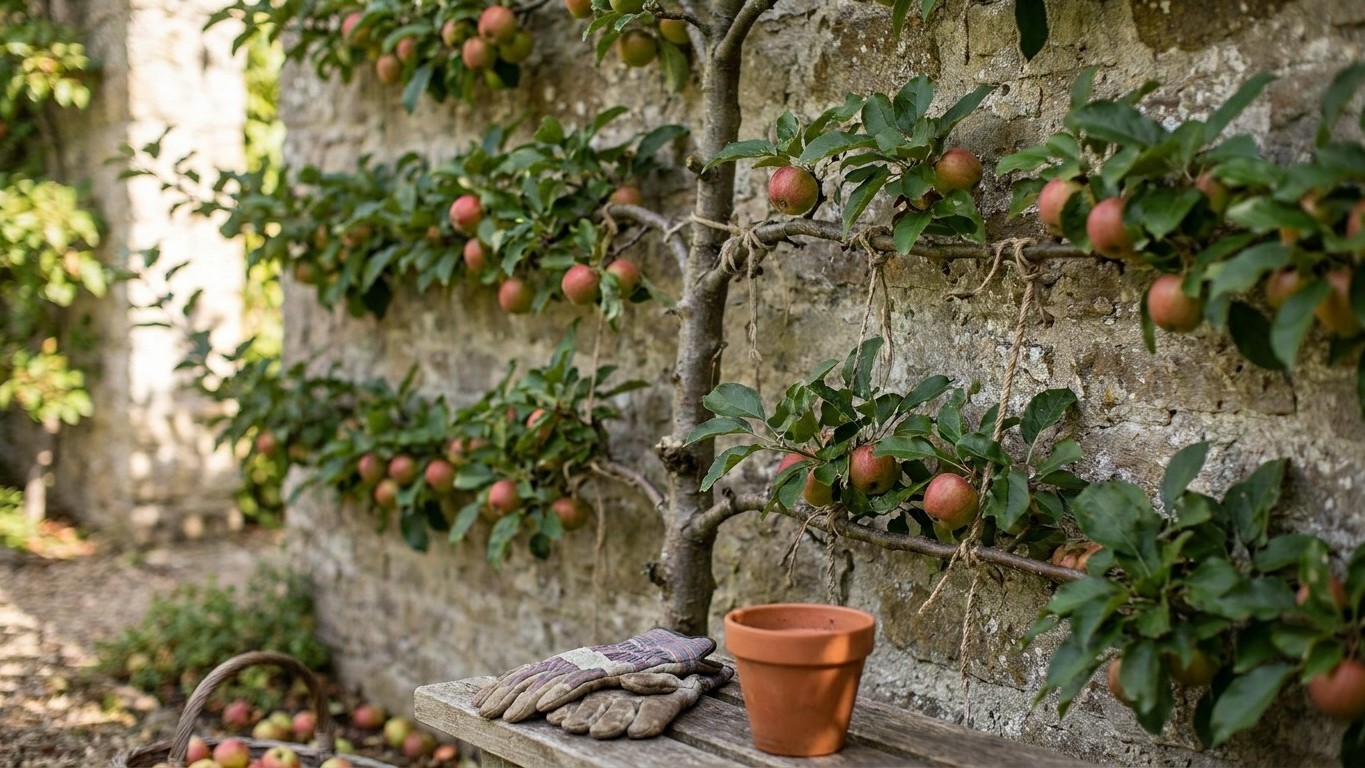

An espaliered apple tree stays flat against a wall by training a single trunk into tiers of horizontal branches tied to wires, but only if it is grafted onto a dwarfing rootstock. USU Extension lists M.9 rootstock at 8 to 12 feet mature height and M.26 at 12 to 15 feet, both small enough to hold a two-dimensional shape without a constant fight. Check the rootstock tag before you buy: a tree on MM.111 or seedling rootstock will never stay flat, no matter how well you prune it.
Why it matters
A wall-trained apple tree earns its space back. Instead of a 30-foot canopy shading half the yard, the whole tree lives in a strip 6 to 8 inches deep, which is why espalier shows up against south walls, along fence lines, and in gardens too small for a standard tree. The masonry or siding behind the tree also holds daytime heat and releases it slowly at night, which can push ripening a little earlier than a freestanding tree of the same variety in the same yard.
The bigger gain is access. Every branch is within reach from the ground, so thinning, spraying, and checking fruit for ripeness happen without a ladder. That matters most at harvest, when judging ripeness by feel and color is easier on a branch at eye level than on one twenty feet up. If you have not settled on how to read ripeness yet, the same tree trained flat or left standard still needs that skill, covered in Knowing When an Apple Is Ready, Without a Calendar.
The part growers underestimate is how permanent the decision is. The rootstock fixes the tree’s mature scale for its entire life, not the training. Once the framework of tiers is built over the first several years, changing your mind about size means starting over with a new tree. That is why the single most consequential choice in an espalier project happens before you dig the hole, at the nursery, reading the rootstock tag rather than the variety name. This is one of the few places where the groundwork covered in general Growing Apples guidance, like rootstock selection and site prep, matters even more than usual.
When to do it
Espalier is not a single job done once. It is a sequence of small jobs, each tied to a stage in the tree’s yearly cycle, repeated for as long as the tree lives.
The stages that matter
- Dormancy: plant bare-root trees, make the first structural cuts, and do the annual framework pruning that keeps tiers from getting congested.
- Green tip: wood is still pliable enough to bend without snapping, which is the window for tying new leaders down onto wires.
- Petal fall: the first summer pruning pass, cutting back vigorous upright shoots before they harden and shade the fruiting spurs behind them.
- After harvest: a second summer tidy, removing any regrowth that shot up after the petal-fall cut.
Pollination timing is where espalier’s small footprint bites back. A formal wall planting often has room for only two or three trees, so the pairing has to work on the first try. Clemson Cooperative Extension’s HGIC 1350 groups apple varieties by relative bloom time: group A includes Anna and Dorsett Golden, group B includes Fuji, Gala, Ginger Gold, Granny Smith, Jerseymac, Mollie’s Delicious, Mutsu, Red Delicious, and Yates, and group C includes Arkansas Black, Golden Delicious, Jonagold, Ozark Gold, Priscilla, Rome Beauty, and Stayman. The order holds everywhere even though the actual calendar dates shift with climate, so a same-group or adjacent-group pair is the safer bet for overlapping bloom on a wall with limited room. Weighing bloom group against flavor and season is exactly what Apple Varieties: Choosing by Taste, Season and Climate walks through in more detail.
One trap hides inside that same list. Jonagold, Mutsu, Stayman, and Winesap all carry sterile pollen, according to HGIC, UGA Extension’s Circular 740, and USU Extension. Each can be pollinated by another variety, but none of them can pollinate anything else. Plant only two trees on a wall and pick two from that group of four, and both will bloom right on schedule and set no fruit at all.
How to do it

The gesture is the same every year: build one horizontal tier, let it mature, build the next one above it.
Step by step
- Choose rootstock first. For a low, tidy wall planting, M.9 (8 to 12 feet, USU) is the standard choice. If the wall is taller or you want an informal fan rather than tight horizontal tiers, M.26 or G.11 (both 12 to 15 feet, USU) give a little more scale without losing manageability.
- Plant a bare-root whip during dormancy, against a wire framework already fixed to the wall, with wires spaced evenly up the height you intend to fill.
- Cut the central leader back just above the first wire. This forces the buds just below the cut to break, and two of those become your first pair of horizontal arms.
- At green tip, when the new shoots are still soft, tie the two selected side shoots down along the first wire, one in each direction, and tie the remaining leader upright toward the second wire.
- Repeat the process at each wire in successive dormant seasons, always letting the central leader continue up while the tiers below fill in and thicken.
- Once the framework is set, dormant pruning each winter keeps the permanent arms clean, while petal-fall and post-harvest pruning keep the short fruiting spurs from being crowded out by vertical regrowth.
| Rootstock | Mature height (USU Extension) | Fit for espalier |
|---|---|---|
| M.9 | 8-12 feet | Best default for tight, formal tiers |
| M.26 | 12-15 feet | Good for a taller or informal wall |
| G.11 | 12-15 feet | Good, similar scale to M.26 |
| G.30 | 18-20 feet | Workable only against a tall, unbroken wall |
| M.7 | 18-20 feet | Needs frequent heavy cutting to hold a flat form |
| M.106 | 25-30 feet | Not suited to espalier |
| MM.111 | 30-35 feet | Not suited to espalier |
| Seedling | 35-40 feet | Not suited to espalier |
What goes wrong
Most espalier failures trace back to one of a handful of habits, and each shows its damage at a different point in the tree’s life.
Common mistakes and when you notice them
- Wrong rootstock: a tree on MM.111 or seedling rootstock, meant to reach 30 feet or more per USU, fights the wire framework from year one. The damage shows up two or three seasons in, as thick vertical growth that needs removing every summer just to keep the shape, at the cost of the fruiting wood you actually want.
- Bending wood at the wrong stage: tying a shoot down after it has hardened past green tip cracks it at the bend. The crack calluses over but that arm never thickens evenly, and it stays the weak point of the tree.
- Missing pollination partner: planting two sterile-pollen varieties, such as Jonagold and Stayman, as the only trees on a wall. Both bloom on time and both fail to set fruit, a problem that does not become obvious until the tree is old enough to bloom heavily and still produces nothing.
- Unchecked water sprouts: vigorous upright shoots along the horizontal arms, left uncut through summer, shade the short spurs behind them. The visible symptom is a wall of vertical green growth by midsummer, with the flat tiers barely visible underneath it.
All four of these are corrections, not disasters, if caught within the same season. The one that is not correctable after the fact is rootstock choice, since it is fixed the moment the tree is grafted, long before it reaches the nursery shelf.
What changes where you are
Bloom group order from HGIC holds true everywhere apples grow, but the actual calendar date it falls on does not. A group B variety like Gala blooms after group A varieties like Anna in every climate, but the gap between them and the date either one opens shifts with the local spring. The same is true of the last spring freeze and the chill-hour totals that decide whether a given variety even flowers reliably, both of which are county-specific and outside what any national fact sheet can state for you.
Wall orientation is the other variable that moves with climate. A south-facing wall that gives welcome extra warmth to a short-season apple in a cool region can push the same variety into sunscald or premature ripening somewhere with hot, dry summers, since the tree has nowhere to shade its own bark the way a full canopy would. There is no single figure to give here because it depends on your summer heat, not on the training method.
Before choosing a rootstock and a bloom-group pairing for your own wall, check your state extension service for the last spring freeze window and chill-hour totals for your area, and confirm the pollination pairing against the specific varieties you are considering rather than the bloom group alone. The general planting steps in Growing Apples cover site prep and rootstock buying regardless of whether the tree ends up flat against a wall or standing free in the open.
Common questions
Does the variety I pick limit whether I can espalier it?
No. Espalier is a training method applied to the top-worked variety, and any apple variety can be trained flat as long as it is grafted onto a dwarfing rootstock such as M.9 or M.26. The variety decides flavor, season, and disease resistance. The rootstock decides whether the tree stays a manageable size against the wall.
How long before an espaliered apple tree actually bears fruit?
Expect several years of framework-building before the tree fruits heavily, since the early seasons go into establishing the tiers rather than into fruiting wood. Once the horizontal arms are set, fruit forms on the short spurs along them, and that spur system builds up over subsequent seasons.
Can I espalier a full-size standard tree instead of a dwarf?
Technically yes, but it fights you constantly. A tree on seedling rootstock reaches 35 to 40 feet and one on MM.111 reaches 30 to 35 feet according to USU Extension, and holding either of those against a wire framework a few feet deep means removing most of its natural growth every year. A dwarfing rootstock does most of the size control for you instead.
Do I need two different apple trees for pollination on a wall?
Yes, almost all apple varieties need a different variety blooming nearby to set fruit, and a wall planting is no exception. Pick two varieties from the same or adjacent Clemson HGIC bloom group, and avoid pairing two sterile-pollen varieties like Jonagold and Winesap, since neither can pollinate the other even though both bloom on schedule.