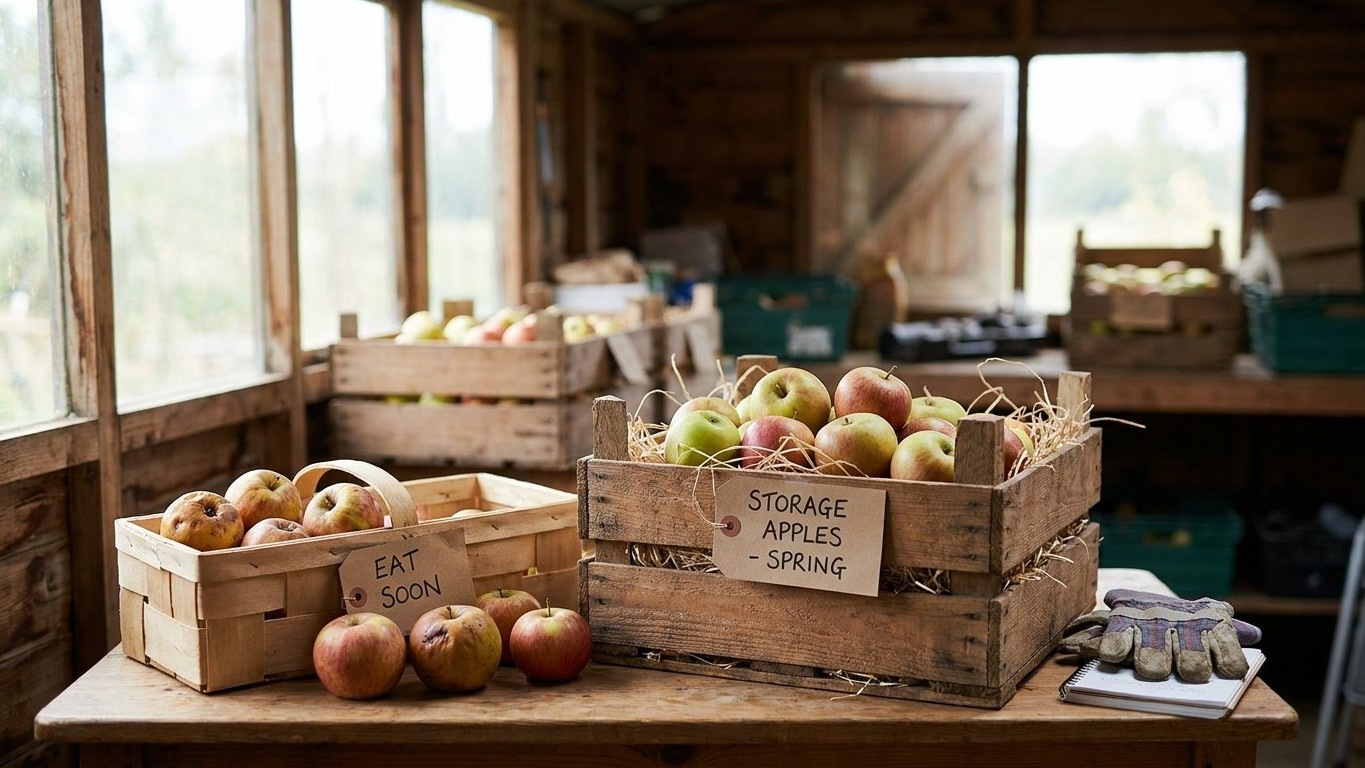

Some apples keep firm and juicy in a cold cellar until spring. Others turn to mush within a few weeks of coming off the tree. The difference is mostly the variety, not how carefully you store it: late-season, firm, high-acid apples like Arkansas Black, Granny Smith, Rome Beauty and Stayman are built to hold, while early types like Anna, Dorsett Golden and Ginger Gold are meant for eating fresh. Sort your harvest by variety before you decide what goes into the storage bin and what goes into the sauce pot this week.
Why it matters
Storage is the last stage of growing apples, the payoff for a season of pruning, thinning and defending the crop from pests and disease. Get the sorting wrong and you lose fruit you already worked for, either to rot in the crate or to a rush of soft, bruised apples that all need using at once. Get it right and a single autumn harvest feeds the household well into winter without a single trip to the store for apples.
The decision starts at planting, not at the crate
The choice of what will store and what will not is made twice: once at planting, when you choose which varieties go into the ground as part of growing apples in the first place, and again at harvest, when you sort the picked fruit by hand. A tree loaded with Ginger Gold or Jerseymac gives you apples best eaten within a few weeks of picking. A tree of Arkansas Black or Stayman gives you apples that are barely at their best straight off the branch, and only turn genuinely good after weeks in a cold, dark spot.
This matters most in the days around harvest, when the crop comes off the tree all at once and there is no going back to fix a bad sorting decision. An apple bruised at picking or packed while still warm from the sun breaks down in storage days or weeks before an undamaged one of the same variety. The apples that end up keeping until spring are the ones that were sound, cool and correctly identified by variety on the day they were picked, not the ones that simply happened to survive.
None of this works if there is no crop to sort in the first place. Deer and birds that strip a tree before you get to the ladder leave nothing to store at all, a separate problem worth solving before harvest and covered in Keeping Birds and Deer Off an Apple Tree.
When to do it
Storage begins at harvest, but harvest itself is not one date. It is a stage that arrives at a different point for each variety. Clemson Cooperative Extension’s HGIC 1350 groups apple varieties by bloom time rather than harvest time, because bloom is what growers can see and compare each spring. Group A varieties such as Anna and Dorsett Golden flower first, group B varieties such as Fuji, Gala, Ginger Gold, Granny Smith, Jerseymac, Mollie’s Delicious, Mutsu, Red Delicious and Yates flower next, and group C varieties such as Arkansas Black, Golden Delicious, Jonagold, Ozark Gold, Priscilla, Rome Beauty and Stayman flower last. That order holds in most gardens even though the calendar dates shift from one climate to the next.
Bloom order sets the harvest order, loosely
Harvest tends to follow the same relative order as bloom, though not exactly. Early bloomers are usually early ripeners headed for the fruit bowl, and late bloomers are usually the last off the tree and the ones most likely built for the root cellar. That is a tendency, not a rule for every cultivar in every group, so check the harvest window for the specific variety you planted rather than assuming bloom letter and storage life always line up.
What moves the actual calendar date is climate, specifically the local bloom window and the length of the growing season that follows it, both of which vary by region even though the bloom order among varieties does not. A grower two states over picks the same variety weeks apart from you, but their group C apples still ripen after their group B apples, and their group B apples still ripen after their group A apples.
The practical marker to watch for is not a date on the calendar but the fruit itself: background skin color losing its green cast, seeds turning brown inside a cut fruit, and the apple separating from the spur with a gentle twist rather than a tug. Pick storage varieties right at that point, not earlier for convenience and not later because the ladder was busy with something else.
How to do it

Sort before you store
Work through the picked fruit the same day, on a table or tarp with good light. Set aside anything with a bruise, a puncture, a soft spot, or a worm hole. One damaged apple in a bin of good ones spreads rot to its neighbors within days, so it does not belong in storage at all, however small the blemish looks. Wipe off dirt but do not wash the fruit before storing. Water left on the skin encourages the same rot you are trying to avoid.
Match the apple to the shelf life it actually has
Not every apple in the harvest is a candidate for the root cellar. Some are built to be eaten within days or weeks; keep those in the kitchen fruit bowl and use them first. The table below groups a run of well known varieties, all named in Clemson HGIC 1350 and the University of Georgia’s Circular 740, by their published bloom group and by their general keeping habit.
| Variety | Bloom group (HGIC 1350) | General keeping habit |
|---|---|---|
| Anna, Dorsett Golden | A | Short: best eaten within a few weeks of picking |
| Ginger Gold, Jerseymac, Gala | B | Short to moderate: use within one to two months |
| Fuji, Granny Smith, Mutsu, Red Delicious, Yates | B | Long: known for holding firm for months in cold storage |
| Golden Delicious, Jonagold, Ozark Gold, Priscilla | C | Moderate: several weeks to a couple of months |
| Arkansas Black, Rome Beauty, Stayman | C | Long: classic winter keepers, some improve in storage |
Bloom group is not a storage guarantee. It only tells you the relative order those varieties flower in, per HGIC 1350; keeping quality is a separate trait of the fruit itself, which is why Ginger Gold and Red Delicious sit in the same bloom group but at opposite ends of the storage table.
Cool it fast, hold it cold and humid
Get long-keeper varieties down to a cold, humid spot as soon as possible after picking, ideally the same day. An unheated root cellar, a spare refrigerator, or a shaded corner of an unheated garage all work, provided the temperature stays low and steady rather than swinging with the outside weather. Store apples in perforated plastic bags or shallow crates rather than sealed containers, so the fruit does not sit in its own trapped moisture. Keep apples away from stored potatoes and carrots where possible. Apples give off ethylene gas as they ripen, and that gas speeds up sprouting and softening in root vegetables stored nearby.
Check the storage bin every couple of weeks through winter and pull out anything that has started to soften, wrinkle or weep. A single rotting apple left in a crate of good ones will take down its neighbors well before spring, which is the whole reason the fruit was sorted by hand in the first place.
What goes wrong
Picking too early is the most common mistake with storage varieties. An apple pulled before full maturity never develops the sugar and acid balance it needs, and it tends to shrivel rather than stay crisp in the crate. Picking too late causes the opposite problem: overripe fruit bruises at the slightest handling and starts breaking down within days of coming off the tree, no matter how carefully it is stored afterward.
Timing and mixing mistakes
Mixing keeping types in one container causes trouble that shows up weeks later rather than right away. A short-season apple like Jerseymac tucked in among long-keeping Arkansas Black will soften on its own timetable, and by the time it visibly spoils it has already begun to affect the fruit touching it. Sort by variety, not just by size or color, before anything goes into the storage bin.
Storing apples too warm shortens their life dramatically compared to a proper cold, humid spot, even when the fruit went in sound and unbruised. Warmth speeds up the same ripening process that eventually turns a firm apple soft, so an apple that would have lasted well into winter in a cold cellar can be mealy within a few weeks in a warm closet or pantry.
The pollination trap that leaves nothing to store
A less obvious failure happens before harvest and has nothing to do with storage technique at all: planting a small garden with only sterile-pollen varieties. Jonagold, Mutsu, Stayman and Winesap all carry sterile pollen, a fact noted by Clemson HGIC 1350, the University of Georgia’s Circular 740 and USU Extension. Each of those four can be pollinated by another variety, but none of them can pollinate anything, including each other. A backyard block planted with only two or three of them can bloom heavily and still set little or no fruit, which means there is nothing to sort or store come autumn regardless of how well the empty crates were prepared.
Finally, apples left unchecked through winter hide their damage. A soft spot that starts against the wall of a crate is not visible from above, and by the time the smell gives it away, several neighboring apples have usually already started to turn.
What changes where you are
How long natural cold storage stays usable depends entirely on your own climate, and that is not something a national fact sheet can settle for you. A root cellar or unheated garage that holds a steady, near-freezing temperature through an entire winter in a cold northern state may swing well above that in a milder one, cutting the effective storage season short by weeks or months. Check with your own state’s extension service for guidance on how long unheated storage typically holds in your area, since this changes county by county far more than it changes by variety.
Climate and rootstock both set the scale
Climate also shifts the calendar dates behind the bloom groups without touching their order. HGIC 1350’s group A, B and C sequence for Anna, Fuji, Arkansas Black and the rest holds true whether you garden in a long, mild season or a short, cool one. What moves is the actual date each group flowers and, by extension, the date each group is ready to pick and sort for storage.
The size of the harvest you need to plan storage for is set years earlier, by rootstock. A tree on M.9 rootstock tops out at 8 to 12 feet according to USU Extension, and produces a modest crop that a couple of shelves in a refrigerator can handle. A tree on MM.111 or an ungrafted seedling rootstock reaches 30 to 40 feet at maturity, and the volume of fruit from a tree that size calls for real cellar or crate space, not a spare drawer. Choosing the rootstock behind a new tree, covered in Apple Rootstocks: What Decides the Size of Your Tree, is really a decision about how much storage capacity you will need to find every autumn from then on.
Common questions
Can I store apples in the same fridge as other produce?
You can, but keep them in a separate drawer or bag away from leafy greens and root vegetables where possible. Apples give off ethylene gas as they ripen, which speeds up yellowing in greens and sprouting in potatoes and carrots stored in the same space.
Do I need to wrap each apple individually?
Wrapping in paper helps mainly by keeping one spoiling apple from touching its neighbors, not by extending the fruit’s own storage life. A shallow crate with the apples in a single layer, checked every couple of weeks, does the same job with less handling.
Why did my “good keeper” apples go soft after just a few weeks?
The most likely cause is storage temperature rather than the variety. Even a classic long keeper like Arkansas Black or Stayman breaks down quickly if held at room temperature instead of a cold, humid spot, since warmth accelerates ripening regardless of the fruit’s genetics.
Can I still store apples that dropped on their own instead of being picked?
Windfall apples are usually a poor bet for long storage even if they look undamaged, because the impact of the drop often bruises the flesh beneath the skin where you cannot see it. Eat or process dropped fruit soon rather than adding it to the storage crate.