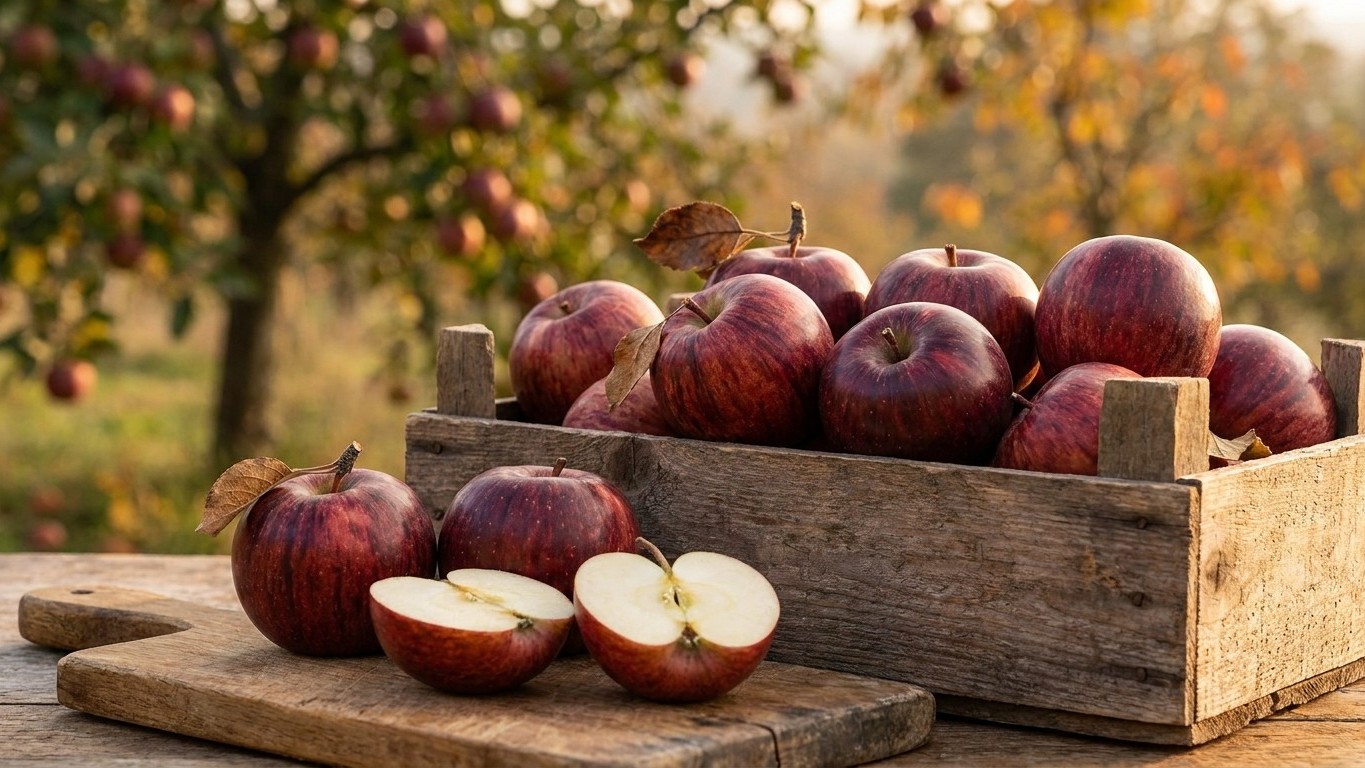

Idared earns real loyalty from home bakers, but it comes with one serious asterisk: fire blight. If that bacterial disease isn’t common where you live, or you’re prepared to manage it, this apple rewards you with dense, tart flesh that holds together in the oven and a tree that fruits reliably in cooler climates. If fire blight is already a problem in your yard or your region, keep reading before you plant.
What Idared actually is

- Ripens: Early October
- Tastes like: Bracingly tart, with firm, dense white flesh
- Good for: Pies and other cooked dishes where the fruit needs to hold its shape
- Keeps: Known as a good keeper, though no specific storage duration is published in our sources
Idared is a mid-to-late-season apple that ripens in early October, according to Utah State University Extension’s guide to home orchard apples. That places it after the early summer varieties and roughly alongside other classic fall storage apples, giving gardeners a firm target date for harvest planning rather than a guess based on color alone.
The eating experience is what sets Idared apart from a soft, sweet dessert apple. USU Extension describes it as bracingly tart, with flesh that’s both firm and dense. That combination is exactly why it shows up in so many pie recipes: a dessert apple like a soft, sweet variety tends to break down into mush once the sugar and butter go to work in a hot oven, while Idared’s dense structure survives the bake. The tartness matters too. Sugar and butter mute flavor as they cook down, and an apple with real acidity cuts back through that richness instead of disappearing into it. That’s the physical reason Idared is called a classic pie apple rather than just a label someone slapped on it.
As for storage, our sources describe Idared as a good keeper without giving an exact number of weeks or months. If you’re deciding between this variety and something bred specifically for long cold storage, don’t guess at the shelf life. Plan to eat or process your harvest at a pace you’re comfortable with, and treat any extended storage as a bonus rather than a guarantee.
Will it grow where you are
Hardiness zones
USU Extension lists Idared as suited to USDA hardiness zones 4 through 6. That’s a genuinely cold-climate range, covering much of the northern tier of the country, from parts of the upper Midwest and interior Northeast down through the mountain West. If you garden in zone 3 or colder, this variety likely isn’t a fit. If you’re in zone 7 or warmer, hardiness against winter cold isn’t your limiting factor, but the next filter might be.
Winter chill
Hardiness zone tells you whether the tree survives your coldest nights. Winter chill is a separate, less obvious requirement: apples need a minimum number of cumulative cold hours during dormancy to break bud properly and flower on schedule the following spring. Skip that requirement and you get a tree that leafs out unevenly, blooms late or thin, and sets a disappointing crop even in a climate that never threatened to kill it outright.
No specific chill-hour figure for Idared is published in our sources, so we won’t invent one. What the zone range does tell us is that this is a variety bred for and adapted to genuinely cold-winter regions, the kind of climate where chill accumulation is rarely in short supply. Gardeners in zones 4 through 6 are very unlikely to run short on chill hours for this apple. The concern flips for anyone gardening at the warm edge of apple country, coastal California, the Gulf Coast, or similar mild-winter zones, where chill accumulation is the more common failure point for cold-climate varieties in general. Without a published number for Idared specifically, the safest approach in a marginal climate is to talk to a local extension office about chill accumulation in your area before committing a spot in the yard to this variety.
What to plant beside it
This is where a lot of new apple growers get tripped up, so it’s worth being precise. Nearly all apple varieties crop better with a compatible partner nearby, since apples are largely self-unfruitful and rely on cross-pollination between two different varieties that bloom at overlapping times. Idared blooms early, according to USU Extension, which narrows the pollination window: whatever you plant beside it needs to flower during that same early stretch of spring, not weeks later.
Here’s the honest limitation: no specific list of compatible pollinator varieties for Idared is published in our sources. Rather than guess at names and risk sending you to the nursery with bad information, we’ll say it plainly: that partner list isn’t documented here. What we can tell you is the principle that governs the choice. Because a parent variety generally cannot pollinate its own seedling, and because bloom timing has to overlap closely, the safe path is to choose another early-blooming variety with confirmed compatibility, not simply the nearest apple tree in the neighborhood.
A few practical options if you’re planting Idared and need a partner nearby:
- Check with a local extension office or nursery for early-blooming varieties confirmed to overlap with Idared’s bloom window in your specific climate, since bloom timing shifts somewhat by region
- Consider a flowering crabapple with an early bloom period, which many home orchards use as a reliable, compact pollinator source
- Avoid assuming any single nearby apple tree will do the job; verify bloom overlap and compatibility before you count on it for fruit set
For a fuller walkthrough of how apple pollination actually works, including how to read bloom charts and what “cross-unfruitful” pairings to avoid, see our apple pollination guide. It’s worth reading before you buy a second tree, not after.
Growing it well
Fire blight susceptibility
This is the headline issue with Idared. USU Extension rates it Very Susceptible to fire blight, a bacterial disease that can move fast through blossoms and new shoots, especially in warm, wet spring weather. In practical terms, that rating means watching closely during and right after bloom for the classic symptom: shoot tips that blacken and curl over into a shape often described as a shepherd’s crook. It means pruning out infected wood promptly, well below the visible damage, and disinfecting tools between cuts so you don’t spread the bacteria yourself. It also means thinking twice about planting Idared in a region where fire blight is already a known problem in local orchards, since a highly susceptible variety in a high-pressure area can lose limbs, or the whole tree, in a single bad spring.
Growth habit
Beyond disease pressure, Idared is grown widely as a dependable home-orchard tree in the cold-climate zones it’s suited to. Mature size depends entirely on the rootstock it’s grafted onto, not on the variety itself, so ask your nursery which rootstock you’re buying and what mature height and spacing that specific rootstock produces before you dig a hole.
Biennial bearing and thinning
No specific tendency toward biennial bearing (the heavy-crop-one-year, light-crop-the-next pattern common in some apple varieties) is documented for Idared in our sources, so we won’t claim one. What’s true across nearly all apple varieties, biennial-prone or not, is that thinning a heavy fruit set in late spring reduces limb stress, improves the size of the remaining apples, and is generally cheap insurance against a lean year that follows a bumper crop.
Picking it and keeping it
USU Extension puts Idared’s harvest in early October, but a calendar date is only a starting point. Weather shifts the exact week from year to year, so the tree itself gives better signals than the calendar does. Work through these checks in order when you think you’re close:
- Lift and twist a sample apple gently upward and to the side. If it separates from the spur easily, with the stem intact, it’s ready. If you have to yank or tug, give it more time.
- Cut one open and check the seed color. Fully mature apple seeds have turned brown to dark brown; pale or greenish seeds mean the fruit needs more time on the tree.
- Check the ground color, the base color of the skin apart from any red blush. As Idared nears maturity, that background color shifts from green toward a yellowish or greenish-yellow tone.
Storage conditions
Idared is known as a solid keeper, though our sources don’t give a specific number of weeks or months to plan around. The general rule for firm, dense-fleshed storage apples applies here: cold and humid beats room temperature every time. A refrigerator crisper drawer, a cool basement, or a root cellar kept near freezing with decent humidity will all extend how long the fruit stays firm far longer than a bowl on the kitchen counter. Check stored apples periodically and pull any that start to soften or spot, since one apple going bad can speed up decline in the ones stored next to it.
Common questions
Is Idared self-pollinating?
No apple variety, including Idared, reliably sets a full crop on its own pollen. Like nearly all apples, it crops better with a compatible partner variety blooming nearby.
What zone is best for growing Idared?
USU Extension lists Idared as suited to USDA hardiness zones 4 through 6, a cold-climate range covering much of the northern United States and mountain West.
Is Idared a good pie apple?
Yes. Its flesh is described as firm and dense, so it holds its shape through baking, and its bracing tartness cuts through the sugar and butter in a pie filling rather than getting muted by them.
How susceptible is Idared to fire blight?
USU Extension rates it Very Susceptible, meaning growers in regions with active fire blight pressure should watch closely at bloom time and prune out infected wood promptly.
When should I pick Idared apples?
Harvest falls in early October according to USU Extension, but confirm ripeness with the lift-and-twist test, seed color, and ground color rather than relying on the date alone.