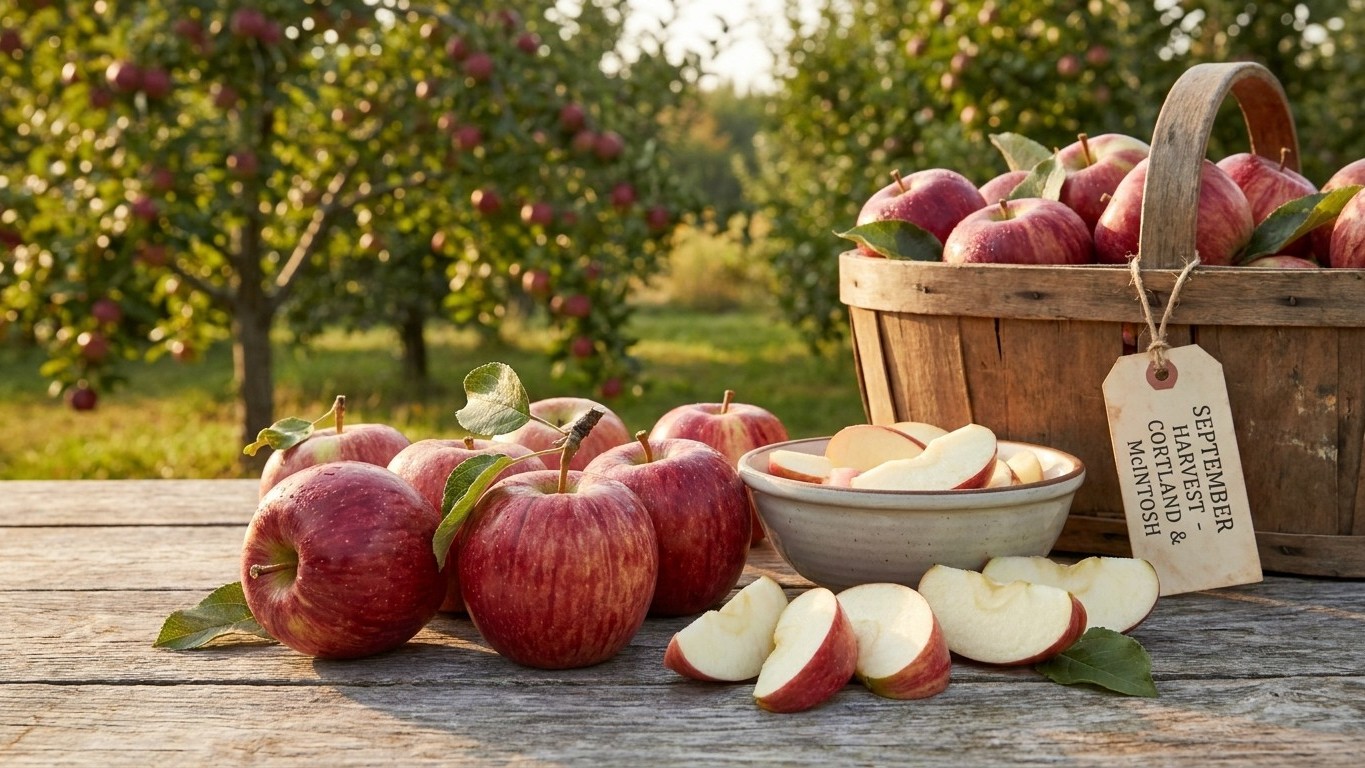

Cortland ripens in September, resists browning better than almost any other apple, and asks for a pollen partner because, like nearly all apple varieties, it crops better with company nearby. Here is what a home orchard needs to know before planting one this fall.
What Cortland actually is

- When it ripens: September
- What it tastes like: Sweet with a hint of tartness
- What it is good for: Salads, snacking, pies, sauce, baking, and freezing
Cortland’s harvest window falls in September, according to USU Extension’s Apple Production for the Utah Home Garden. That puts it squarely in the main fall apple season, alongside familiar names but with a flavor profile of its own: the University of Maine Cooperative Extension (Bulletin #4262) describes the eating quality as sweet with a hint of tartness, a balance that leans toward dessert use rather than the sharp acidity of a baking-only apple.
What sets Cortland apart in the kitchen has less to do with taste and more to do with texture and chemistry. The flesh resists browning, a trait the Maine Extension bulletin calls out specifically, which is why Cortland shows up in salad recipes and fruit trays where other cut apples turn brown within minutes. That same bulletin lists it as excellent across nearly every use: salads, snacking, pies, sauce, baking, and freezing. Few varieties earn a recommendation that wide. A dedicated pie apple usually needs flesh that holds its shape under heat and acid that survives baking without going flat, and Cortland’s balance of sweetness and tartness lets it do that while still working as a fresh eating apple.
One practical note for anyone shopping by name rather than by tag: some apple varieties are sold under two names depending on the region or the marketing label (Mutsu appears as Crispin, Pink Lady as Cripps Pink). Cortland does not carry that kind of alias in the sources reviewed here, so a tree or fruit labeled Cortland is simply Cortland, no substitution to check for.
Will it grow where you are
Hardiness zones
Cortland is rated for USDA hardiness zones 4 through 7, per USU Extension. That is a wide band, running from cold-winter regions like northern Minnesota and Vermont down through the mid-Atlantic and much of the Ohio Valley. Treat that 4-7 range as the outer boundary, not a guarantee of thriving: a tree at the cold edge of zone 4 will face harder winters and a shorter growing season than one in zone 7, even though both fall inside the published range.
Winter chill
Hardiness zone is only half the picture. Apple trees also need a minimum number of chill hours, the accumulated time spent at cold-but-not-freezing temperatures during dormancy, before they will break bud and flower normally in spring. What can be said is that Cortland’s zone 4-7 range places it firmly among northern and cold-climate apples, the group that generally needs, and reliably gets, more winter chill than what a warm-winter or coastal Southern garden provides. Gardeners in zones 8 and warmer, where chill accumulation is often the limiting factor rather than cold hardiness, should treat Cortland as a poor match even though no specific chill number confirms it.
What to plant beside it
This is usually the question that sends people looking for a variety page in the first place, and here the honest answer matters more than a confident-sounding list. No variety name is given at a guess in place of that missing fact.
What is documented is Cortland’s bloom season: mid-season, according to USU Extension. That detail still does real work. Nearly all apple varieties crop better with a compatible partner blooming at the same time, since apples are largely cross-pollinated by bees moving between varieties in flower together. A neighbor’s tree, a nearby orchard, or even a crabapple can sometimes supply that pollen if it blooms in the same window. Practically, that means looking for another mid-season apple variety, since bloom timing that is off by more than a week or two sharply reduces the overlap bees can use.
Bloom timing alone does not settle the question, though. Two varieties flowering together are not automatically compatible: a parent variety cannot pollinate its own seedling, and some varieties carry pollen that is effectively sterile, meaning they can receive pollen and set fruit but cannot supply usable pollen back to a neighbor. Neither of those exclusions is documented for Cortland in the sources reviewed here, so none is claimed. Anyone planting Cortland this season should confirm a specific partner variety with a local nursery or extension office rather than relying on bloom season alone, and the general mechanics of matching bloom times, self-fertility, and known exclusions are covered in more detail in our apple pollination guide.
The practical takeaway: plant at least one other mid-season apple variety within bee range, confirmed as a known Cortland partner by a local source, rather than assuming any mid-blooming tree will do the job.
Growing it well
Fire blight susceptibility
USU Extension rates Cortland as susceptible to fire blight, a bacterial disease that spreads fast in warm, wet spring weather right around bloom time. In the garden, that shows up as blackened blossoms and shoot tips that curl over into a shape often described as a shepherd’s crook, with the damage able to spread down into larger branches if left unchecked. A susceptible rating means a grower should prune out infected wood promptly, well below the visible damage, and disinfect pruning tools between cuts to avoid spreading the bacteria to healthy parts of the tree. It also means avoiding heavy nitrogen fertilization, which pushes soft, fast-growing shoots that are more vulnerable to infection.
Habit and biennial bearing
Neither Cortland’s growth habit nor its tendency toward biennial bearing, the pattern where a tree produces a heavy crop one year and a light one the next, is documented in the sources used for this page. That gap is worth naming rather than filling with a guess. What holds true across most apple varieties, biennial-prone or not, is that thinning young fruit in late spring, leaving roughly one apple every 6 to 8 inches along a branch, reduces stress on the tree and improves the size and quality of what remains. That practice is a reasonable default for Cortland even without a documented biennial rating.
Picking it and keeping it
Cortland’s harvest window is September, per USU Extension, but a calendar date is only a starting point. The tree itself gives clearer signals, and checking them in order avoids picking too early, which is the more common mistake with September apples.
- Lift and twist: Cup a fruit in your hand, lift it gently upward, and give it a slight twist. A ripe apple separates from the spur with little resistance; one that clings and requires yanking or bending the branch needs more time.
- Seed color: Cut one test apple open. Pale or greenish seeds mean the fruit is still immature; seeds that have turned brown to dark brown are a strong sign the apple is ready.
- Ground color: Check the background color on the skin, the shade underneath any red blush. As Cortland ripens, that ground color shifts from a hard green toward a softer, more yellow-green tone.
Storage
General apple storage practice still applies: refrigeration at cold, humid conditions slows ripening far more effectively than a countertop or a warm pantry, and checking stored fruit periodically for soft spots prevents one spoiling apple from affecting its neighbors in the same bag or bin.
Common questions
Is Cortland the same apple as Crispin or another renamed variety?
No alias is documented for Cortland in the sources used here. Unlike Mutsu, sold as Crispin, or Pink Lady, sold as Cripps Pink, Cortland appears under one name.
Can I grow Cortland from a single tree with no other apples nearby?
Nearly all apple varieties, Cortland included, crop better with a compatible pollen partner blooming at the same time rather than relying on their own pollen alone.
What USDA zones can grow Cortland?
USU Extension lists Cortland as hardy in USDA zones 4 through 7, a range spanning much of the northern and mid-Atlantic United States.
Is Cortland better for pies or for eating fresh?
Both, according to University of Maine Cooperative Extension: it is rated excellent for salads, snacking, pies, sauce, baking, and freezing, thanks to flesh that resists browning and a sweet-tart balance that holds up under heat.
How do I know when to pick Cortland apples?
Check three things in order: whether the fruit lifts and twists free easily, whether the seeds inside have turned brown, and whether the ground color has shifted from green toward yellow-green. Harvest generally falls in September.
Related guides
- Crimson Crisp Apple: Ripening Mid September, and What to Plant Beside It
- Dorsett Golden Apple: What It Tastes Like and What Pollinates It
- Earligold Apple: Worth Growing, If Fire Blight Is Not Your Problem
- Pruning an Apple Tree in Winter
- What Pollinates Snapp Staymen, and What Cannot
- What Pollinates Earligold, and What Cannot
- Prima Apple: One of the Few That Shrugs Off Fire Blight