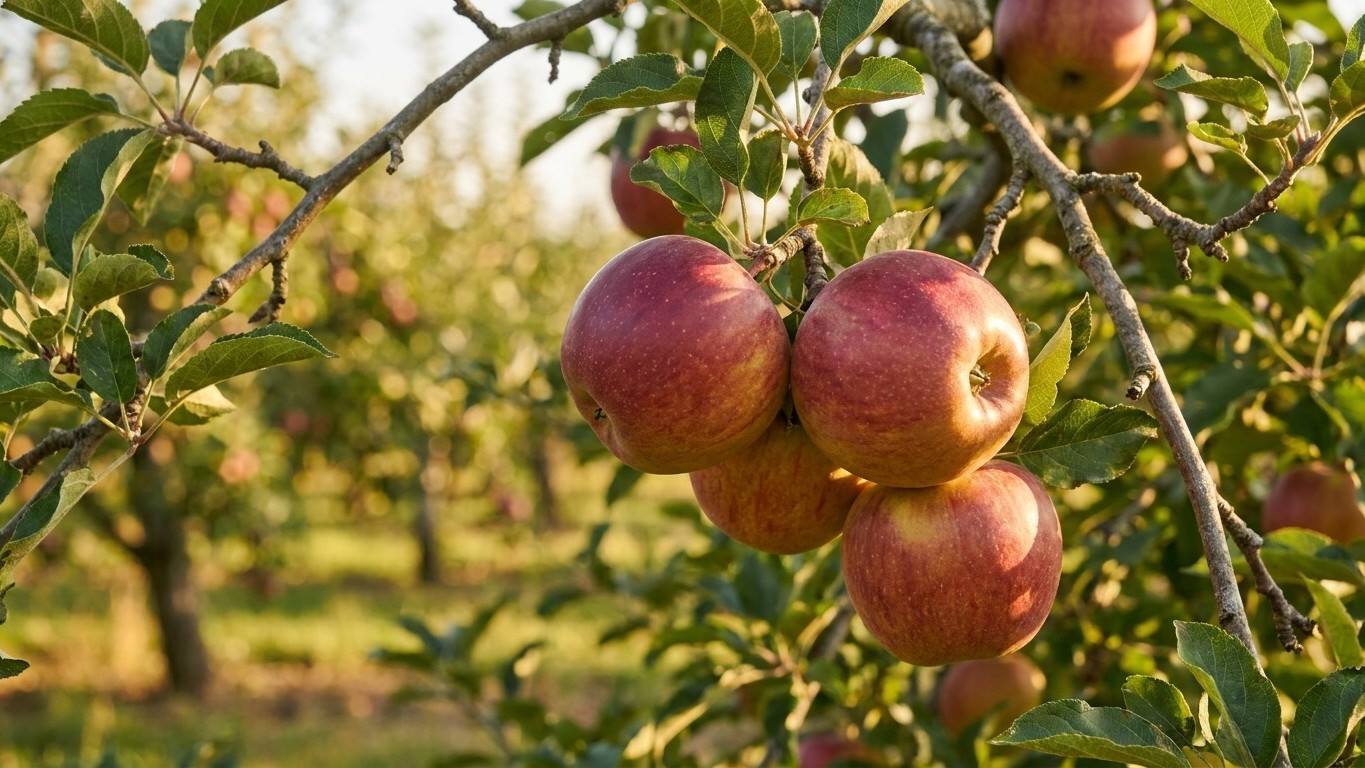

Prima earns its spot on this fire-blight-resistance list for one reason: the USU Extension rates it Resistant, not just Tolerant, in a category of apples where most varieties get hit hard. Add a late bloom that dodges frost, a mid-September harvest, and sweet-tart, crisp flesh, and you get a home-orchard apple that asks less spraying and less worry than most of its cousins.
What Prima actually is

- Ripens: Mid September
- Tastes like: Sweet-tart and mildly aromatic, with crisp flesh
- Good for: Fresh eating and cooking, though not long-term keeping
- Keeps: Loses flavor after a month or two in storage
Prima’s bloom is classed as Late by USU Extension, which matters more than most catalog copy lets on. A late bloomer flowers after the worst of the frost risk has passed in most regions, so the crop that sets in spring is more likely to still be hanging in September. That September harvest window puts Prima in the middle of the apple season, past the early varieties that get picked in August and well before the late-season storage apples that hang on into October.
On the plate, Prima splits the difference between a dessert apple and a cooking apple, and the reason is physical, not just descriptive. The flesh holds its shape when heated, which is what a pie or a baked apple needs, but the acidity that gives it a sweet-tart bite also survives cooking instead of flattening into blandness. That combination is why the USU material notes it eats well fresh and holds together in the pan.
What Prima will not do is sit in a fruit bowl or a root cellar for months. The flavor fades within four to eight weeks, so this is an apple to plan around eating soon after harvest rather than one to stock a winter pantry with. That single fact should shape how much fruit a grower plants relative to how many people are eating it.
Will it grow where you are
Hardiness zones 4 through 7
USU Extension lists Prima as suited to hardiness zones 4 through 7, which is a wide band. Zone 4 covers cold pockets of the northern Plains and interior New England, where winter lows can drop to minus 30 degrees Fahrenheit. Zone 7 reaches into the mid-Atlantic and parts of the coastal Southeast, where winters are mild by comparison. If your county falls anywhere in that range, cold hardiness itself is not the factor that rules Prima out.
Winter chill: not published
Hardiness zone is only half the equation. Apple trees also need a minimum number of hours below roughly 45 degrees Fahrenheit each winter, a requirement called chill hours, before they’ll bloom and leaf out normally the following spring. Varieties bred for northern climates typically need more chill hours than those bred for milder winters, and a tree planted somewhere with too little winter cold will bloom late, unevenly, or not at all.
For Prima, that chill-hour figure is not published in the sources available here. Rather than guess at a number, the honest answer is that a grower in a borderline climate, say the warmer edge of zone 7 or anywhere winters run mild and short, should check with a local extension office or an experienced orchardist in the area before committing. The zone range from USU tells you Prima can survive the cold; it does not by itself confirm the tree will get the winter rest it needs to fruit well in a mild-winter spot.
What to plant beside it
This is where most apple-buying decisions actually get made, and it’s worth being direct about what’s known and what isn’t. Nearly all apple varieties crop better with a compatible partner nearby, since very few set a full harvest on their own pollen alone. A neighbor’s apple tree, a crabapple planted nearby, or a second variety in the same yard can all supply that pollen, but the two trees need to bloom at overlapping times and be genetically compatible.
For Prima specifically, no named list of pollination partners appears in the sources used for this page. That’s a gap worth stating plainly rather than papering over with a guess, because naming the wrong partner wastes a growing season. What can be said with confidence, from the bloom timing alone, is that Prima flowers late in the season, so any partner variety needs a late or mid-to-late bloom window to overlap with it. A grower shopping for a companion tree should ask a local nursery which late-blooming varieties are known to cross well with Prima in that specific climate, since bloom overlap varies somewhat by region and by year.
It’s also worth flagging a rule that trips up a lot of orchard planning: two varieties blooming at the same time is not automatically enough. A seedling variety generally cannot be pollinated by its own parent tree, because the genetics are too close for fertilization to succeed. Where a variety’s parentage is documented, that exclusion needs to be checked before assuming any two late bloomers will do the job. For Prima, no such parent exclusion is documented in the sources here, but the general caution stands for any apple purchase.
Anyone piecing together a small home orchard should treat pollination as its own planning step, separate from picking flavor and disease resistance. A closer look at bloom windows and known cross-compatible pairings across common apple varieties is laid out in this apple pollination chart, which is a useful next stop before ordering trees.
Growing it well
Fire blight: Resistant
This is Prima’s headline trait. USU Extension rates it Resistant to fire blight, a bacterial disease that can kill blossoms, shoots, and entire limbs within weeks during warm, wet spring weather. In a susceptible variety, fire blight shows up as blackened shoot tips that curl over like a shepherd’s crook, oozing bacterial slime in humid conditions, and the standard response is cutting well below the visible damage and disinfecting tools between cuts. A resistant rating means Prima’s blossoms and shoots are far less likely to be infected in the first place, so a grower in a region where fire blight is common, the humid Southeast and mid-Atlantic especially, spends less time scouting for cankers and less money on copper sprays timed to bloom.
Growth habit
Beyond the disease rating, the sources here don’t detail Prima’s canopy shape or vigor in specifics, so it’s worth asking a local nursery how the variety performs on the rootstock being considered, since rootstock, not variety, determines the eventual size of the tree. A dwarfing rootstock keeps a tree small enough to prune and pick from the ground; a standard rootstock produces a much larger tree that needs a ladder.
Biennial bearing and thinning
No biennial-bearing tendency is documented for Prima in the sources used here, so it shouldn’t be assumed one way or the other. As general practice with any apple variety, thinning the fruit down to one apple per cluster in late spring, spacing them roughly six inches apart along the branch, helps even out the crop load year to year and produces larger fruit at harvest.
Picking it and keeping it
USU lists Prima’s harvest as Mid September, but a calendar date is only a starting point. Weather shifts the actual ripening window by a week or more in either direction, so the more reliable approach is checking the fruit itself rather than the calendar.
- Lift and twist: Cup a fruit in your hand, tilt it upward, and give it a gentle twist. A ripe apple separates from the spur with almost no resistance; if it holds on tight, it needs more time.
- Seed color: Cut one test apple open. Ripe seeds have turned brown to dark brown; white or pale seeds mean the fruit was pulled too early.
- Ground color: Check the background skin color, the shade underneath any red blush, on a few sample fruits. A shift from green toward yellow signals the fruit is nearing full ripeness.
Storage
Prima is not a long keeper. Flavor drops off within four to eight weeks even under decent storage, so this is an apple to harvest and use in a reasonably tight window rather than one to bank on for winter eating. A cold spot, refrigerator crisper drawer or an unheated garage in cool weather, will stretch that window toward the longer end, but there’s no getting around the fact that this variety is built for near-term eating and cooking rather than months in a root cellar.
Common questions
Is Prima the same apple sold under a different name?
No alternate market name for Prima is documented in the sources used for this page, unlike varieties such as Cripps Pink, which is sold commercially as Pink Lady.
Can one Prima tree produce apples on its own?
Possibly a light crop, since some self-fruiting occurs in many apple varieties, but nearly all varieties, including Prima, crop far better with a compatible pollinator nearby. No specific partner list is published for Prima, so checking with a local nursery about late-blooming companions is the practical next step.
Why does Prima lose flavor so quickly compared to other apples?
It’s simply how the variety is built: its eating quality peaks near harvest and the sugars and acids that create its sweet-tart, aromatic flavor break down faster than in varieties bred specifically for long cold storage.
Does Prima need spraying for fire blight?
Less than most. Its Resistant rating from USU Extension means the blossoms and new shoots are far less prone to infection, though no rating removes risk entirely in a severe outbreak year.
What planting zones suit Prima best?
USU Extension lists hardiness zones 4 through 7, a band running from cold northern climates to milder mid-Atlantic and Southeastern regions, though winter chill-hour needs for this variety aren’t published and should be confirmed locally in warmer parts of that range.