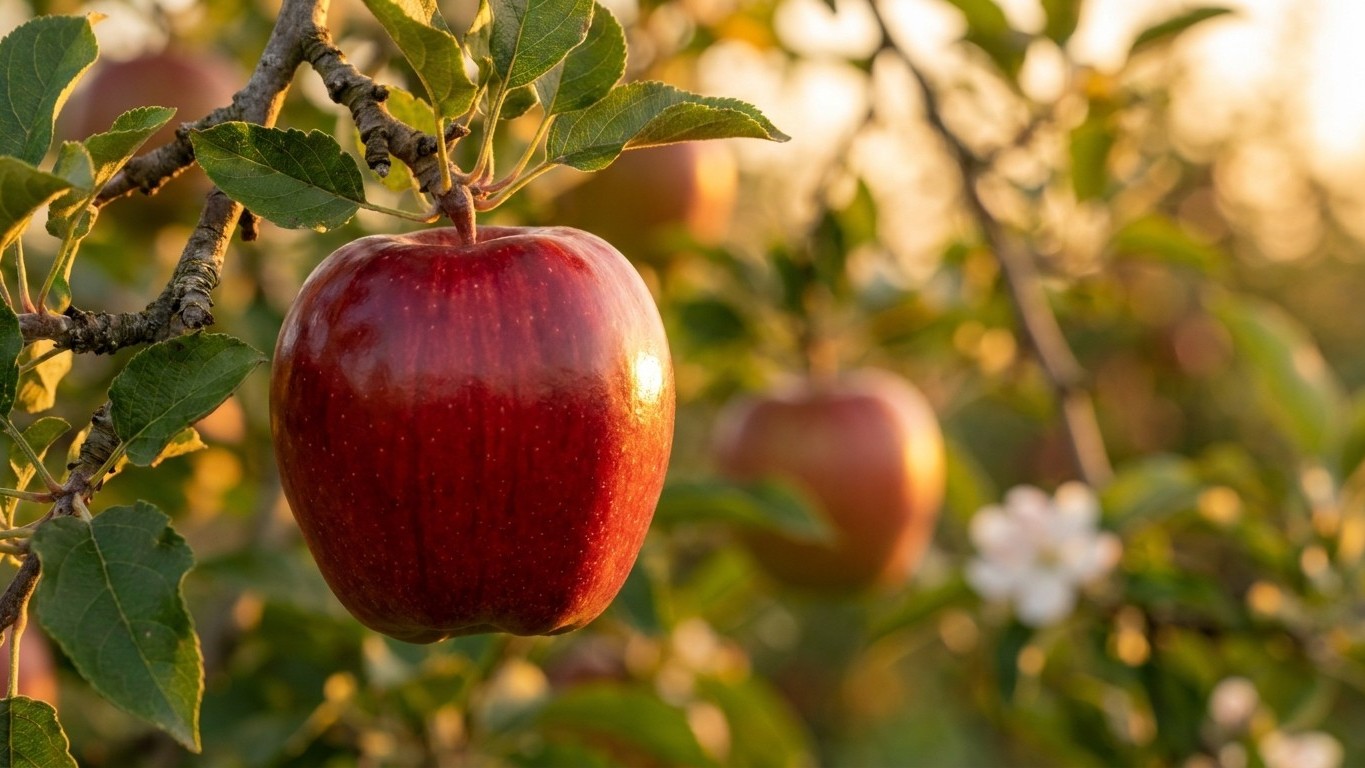

Red Delicious is one of the rare apple varieties that USU Extension rates as resistant to fire blight, a bacterial disease that wipes out entire branches on more susceptible trees in a single wet spring. It’s hardy in USDA zones 4-8, ripens in October, and needs a pollinizer planted nearby since its own pollen can’t do the job for every partner. Here’s what a grower actually needs to know before planting one.
What Red Delicious actually is

Unlike Mutsu (sold as Crispin) or Pink Lady (sold as Cripps Pink), Red Delicious carries only the one name at the store and at the nursery. No alias to track down, no confusion at the checkout. Here’s what a grower gets, in short form before the detail:
- Ripens: October
- Tastes like: Firm, crisp; sweet
- Best for: Fresh eating or salads
- Keeps: Well past harvest with proper cold storage
The eating quality comes straight from Clemson Cooperative Extension’s variety table: firm, crisp flesh with a sweet flavor and no sharp acid edge to it. That combination is exactly why the variety lands in the fresh-eating and salad column rather than the pie column. Baking depends on flesh that holds its shape under heat and acidity that doesn’t disappear into the sugar once it’s cooked. Red Delicious doesn’t carry that acid backbone, so a pie made from it tends toward flat and soft rather than bright and firm. Slice it into a lunchbox or a salad instead, where the crisp bite and sweetness are the whole point.
The harvest window, per Utah State University Extension’s apple production guide for home gardens, falls in October across most of the zones where the tree is grown. That’s a single month, not a precise date, because bloom timing, summer heat, and elevation all shift the calendar a little from one yard to the next. What doesn’t shift is the order of events relative to other varieties in the orchard, which matters more than the calendar once pollination enters the picture.
Will it grow where you are
Hardiness zones
USU Extension lists Red Delicious as hardy across USDA zones 4 through 8. That’s a wide band, running from the cold winters of the upper Midwest and northern New England down through the milder mid-Atlantic and much of the Southeast’s warmer valleys. A tree at zone 4 and a tree at zone 8 are dealing with very different winters, but both fall inside the range the source gives, so neither end should be treated as a stretch.
Winter chill
Hardiness zone is only half the equation. The other half is winter chill, the number of cold hours a tree needs each winter to break dormancy properly and flower on schedule. Skip that requirement and a tree can leaf out unevenly or bloom weeks late, even in a zone where it’s supposed to thrive. No specific chill-hour figure for Red Delicious appears in the sourced material here, so none is given rather than guessed at. What can be said with confidence: a variety hardy into zone 4 is built for a real winter, and gardeners in the mildest parts of zone 8, where winters barely dip into freezing for a sustained stretch, should check with a local extension office before assuming the tree will perform the way it does farther north.
What to plant beside it
This is the section that decides whether a Red Delicious tree fruits at all. Nearly all apple varieties crop better with a compatible partner nearby, and Red Delicious is no exception. According to the sourced pollination data, it can be pollinated by the following varieties:
- Fuji
- Gala
- Ginger Gold
- Granny Smith
- Jerseymac
- Mollie’s Delicious
- Yates
Any one of those, planted within pollinating distance and flowering at a compatible time, can supply the pollen Red Delicious needs to set a full crop. That’s the list to bring to the nursery.
Mutsu is the exception worth flagging clearly. Mutsu flowers at the same time as Red Delicious, sitting in the same bloom group, but its pollen is sterile. That means Mutsu can be pollinated by other varieties, but it can’t pollinate anything else, including Red Delicious. Plant only these two together and the bloom timing lines up perfectly while the fruit set fails completely, because neither tree is supplying the working pollen the other needs. A garden built around Red Delicious and Mutsu alone needs a third variety from the list above to actually produce apples on either tree.
Bloom group also matters here. Red Delicious sits in bloom group B, a mid-season bloomer according to Clemson HGIC and University of Georgia Extension. Bloom group is a relative order, not a fixed calendar date, so the exact week of flowering shifts with the local climate, but the sequence relative to other varieties stays consistent. A partner variety needs overlapping bloom timing to matter, which is part of why the varieties on the list above work and others don’t. For a broader look at how bloom groups interact across more varieties, the apple pollination guide lays out the full picture.
Growing it well
Fire blight resistance
USU Extension rates Red Delicious as resistant to fire blight, a bacterial infection that spreads through blossoms and new growth, especially during warm, wet spring weather. On susceptible varieties, fire blight shows up as blackened shoot tips that curl over like a shepherd’s crook, and it can kill entire limbs in a single season if left unchecked. A resistant rating doesn’t mean the tree is guaranteed to never show symptoms, but it does mean the tree is far less likely to suffer serious dieback compared with varieties that carry no resistance at all. For a home orchard in a humid climate, or in a region that’s already lost a susceptible tree to blight, this resistance is one of the strongest practical reasons to choose Red Delicious over a more vulnerable variety.
Bloom timing and frost risk
Because Red Delicious blooms mid-season rather than early, it carries somewhat less risk of losing a full crop to a late spring frost compared with early bloomers that flower before the last freeze has passed. That timing also shapes which partner varieties actually overlap with it in bloom, which is why the pollination list above matters as much as the resistance rating.
Thinning and biennial bearing
The sourced profile for this variety doesn’t include a documented biennial-bearing tendency, so nothing specific is claimed here. What holds true across most apple varieties still applies: thinning young fruit down to one apple per cluster in late spring reduces stress on the tree and tends to even out production from year to year, whether or not a strong alternate-bearing pattern has been documented for this particular variety.
Picking it and keeping it
USU Extension places the harvest window for Red Delicious in October. Waiting for the calendar alone isn’t reliable, though, since the exact week shifts with weather and elevation. A grower standing under the tree needs a physical check, not just a date, and the standard sequence runs in order:
- Lift and twist a fruit gently. A ripe apple separates from the spur with little resistance; one that clings and has to be pulled or yanked isn’t ready yet.
- Cut one apple open and check the seed color. Ripe apples typically show seeds that have turned brown rather than pale green or white.
- Check the ground color, the background shade beneath the red blush, which shifts from green toward a creamy yellow as the apple finishes ripening.
Storage
Once picked, Red Delicious holds up well in cold storage, one of the reasons it became a fixture in grocery stores that need fruit to survive weeks of shipping and shelf time. For the home grower, refrigeration close to freezing with steady humidity keeps the fruit firm and crisp for an extended stretch well past the October harvest, making it a practical choice for anyone who wants apples on hand into the winter months without a root cellar or commercial cold room.
Common questions
Does Red Delicious need another apple tree nearby to produce fruit?
Yes, in nearly all cases. It sets fruit far better with a compatible pollinizer such as Fuji, Gala, Ginger Gold, Granny Smith, Jerseymac, Mollie’s Delicious, or Yates planted close enough for bees to move between the trees.
Can two Red Delicious trees pollinate each other?
No. Planting two trees of the same variety doesn’t solve the pollination problem, since a variety generally can’t provide the genetic diversity it needs from its own pollen. A different, compatible variety is required.
Why won’t a Mutsu tree pollinate my Red Delicious?
Mutsu blooms at the same time as Red Delicious, but its pollen is sterile. It can receive pollen from other trees, but it can’t supply working pollen to anything else, including Red Delicious.
Is Red Delicious good for baking pies?
Not really. Its flesh is firm and crisp but lacks the acidity that lets pie apples hold their shape and tartness under heat. It’s better suited to fresh eating and salads, where that same firm, sweet flesh is an asset rather than a drawback.
How do I know a Red Delicious apple is ready to pick?
Check three things in order: whether the fruit separates easily with a lift-and-twist motion, whether the seeds inside have turned brown, and whether the background color under the red skin has shifted from green to a creamy yellow.