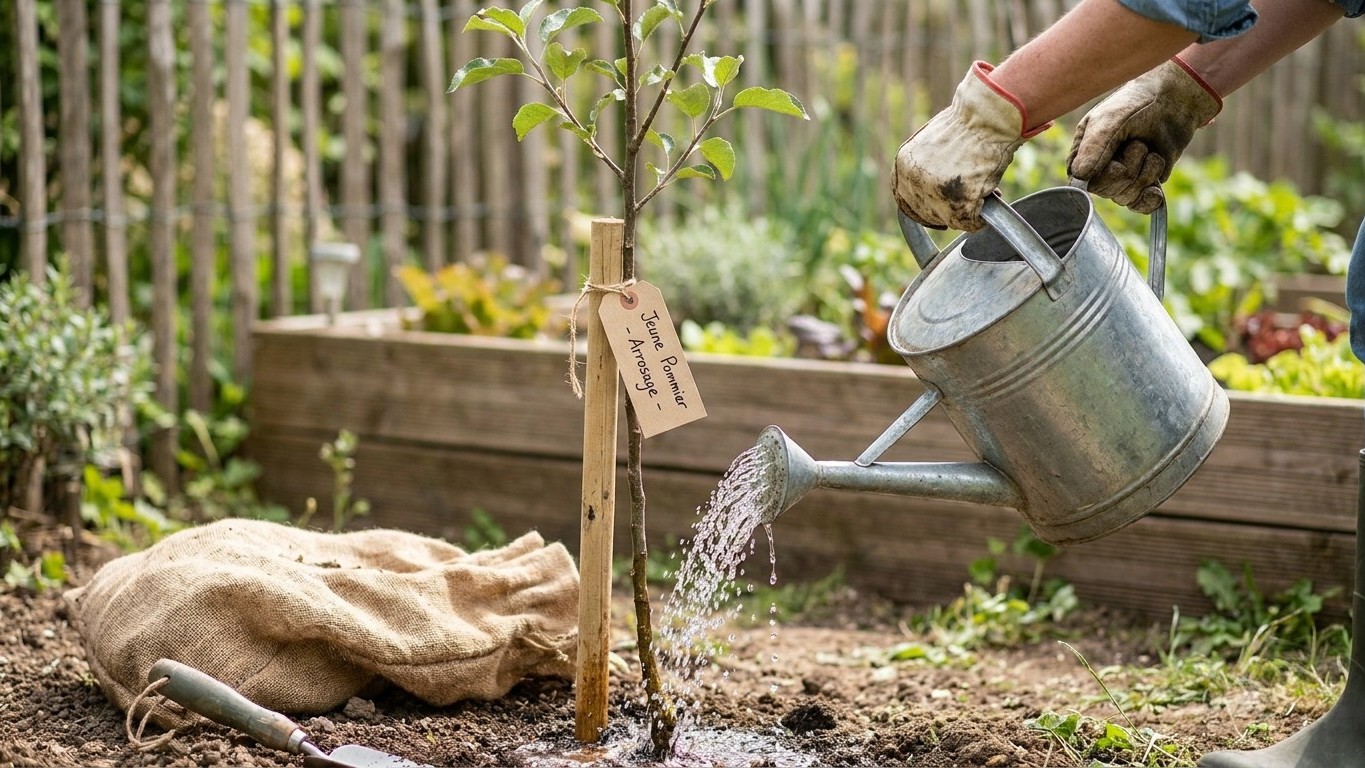

That root ball sitting in the planting hole holds almost nothing — a few bare strands or a fist-sized clump, nowhere near enough to go hunting for water the way a five-year-old tree does. So the once-a-week soak that works fine later on can leave a first-year apple gasping between waterings, or worse, sitting in soggy soil while you wait out the schedule. What this tree needs isn’t a bigger drink; it’s soil that never swings between bone-dry and drenched while those first roots push outward.
Why it matters
A newly planted apple tree has almost no root system to draw on. Whatever roots came with it from the nursery are confined to a small ball or a few bare strands, and until they spread into the surrounding soil, the tree depends entirely on water held in that immediate zone. Skip watering for too long during the first growing season and the tree stalls: shoot growth slows, leaves curl or drop early, and the graft union can fail to callus properly. This is the stage where consistent soil moisture matters more than volume, because a tree that never dries out and never drowns builds roots faster than one lurching between the two.
Once the tree is established, generally by its second or third year in the ground, water stress shows up differently. It arrives at bloom and again at petal fall, when the tree is setting fruit and swelling the first cells of each young apple. A tree short of water during these stages drops blossoms and small fruit rather than shoots, because it protects its own wood over a crop it can regrow next year. That protective drop is normal to a point, but a grower who wants a full crop needs to keep water available right through bloom and fruit set, not just at planting.
The rootstock also decides how long this vulnerable early stage lasts. A tree on M.9, 8-12 feet at maturity per USU Extension, fills its modest root zone within a couple of seasons. A tree on MM.111 or on seedling rootstock, reaching 30-35 feet and 35-40 feet respectively, spends longer establishing because it has more root system to build before it can lean on subsoil moisture the way a mature tree does.
When to do it
Timing runs off the tree’s stage, not the calendar, because the same stage falls on a different date depending on where you garden and how warm the spring has been. In dormancy, from leaf drop through the buds staying tight and brown, an established tree needs little to no supplemental water unless the season has been unusually dry. A young tree in its first winter is the exception: newly disturbed soil around the roots drains and dries faster than settled ground, so it is worth checking even while the tree looks completely asleep.
Water demand climbs at green tip, when the buds swell and split to show a sliver of leaf, because the tree is pushing new growth and drawing on stored moisture to do it. It climbs again through pink, when the unopened blossoms show color, and peaks at bloom itself. This is the point in the tree’s year where a dry stretch does the most damage, because the tree is flowering, setting fruit, and unfolding leaves all at once, and it will sacrifice blossoms first if the water is not there.
What moves the schedule is rainfall, not the month. A week of soaking rain during bloom means the tree needs nothing from you, while a dry, windy week at the same stage in a different year might mean watering every few days. Wind and heat pull moisture out of the top few inches of soil fast, so a tree that seemed fine last week can be dry this week without a single day of missed rain. After petal fall, as the small fruit begin to swell, keep checking rather than assuming the tree is past its risky stage. By this point a tree pollinated by a sterile-pollen variety such as Jonagold, Mutsu, Stayman, or Winesap, per Clemson HGIC and UGA Extension, has already set its fruit, so pollen partners no longer factor into what the tree needs from you. Only water does.
How to do it

Water slowly and deeply rather than briefly and often. A quick splash from a watering can wets the top inch of soil and evaporates by afternoon, while the roots that need the water sit several inches down. Run a hose at a trickle, use a drip line, or fill a watering bag around the trunk and let it empty on its own, so the water has time to soak down instead of running off the surface.
Check before you water
Before adding water, push a finger or a screwdriver into the soil a few inches out from the trunk, past the mulch if there is any. If it goes in easily and comes out with soil clinging to it, hold off. If it meets dry, crumbly resistance, water. This check matters more than any fixed schedule, because soil that drains fast after rain and soil that holds water for a week need completely different routines even for the same tree.
Match the area to the rootstock
Water the whole area under the canopy and a little beyond it, not just a ring at the trunk, because that is where the active feeder roots spread as the tree grows. How wide that area gets over the tree’s life tracks the rootstock underneath it:
| Rootstock | Mature height (USU Extension) | Root zone as the tree matures |
|---|---|---|
| M.9 | 8-12 feet | Stays compact for the tree’s whole life |
| M.26 | 12-15 feet | Small, widens modestly |
| G.11 | 12-15 feet | Small, widens modestly |
| G.30 | 18-20 feet | Moderate, widens steadily |
| M.7 | 18-20 feet | Moderate, widens steadily |
| M.106 | 25-30 feet | Wide by the tree’s later years |
| MM.111 | 30-35 feet | Wide, extends well past the drip line |
| Seedling | 35-40 feet | Widest, needs the most ground watered over time |
Mulch helps hold that moisture in place once you’ve put the work in, though it has to be kept clear of the trunk itself or it invites rot at the bark, a mistake covered in Mulching an Apple Tree Without Killing It. A ring of mulch a few inches out from the trunk, tapered thin near the wood, slows evaporation between waterings without holding moisture against the bark.
Feeding and watering interact too. A tree pushed with nitrogen while its roots are dry cannot use the fertilizer, and a well-watered but overfed tree tends to show scorched leaf margins rather than the healthy growth you were aiming for. Treat the two as one job rather than two separate chores, a balance covered in Feeding an Apple Tree: When It Helps and When It Hurts.
What goes wrong
Overwatering is the more common mistake in a home garden, not underwatering, because it feels like the responsible thing to do for a young tree. Roots sitting in saturated soil cannot take up oxygen, and they start to rot within days rather than weeks. The first sign above ground is often yellowing leaves that look like a nutrient problem, which sends a lot of growers reaching for fertilizer instead of pulling back on the hose. By the time whole branches wilt despite wet soil, the root damage is already done and the tree may not recover that season.
Underwatering shows up more slowly but costs more at harvest. A tree that runs dry during the weeks after bloom drops fruit it already set, sometimes with no other visible symptom until you notice how few apples are left on the branch. A tree that runs dry earlier, at green tip or pink, simply grows less: shorter shoots, smaller leaves, less wood built for next year’s crop. Both kinds of shortfall are quieter than overwatering and easier to miss because the tree does not collapse, it just underperforms.
Watering the wrong area wastes effort either way. Soaking a tight ring right against the trunk misses the feeder roots that have already spread out under the drip line, especially on a standard tree on MM.111 or seedling rootstock that will eventually reach 30 feet or more. Piling mulch against the trunk to try to hold that water in instead traps moisture against the bark and invites collar rot, a separate problem from anything happening at the root tips.
Inconsistent watering, wet one week and dry for three, shows up on the fruit itself as irregular swelling that turns into cracking or a lopsided apple later in the season. This is different from a plain lack of water. It is the swing between wet and dry that stresses the fruit’s skin faster than it can grow, and it is one of the few watering problems you can actually see on the harvest rather than just on the tree.
What changes where you are
Soil type changes the watering routine more than most growers expect. Sandy soil drains fast and needs shorter, more frequent watering to keep the root zone from drying between sessions. Heavy clay holds water far longer and can stay wet enough to rot young roots for days after a soak that would already have drained on sandy ground. The same rootstock, the same stage, and the same rainfall total can call for two completely different routines depending on which soil is under the tree, so a schedule that worked at a friend’s place across town is no guarantee it works at yours.
Climate shifts the calendar dates that stages fall on, even though the stages themselves stay in the same order everywhere. Bloom groups, the relative order in which varieties flower, hold their sequence from one region to another even as the actual dates move: Clemson HGIC lists Anna and Dorsett Golden in the earliest group, Fuji, Gala, Ginger Gold, Granny Smith, and several others in the middle group, and Arkansas Black, Golden Delicious, Jonagold, and Rome Beauty later. What that means for watering is practical. If bloom in your area falls earlier or later than elsewhere, so does the stretch when the tree is least able to tolerate a dry spell, and the calendar date attached to that risk moves right along with it.
Heat and wind exposure change how fast the soil dries between waterings, more than the raw temperature does. An exposed, windy site pulls moisture out of the top of the soil faster than a sheltered one even at the same daytime high, which is one more reason to check the soil directly rather than watering by a fixed number of days. For guidance specific to your own frost dates, chill hours, and rainfall pattern, your state or county extension service is the right source, and the general steps that watering fits into are laid out in Growing Apples.
Common questions
How soon after planting should I start watering?
Right away. Water in the backfill at planting time to settle the soil around the roots and close any air pockets, then keep checking soil moisture through that whole first season rather than waiting for the tree to show stress.
My apple tree’s leaves droop in the afternoon heat but look fine by morning. Is that a watering problem?
Not necessarily. Leaves lose water faster than roots can replace it on a hot, sunny afternoon even in moist soil, and they recover overnight as the air cools. Check the soil itself before reaching for the hose. If it is moist a few inches down and the leaves recover by morning, the tree is managing the heat on its own.
Do trees on dwarfing rootstock like M.9 or M.26 need watering more often than standard trees?
Often, yes. A compact root system on M.9 or M.26, listed by USU Extension at 8-12 feet and 12-15 feet mature height, holds a smaller reserve of soil moisture to draw on between waterings. A standard tree on MM.111 or seedling rootstock has more soil volume to buffer a missed watering, even though its canopy eventually needs a much wider watered area overall.
Can I water an apple tree with a sprinkler instead of a hose or drip line?
You can, but overhead sprinklers lose a lot of water to evaporation and wet the leaves and trunk, which does nothing for the roots and can encourage foliage problems. A hose run at a trickle, a drip line, or a slow-release bag around the trunk puts the water where the roots actually are.