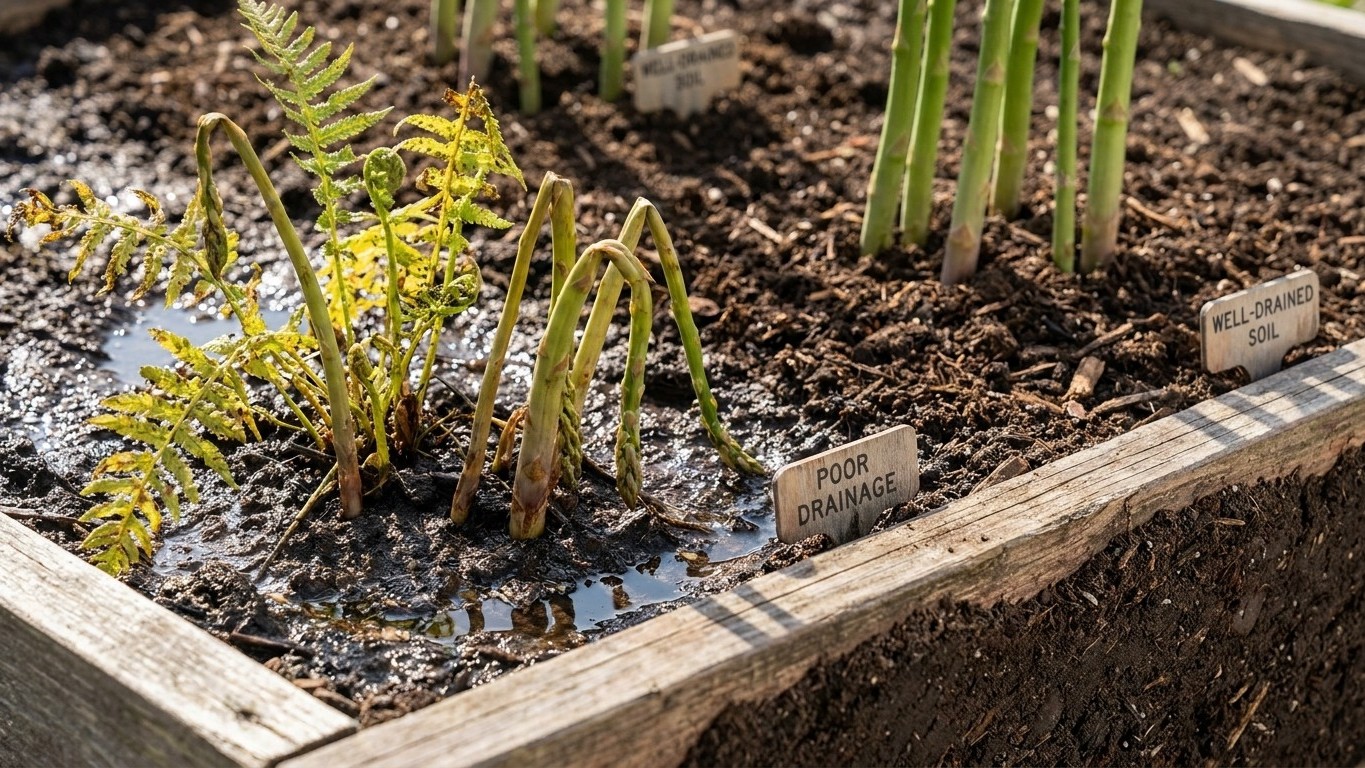

Most asparagus beds fail for a handful of repeatable reasons: standing water at the roots, a crown buried too fast instead of gradually, harvesting before the plant has stored enough energy, or pest and disease pressure that builds up unnoticed. None of these is a mystery once you see the mechanism behind it. The bed itself doesn’t just decline on its own; specific missteps at planting or in the years after do the damage, and each one is preventable.
The short answer
Utah State University Extension is direct about what threatens an asparagus planting: asparagus aphid, asparagus beetle, root rot diseases, and viruses. That’s the short list of biological threats named in its guidance on Growing Asparagus in the garden. But the source is just as direct about the single biggest structural cause of failure, and it has nothing to do with insects. “Most soils will do provided they are WELL DRAINED,” the Extension notes, which means the soil type matters far less than whether water sits at the root zone after a rain.
That single sentence explains a lot of failed beds. Asparagus crowns are perennial structures that live in the same spot for well over a decade. A crown that sits in saturated soil for even part of the year is a crown exposed to root rot, and once root rot sets in, there’s no rescuing that plant. The Extension’s recommendation is for a bed built on “fertile, well-drained soil enriched with organic matter and phosphorus,” which tells you drainage and fertility are treated as a package, not separate concerns.
Fertilizer numbers back up how deliberate this crop is about early growth. Utah State University Extension recommends a complete fertilizer, 16-16-8, applied at about 1 pound per 100 square feet, alongside 1/2 pounds of high phosphate (11-52-0) fertilizer per 100 square feet of furrow. Phosphorus placed right in the furrow, where the young roots will actually reach it, is a different move than broadcasting fertilizer over the surface and hoping it works its way down. Skip that step and the bed starts life underfed exactly when it needs the most help establishing itself.
What the source doesn’t say matters too. It gives no soil pH target and no winter chilling requirement for asparagus, so any number floating around for either of those isn’t coming from this Extension guidance. A hardiness zone tells you what a plant can survive; it isn’t the same thing as a chilling requirement, and the two shouldn’t be treated as interchangeable.
What actually decides it
Drainage and root rot
Asparagus roots are fleshy and store carbohydrates the plant will draw on year after year. Sitting in wet soil suffocates those roots and opens the door to the root rot diseases Utah State University Extension lists among the crop’s main problems. A bed on a low spot in the yard, or one planted where clay holds water after every storm, is working against itself before a single spear appears.
Planting depth handled as a process, not a single act
Clemson Extension is specific here in a way that gets missed constantly: crowns are set “15 to 18 inches apart and 6 to 8 inches deep,” but that final depth isn’t reached on planting day. The guidance is to “continue to pull soil over the crowns (about 2 inches every two to three weeks) until the trench is filled, and the crowns are 6 to 8 inches deep.” The crown starts in an open trench, shallow, with room to breathe and push up growth, and the soil comes in gradually as the plant grows. Bury it at full depth immediately and you’ve removed the margin the plant needs to get established.
Harvest timing tied to the plant’s reserves, not the calendar
Spear diameter is the signal, not a date. Clemson Extension puts it plainly: “Stop harvesting when the diameter of the spears has been reduced to pencil-size and allow the spear to grow to full height.” A bed harvested past that point, or harvested too early in its life, spends down energy reserves it hasn’t built up yet, and the following year’s spears show it.
Pest and disease pressure that accumulates
Asparagus aphid, asparagus beetle, root rot diseases, and viruses don’t usually wipe out a bed in one season. They build over years in a planting that stays in one spot for a decade or more, which is exactly why Utah State University Extension names them as the ongoing concerns for this crop rather than a first-year risk.
How to do it
- Choose a site with fertile, well-drained soil enriched with organic matter and phosphorus. This is the one condition Utah State University Extension treats as non-negotiable: soils will do, provided they drain.
- Dig a trench and set the crowns 15 to 18 inches apart and 6 to 8 inches deep, per Clemson Extension, but leave the trench open rather than filling it immediately.
- Apply phosphorus in the furrow at planting. Utah State University Extension specifies 1/2 pounds of high phosphate (11-52-0) fertilizer per 100 square feet of furrow, placed where developing roots will reach it.
- Work in a complete fertilizer, 16-16-8, at about 1 pound per 100 square feet, as the Extension recommends for the bed generally.
- Pull soil over the crowns gradually as spears emerge and grow, about 2 inches every two to three weeks, continuing until the trench is filled and the crowns sit at their final 6 to 8 inch depth (Clemson Extension).
- Choose a variety understanding that only sex, not performance, is what’s typically named: Jersey Giant and Jersey Knight are all-male selections, while UC 157 F1 and Purple Passion are male/female types. No flavor, yield, or reason to prefer one over another is published in the Extension guidance referenced here.
- Do not harvest in the first two years. Harvesting begins in year three.
- In year three, harvest for about 4 weeks. In year four, extend to about 6 weeks. From year five on, harvest for about 8 weeks.
- Each season, stop harvesting once most spears have thinned to pencil-size, per Clemson Extension’s guidance, and let remaining spears grow to full height and fern out.
- After the ferns die back in fall, mow them down and use the residue as a soil mulch over the bed, following Utah State University Extension’s recommendation.
- Watch through the growing season for asparagus aphid, asparagus beetle, root rot symptoms, and viral symptoms, the four problems the Extension Names for this crop.
What goes wrong
- The bed sits in poorly drained soil. Utah State University Extension is explicit that soil type is flexible but drainage isn’t; a low, wet spot invites root rot regardless of how fertile the ground looks. The remedy is choosing a different site or raising the bed before planting, not amending an already-planted low spot after the fact.
- The crown gets buried at full depth on day one. Clemson Extension’s process calls for filling the trench gradually, about 2 inches every two to three weeks, until the crown reaches 6 to 8 inches. Filling the trench in one pass skips the phase where the plant establishes itself in shallower, warmer soil, and it’s a common way a new planting struggles from the start.
- Harvest starts too early. No harvest happens in the first two seasons. Cutting spears in year one or two pulls energy the crown hasn’t stored yet, weakening a bed that hasn’t even finished establishing its root system.
- Harvest runs too long into the season. The fix is watching the spears, not the date. Clemson Extension’s rule is to stop once diameter drops to pencil-size and let the remaining spears fern out, because that fern is what rebuilds the reserves the next season’s harvest depends on.
- Pests and disease build up unchecked. Asparagus aphid, asparagus beetle, root rot diseases, and viruses are the four problems Utah State University Extension names for this crop. A bed that isn’t inspected across the growing season lets any of these establish before symptoms are obvious.
- Ferns get cleared instead of mulched. The Extension’s fall recommendation is to mow down the dead ferns and use them as soil mulch, not remove them from the bed. Skipping this step wastes organic matter the bed could be using over winter.
Common questions
How long before an asparagus bed can be harvested?
No harvest happens in the first two years after planting. Harvesting begins in year three, then extends in the years that follow: about 4 weeks in year three, about 6 weeks in year four, and about 8 weeks from year five onward.
Does soil pH matter for asparagus?
Utah State University Extension’s guidance referenced here is silent on soil pH, so no target range is supplied. What the source does specify is that soil needs to be well drained and enriched with organic matter and phosphorus.
Should the crown be buried at full depth right away?
No. Clemson Extension describes a gradual process: crowns start in an open trench 6 to 8 inches deep, and soil is pulled over them about 2 inches every two to three weeks until the trench fills and the crown reaches its final depth.
How do you know When to Stop Cutting spears each season?
Watch the spears themselves rather than a date on the calendar. Clemson Extension’s guidance is to stop harvesting once spear diameter has been reduced to pencil-size, then let the remaining spears grow to full height so the plant can rebuild its reserves.