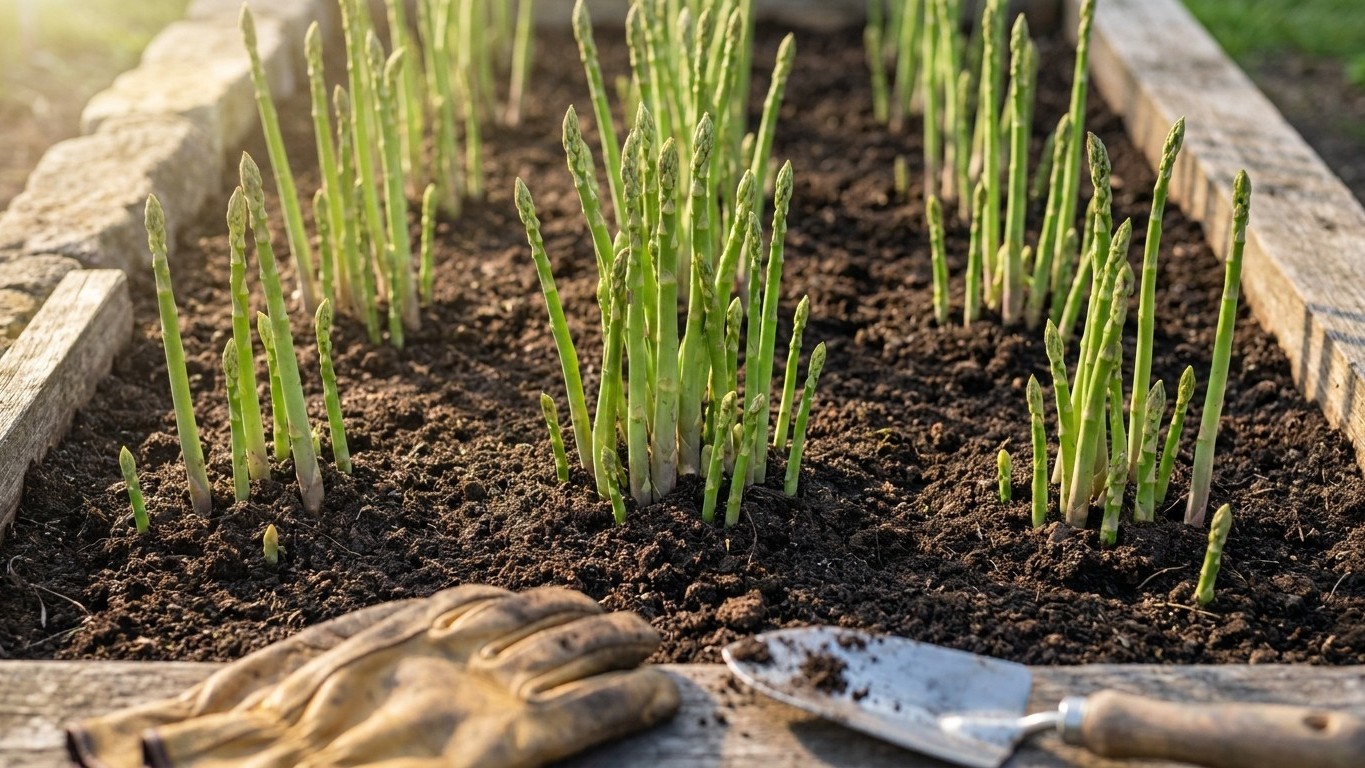

Jersey Supreme is an all-male hybrid asparagus cultivar recommended by Clemson Cooperative Extension for home gardens. Because it sets no seed, every bit of the plant’s energy goes into producing spears rather than berries, and the bed won’t fill in with volunteer seedlings the way an open-pollinated variety will. No yield figure or days-to-maturity is published for this cultivar.
What “all-male hybrid” actually means for your bed
The label on a seed packet or crown order rarely explains why the word “male” matters, but it changes what you’re managing in the ground. Asparagus plants are naturally either male or female, and a female plant that gets pollinated produces small red berries each fall. Those berries drop, overwinter in the soil, and sprout the following spring as unwanted seedlings scattered through the row, competing with the crowns you actually planted.
Spears instead of berries
An all-male hybrid like Jersey Supreme skips that step entirely. With no female flowers to pollinate and no berries to ripen, the plant redirects the energy that would have gone into seed production straight into spear growth instead. Clemson Cooperative Extension lists Jersey Supreme among the cultivars it recommends specifically for this trait: consistent spear production without the volunteer-seedling cleanup that comes with older, open-pollinated varieties.
What an open-pollinated bed gives you instead
Open-pollinated asparagus typically produces close to an even split of male and female plants. A bed that’s half female is a bed that’s dropping seed every fall, meaning years of pulling asparagus seedlings out of the same row where you’re trying to grow the crowns you planted on purpose. It’s not a dealbreaker for every gardener, but it is ongoing maintenance that an all-male hybrid simply removes from the list.
None of this translates into a published number. No seed catalog or extension bulletin puts a yield figure or a days-to-maturity date on Jersey Supreme, because asparagus doesn’t behave like an annual vegetable that ripens on a schedule. What you’re buying with an all-male hybrid is cleaner maintenance, not a faster harvest.
The wait before the first real harvest
This is the part that decides whether planting asparagus makes sense for your situation at all. Clemson Cooperative Extension states it plainly: “asparagus takes two to three years to begin production.” That’s not a worst-case estimate. It’s the baseline timeline for a perennial crop that spends its early seasons building an underground root system before it can support any spears above ground.
What “limited harvesting” really means
Even once that window passes, the extension service doesn’t describe a full harvest arriving on schedule. Crowns “may need two to three full growing seasons before limited harvesting can be done in the third or fourth year.” Read that carefully: limited harvesting, not a normal harvest. In year three or four, you might cut spears for a couple of weeks and then stop, letting the rest of the season’s growth go toward building the fern that feeds next year’s root system. A full, weeks-long harvest season doesn’t arrive until the bed is more mature than that.
What you’re actually signing up for
Plant a Jersey Supreme crown this year, and you’re committing to two or three seasons of watering, weeding, and fertilizing a bed that gives you nothing to eat. That’s a real cost in time and bed space, especially in a small backyard garden where every square foot competes with tomatoes, peppers, and everything else on your planting list. The tradeoff is that a well-established asparagus bed can keep producing for decades once it’s mature, a return no annual vegetable offers. Anyone deciding whether to plant should weigh that multi-year gap against the payoff.
Trenching and planting depth, step by step
Asparagus crowns don’t go into a simple hole the way a tomato transplant does. They go into a trench, and the way that trench gets filled in is where a lot of home gardeners lose plants without realizing what went wrong.
Spacing and starting depth
Clemson Cooperative Extension’s guidance is specific: “Set the crowns 15 to 18 inches apart and 6 to 8 inches deep.” Those ranges matter more than they might seem to. Spacing too tight crowds the root systems as the plants mature over the following decade; planting too shallow at the outset leaves crowns exposed to temperature swings before they’ve had a chance to establish.
Why the trench isn’t filled on day one
Here’s the detail that gets skipped on most planting guides, and it’s the one that actually determines whether a new bed survives its first year. The crown does not go into the ground buried at its full 6 to 8 inch depth right away. Instead, Clemson instructs gardeners to “continue to pull soil over the crowns (about 2 inches every two to three weeks) until the trench is filled,” and the crowns end up at that 6 to 8 inch depth gradually, not immediately. The crown sits in an open trench at planting time, and as spears emerge and grow, you pull a couple more inches of soil over them, encouraging the plant to keep pushing upward while its root system develops below. Bury a crown at full depth the day you plant it, and you risk smothering the emerging growth before it’s established enough to push through that much soil. This gradual backfilling is what actually gets a new bed off to a strong start.
When to stop cutting spears each spring
Once a bed reaches full production, the trickiest ongoing decision isn’t when to start harvesting each spring, it’s when to stop. Cut for too long, and the bed enters the following winter without the reserves it needs to come back strong.
Reading the spear, not the calendar
Clemson Cooperative Extension frames the cutoff around a visual signal rather than a date: “Stop harvesting when the diameter of the spears has been reduced to pencil-size and allow the spear to grow to full height.” That instruction works the same way whether you’re gardening in coastal South Carolina or well up into a cooler climate zone, because it’s tied to the plant’s own condition rather than to a fixed week on the calendar.
The mechanism behind the rule
A mature asparagus crown stores energy underground over the fall and winter, then spends that stored energy pushing up thick spears each spring. As the harvest window continues, the crown’s reserves run low, and the spears it sends up get progressively thinner, eventually narrowing down to pencil width. That’s the plant telling you it needs to shift from producing spears to producing fern. Left uncut, those thin spears grow into tall, feathery fronds that photosynthesize all summer, rebuilding the underground reserves the crown will draw on again the following spring. Keep cutting past the pencil-size point, and you’re harvesting from a bed that hasn’t had the chance to recharge, which weakens next year’s spring harvest and, over several seasons, can shorten the productive life of the whole bed.
Common questions
Is Jersey Supreme better than open-pollinated asparagus?
It depends on what you’re optimizing for. Jersey Supreme, as an all-male hybrid, avoids the volunteer-seedling maintenance that comes with open-pollinated varieties, but no published data compares yield between the two, so the choice comes down to how much seedling cleanup you’re willing to do.
How long until Jersey Supreme asparagus is ready to eat?
Clemson Cooperative Extension states that asparagus generally takes two to three years to begin production, with limited harvesting possible in year three or four. No cultivar-specific days-to-maturity figure is published for Jersey Supreme.
How deep should I plant asparagus crowns?
Crowns are set 6 to 8 inches deep, spaced 15 to 18 inches apart, according to Clemson. That depth is reached gradually, with soil pulled over the crowns roughly 2 inches at a time every two to three weeks until the trench is filled.
How do I know when to stop harvesting asparagus each spring?
Stop cutting once the spears narrow down to pencil-size diameter, and let the remaining growth reach full height. That signal, rather than a fixed date, tells you the bed needs to rebuild its energy reserves for the next season.