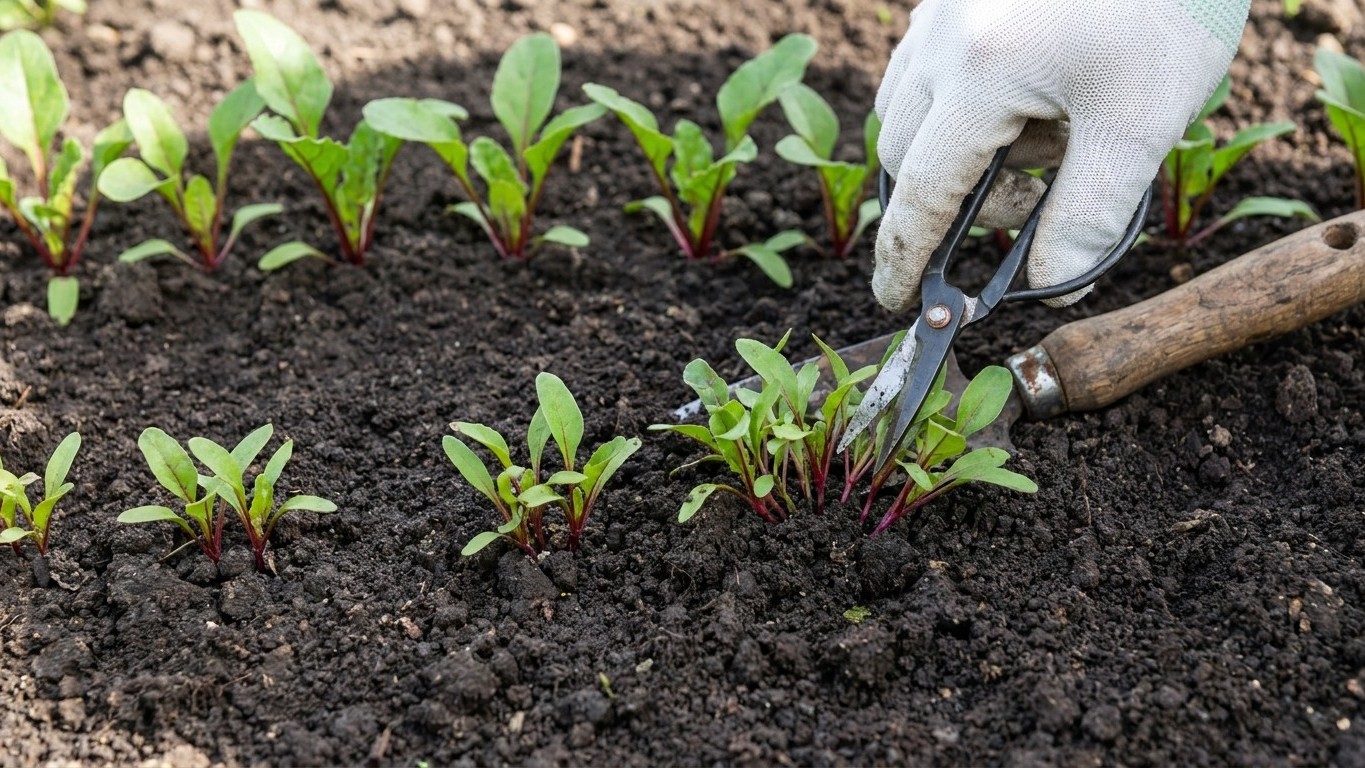

Three inches. That’s the spacing beet seedlings need once they’ve grown past their first true leaves, and skipping this step is the single most common reason home gardeners end up with skinny, tangled roots at harvest. Beet seeds are actually seed clusters, several seedlings sprout from what looks like one seed, and without thinning, none of them get room to swell into a proper root. This isn’t cosmetic. It’s the difference between round, solid beets and a row of pale, twisted threads.
The short answer
Utah State University Extension, in its guide “Beets in the Garden,” gives a specific number: thin seedlings to 3 inches apart within the row, and keep the rows themselves spaced 12 to 18 inches apart. That’s not a suggestion with wiggle room. It’s the spacing the crop needs to develop a round, dense root instead of a stunted, forked one.
The reason this matters comes down to how beets germinate. What gardeners plant as a single “seed” is actually a dried fruit containing several true seeds fused together, a quirk of the beet family. Sow a row at normal spacing and you don’t get one seedling every few inches, you get clusters of two, three, sometimes four seedlings emerging shoulder to shoulder. Left alone, those seedlings spend the whole season competing for the same patch of soil, the same water, the same light. None of them wins outright, so none of them bulks up the way a single, unchallenged root would.
Thinning breaks that competition on purpose. Once seedlings are large enough to handle, the gardener chooses the strongest one in each cluster and removes the rest, leaving a final spacing of 3 inches between the survivors. Rows themselves need that 12 to 18 inch buffer too, since roots swell sideways as well as down, and crowded rows shade each other and restrict airflow around the foliage.
This applies across the crop generally. Utah State University Extension names five varieties commonly grown in home gardens, Detroit Dark Red, Red Ace, Early Wonder, Green Leaf, and Golden, but it doesn’t attach separate spacing figures to any of them. The 3 inch rule is a baseline for beets as a crop, not a variety-specific number, so there’s no need to hunt for different spacing depending on which seed packet is in hand.
What actually decides it
Two different failures get blamed on “not enough water” when they actually come from different points in the growing season, and treating them as one problem leads to the wrong fix.
Early water stress and bolting
When seedlings are crowded, or when the soil dries out while roots are still small, the plant reads that stress as a signal to reproduce rather than grow. Instead of investing energy into a thickening root, it sends energy up into a flowering stalk, a process gardeners call bolting. Once a beet bolts, the root stops developing and turns woody and bitter at the core, no matter how much water follows. Crowded rows make this worse because unthinned seedlings are effectively competing for the same limited moisture supply, which mimics drought stress even when the garden bed looks adequately watered from the surface.
Later heat and woody texture
A second, separate failure shows up closer to harvest. Roots that stayed crowded through the middle of the season, or that sat in the ground too long as temperatures climbed, develop a fibrous, woody texture even if they never bolted. This is a heat and time problem layered on top of a spacing problem, not the same failure as early bolting. Since roots reach maturity 60 to 80 days from seeding, depending on variety, a crowded row that’s left unthinned for most of that window is fighting both problems at once: early competition that stunts development, then late heat that toughens whatever root did form. The fix for one doesn’t automatically fix the other, which is why thinning has to happen early, not as a rescue attempt once the rows already look crowded.
How to do it
- Wait until seedlings have their first true leaves and are sturdy enough to handle without snapping the stems.
- Walk the row and identify each seed cluster, usually visible as two or more seedlings growing from the same point.
- Pick the strongest, most upright seedling in each cluster to keep.
- Snip the weaker seedlings at the soil line with scissors rather than pulling them, since pulling disturbs the roots of the seedling sharing that cluster.
- Space the remaining seedlings so survivors sit 3 inches apart within the row.
- Check that rows overall are spaced 12 to 18 inches apart, adjusting future plantings if the original spacing ran tighter.
- Water the row after thinning to settle the soil back around the seedlings left in place.
- Revisit the row a week or two later, since some clusters germinate late and may need a second pass of thinning.
What goes wrong
- Thinning too late. Once seedlings have grown large and their roots have started to tangle underground, removing neighbors damages the one you’re trying to keep. Thin as soon as true leaves appear, don’t wait for the row to look crowded.
- Pulling instead of snipping. Since several seedlings share one seed cluster, their roots are often intertwined below the surface. Pulling a weak seedling can rip out the strong one next to it. Snip at the soil line instead.
- Skipping thinning entirely. Leaving clusters intact produces a tangle of thin, misshapen roots with no single beet ever getting the room to swell. There’s no shortcut around this step, the crop simply needs the space.
- Rows planted tighter than 12 to 18 inches. Even well-thinned plants suffer if the rows themselves are too close, since roots need lateral room and foliage needs airflow. Measure row spacing at seeding time, not after the fact.
- Delaying thinning until the weather turns hot. Crowding stress and heat stress stack on top of each other, pushing roots toward the woody texture described above. Thin promptly early in the season regardless of temperature, then let the maturity window run its course.
Common questions
Does the 3 inch spacing change depending on the variety? Utah State University Extension names Detroit Dark Red, Red Ace, Early Wonder, Green Leaf, and Golden as common garden varieties, but gives no separate spacing figure for any of them. Treat the 3 inch, 12 to 18 inch guidance as the baseline across the group.
How long after seeding will the beets be ready? Roots mature 60 to 80 days from seeding, depending on variety. That count starts at the seeding date, since beets are sown directly in place and never transplanted, so there’s no separate transplant date to track.
Can the thinned seedlings be used for anything? Many gardeners toss the thinned seedlings into a salad, since beet greens are edible at that young, tender stage. It’s a practical way to avoid waste rather than a step called for by any spacing guide.
How should harvested beets be stored, and for how long? Store at 32 F and 95 percent relative humidity, where they’ll keep for 2 to 4 months. Getting the humidity right matters as much as the temperature, since beets left in dry storage conditions shrivel well before that window is up.