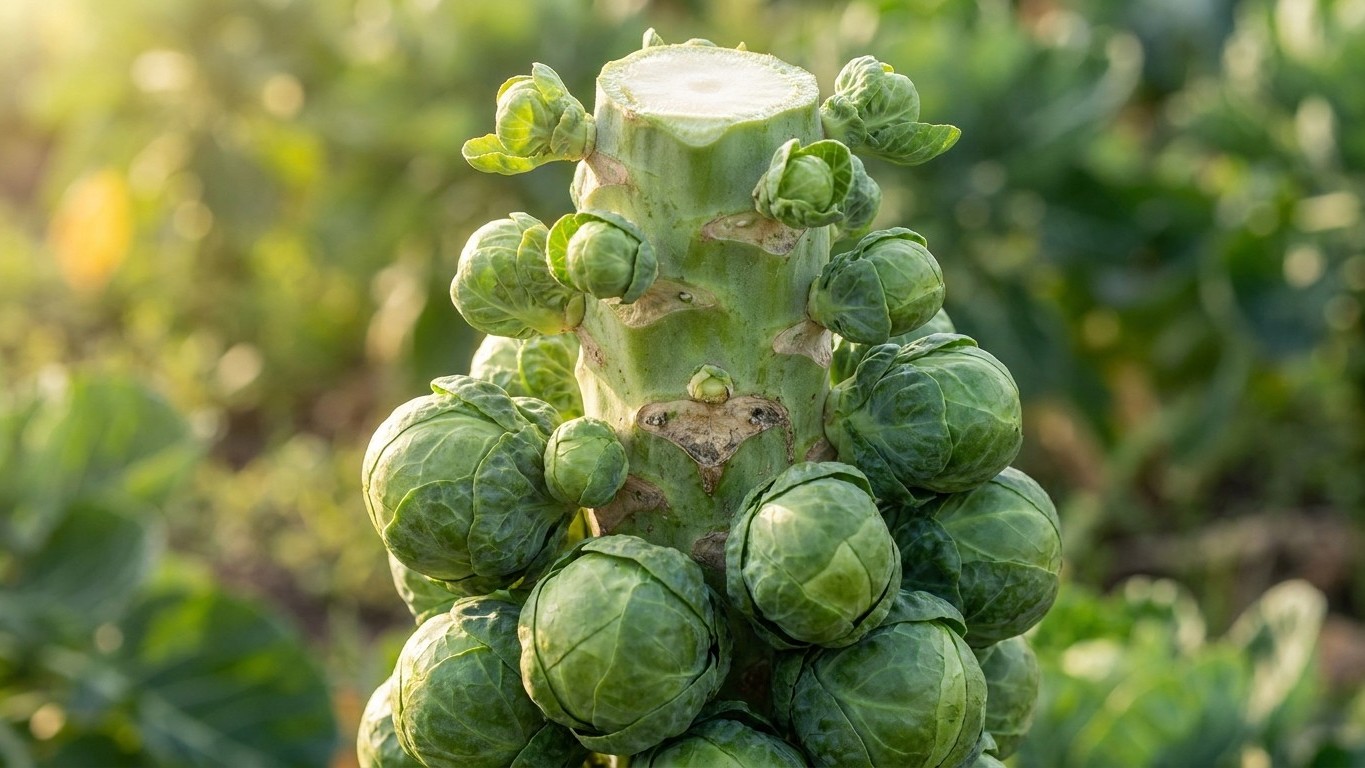

Yes. Utah State University Extension recommends removing the growing point at the top of the Brussels sprouts plant once the lower sprouts begin to form. Left alone, the stem ripens from the bottom up over weeks, with the top staying immature long after the first sprouts are ready. Cutting the growing tip stops that stretch and pushes the whole stalk toward maturity together, timed to finish as your first fall frost approaches.
The short answer
Brussels sprouts don’t ripen all at once by nature. The lowest buds on the stem form first, and as those get picked, the sprouts higher up keep enlarging on their own schedule. Utah State University Extension puts it plainly: “Sprouts near the bottom of the plant develop first. As they are harvested, sprouts further up the stem continue to enlarge.” Left to grow this way, a single stalk can keep producing for a long stretch, which is fine if you want a rolling harvest but frustrating if you’re racing the calendar toward your first fall frost.
The fix is topping. The same Extension guide states it directly: “For more uniform sprout development along the whole stem, remove the growing point at the top of the plant when the lower sprouts begin to form.” That’s the whole technique in one move. You’re not adding anything to the plant, not feeding it more, just taking away the one part that keeps telling the stem to keep growing upward instead of finishing what’s already started.
This matters because Brussels Sprouts Are a Summer-sown crop grown for a fall harvest, unlike most vegetables in a home garden. The plant is built to size up its sprouts as the weather cools, and it tolerates temperatures below freezing without serious damage, according to the same source. That cold tolerance is exactly why gardeners lean on topping: it lets the whole stalk mature together, right as the season’s first frosts settle in, instead of dragging the harvest out past the point where cold weather would have shut growth down anyway.
Once sprouts are ready, the same guide gives the harvest marker: pick “when the sprouts reach one (1) inch in diameter and are firm and compact,” but before they split open. They can be broken or cut off the stem, and the Extension recommends working the harvest the same direction the plant grows: “Start at the bottom and work up the stalk.”
What actually decides it

The growing point keeps pulling resources upward
A Brussels sprouts plant has one active growing point at its top, and as long as that point stays intact, the plant keeps directing energy toward new leaf growth and new sprout initiation higher on the stem. That’s why the lowest sprouts, which formed earliest, mature first while the top of the plant is still busy producing more growth. The stem never “decides” to stop and finish everything at once, because the growing tip keeps giving it a reason to keep going.
Removing that tip removes the competition. With no new growth to feed, the plant’s remaining energy has nowhere else to go but into the sprouts already lined up along the stem. That’s the mechanism behind the Extension’s recommendation: cutting the top doesn’t add vigor to the plant, it redirects the vigor that’s already there toward finishing the sprouts instead of starting new ones.
Timing the cue to the plant, not the calendar
The cue for topping isn’t a date, it’s a stage: “when the lower sprouts begin to form.” That’s a plant-based signal because Brussels sprouts development doesn’t run on a fixed schedule from one garden to the next. Soil, spacing, and how mild or cool the season has been all shift when those lower sprouts show up. Watching the plant instead of the calendar keeps the timing accurate no matter where you garden.
Because this crop is grown for harvest after the plant tolerates the first cold snaps of fall, topping at the right stage lines the stem’s finish point up with that cooling window. Top too early, before the lower sprouts have started, and there’s not enough sprout development yet for the plant’s energy to be redirected into. Top too late, after the top has already put on a lot of extra growth, and you’ve lost some of the benefit, since that growth already consumed resources the lower sprouts could have used.
How to do it
- Watch the base of the stem, not the top. The cue is a plant stage: the lower sprouts beginning to form. That’s the signal to act, according to Utah State University Extension.
- Identify the growing point. It’s the cluster of small leaves and tissue at the very top of the plant, above where the topmost sprouts are just starting to swell.
- Remove it. Cut or pinch off the growing point once the lower sprouts have started forming, leaving the rest of the stem and its developing sprouts intact.
- Factor in your variety’s maturity window. Days to maturity vary by variety, for example Long Island Improved matures in 90 days, Jade Cross in 100, and Diablo in 110. Knowing which one you planted helps you judge how much of the fall growing season is left once you top the plant.
- Keep up routine care. Continue watering as usual so the sprouts already on the stem can size up together instead of competing with new top growth.
- Harvest by size and firmness. Pick sprouts once they reach one inch in diameter and feel firm and compact, and do it before they split open.
- Work bottom to top. Start at the base of the stalk and move upward, breaking or cutting sprouts off the stem as you go, per the Extension’s harvest order.
What goes wrong

- Topping too early. If the growing point is removed before the lower sprouts have begun forming, the plant doesn’t have enough sprout development yet to redirect its energy into. Wait for the stage cue, lower sprouts starting to form, rather than acting on a guess.
- Topping too late. If the top is left on well after the lower sprouts have already started, the plant has already spent resources on extra top growth that won’t come back. The remedy is the same either way: check the lower stem regularly during that window instead of relying on memory.
- Sprouts stay loose and leafy instead of firm. This is often mistaken for a nutrient shortage, but it’s usually a transport issue: the growing point is still active and still pulling energy upward instead of into the existing sprouts. Adding more fertilizer doesn’t fix that, because the problem isn’t a lack of nutrients, it’s where the plant is sending them. Removing the top redirects the flow.
- Sprouts split open before you get to them. This is a harvest-timing failure, not a topping failure. The Extension’s marker is picking sprouts at one inch in diameter, firm and compact, before they split. Checking the stem regularly once sprouts start sizing up prevents this.
- Uneven ripening even after topping. If topping happened at the right stage but the lowest sprouts were already overripe by the time you got to harvest, the fix isn’t more topping, it’s harvest order. Starting at the bottom and working up the stalk, as recommended, catches the earliest sprouts before they pass their prime.
Common questions
Does cutting the top hurt the plant? No. The technique redirects the plant’s own energy toward the sprouts already forming along the stem rather than into new top growth, which is the point of doing it.
What if I miss the window and don’t top the plant at all? The stem still produces sprouts, just on its natural bottom-up schedule, with the lower ones ready well before the upper ones. You’ll harvest in stages instead of all at once, which some gardeners prefer for a rolling supply.
Which comes first, harvesting or topping? Neither one happens in isolation. Topping is done when the lower sprouts begin to form, and harvesting starts once those same lower sprouts reach one inch in diameter and firm, compact texture, working up the stalk from there.
Does the technique work the same on every variety? The stage cue, lower sprouts beginning to form, applies across varieties, though when that stage arrives will differ. A shorter-season variety like Long Island Improved at 90 days reaches that point sooner than a longer-season one like Diablo at 110 days, so knowing your variety helps you anticipate when to start checking.