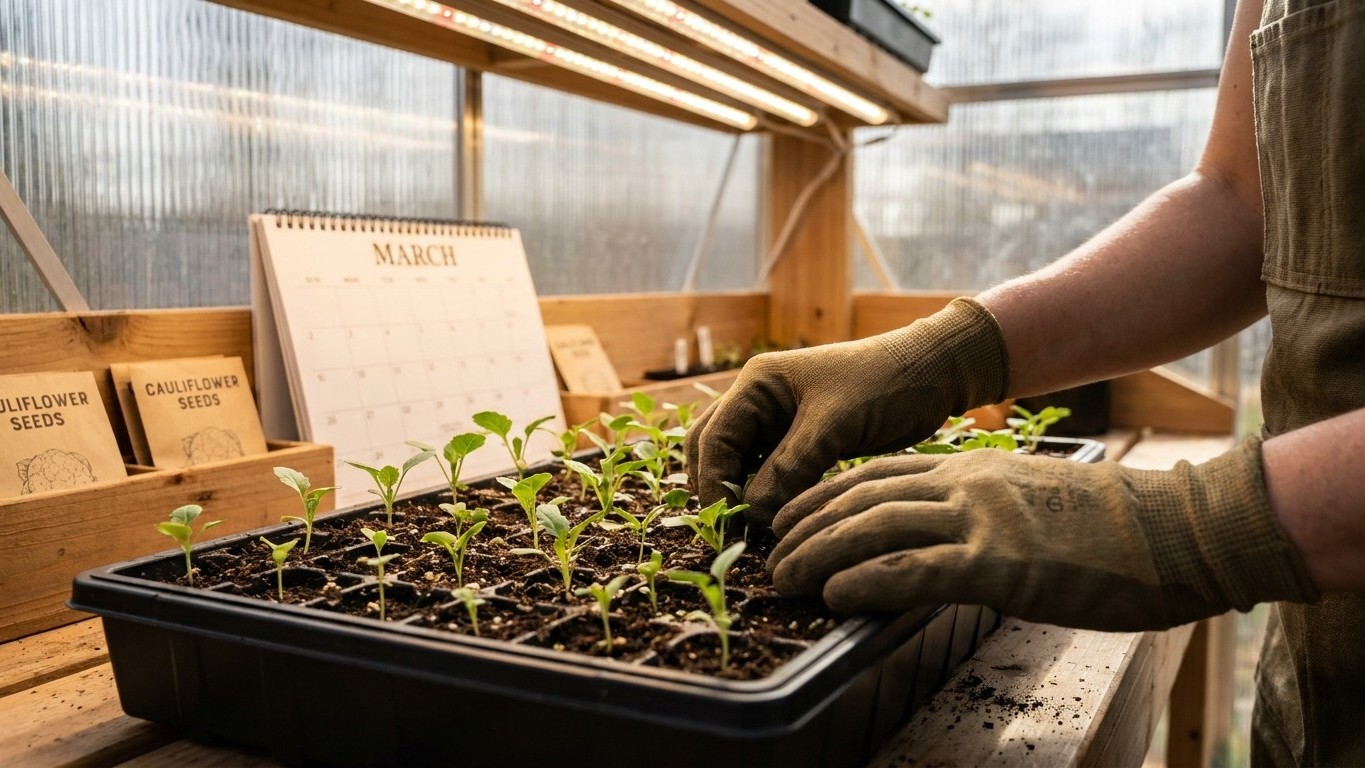

Cauliflower seed goes into trays six to seven Weeks Before the transplant goes into the garden, according to Utah State University Extension’s guide to growing cauliflower. That’s the same rough lead time as cabbage. What’s different is the exit: cauliflower transplants wait one to two weeks Before the Last Frost, while cabbage and broccoli are already out at two to three weeks before frost. Same clock, different door.
The short answer
Utah State University Extension states it plainly: cauliflower grown for transplants should be sown six to seven weeks before the expected planting date in the garden. That’s the number to write on the seed packet, on the calendar, wherever you’ll actually see it again in five weeks. It’s not a suggestion with wiggle room built in on both ends. It’s the window the plant needs to build the root mass and leaf set it will rely on once it hits garden soil and cooler air.
The part that trips people up is what happens after those six to seven weeks are done. Cabbage and broccoli transplants move outside two to three weeks before the last frost date for the area. Cauliflower moves outside one to two weeks before that same frost date. Seeded cauliflower, if you direct-sow instead of transplanting, follows the same one-to-two-week rule. That’s a real, named difference in the source, not a rounding error between similar crops lumped into one planting chart.
Why the extra week of patience for cauliflower? The source ties it to Temperature tolerance rather than to the seedling’s calendar age. Cauliflower’s named ceiling is 75°F and its named low is 32°F. Cabbage tolerates a wider band, 80°F on the warm side and down to 25°F on the cold side. Broccoli sits at 75°F and 28°F. Cauliflower’s cold tolerance is the tightest of the three brassicas covered by this source, which is exactly why it stays in the tray, or under cover, a week longer than its cousins before facing open-garden frost risk.
So the short answer has two parts, and both matter. Sow six to seven weeks before you intend to plant. Then plant one to two weeks before your last frost date, not two to three. Treat cauliflower like cabbage on the seed-starting end and like a slightly more frost-sensitive plant on the transplanting end, and the schedule Utah State University Extension lays out lines up.
What actually decides it
The size threshold, not a date
Utah State University Extension gives a physical marker for transplant readiness, not just a week count: 4-6 mature leaves and a well-developed root system. The six-to-seven-week figure gets a seedling to roughly that point under typical conditions, but the leaves and roots are the actual gate. A tray started late, or one that’s been sitting in cool, low-light conditions, might need more time to reach that leaf count. A tray that’s been warm and bright might get there sooner. The week count is the planning tool. The leaf count is the checkpoint.
Temperature tolerance sets the frost window
The one-to-two-week gap before last frost isn’t arbitrary. It comes from cauliflower’s named cold limit of 32°F, compared with cabbage’s 25°F and broccoli’s 28°F. A plant that can only take frost down to 32°F has less margin than one rated to 25°F, so it goes outside later relative to the frost date, even though it was started on the same schedule. Two crops can share a seed-starting timeline and still need different transplant dates, because the frost tolerance, not the seedling’s age, is what’s being managed on the back end.
Curd color depends on hand work, not variety alone
Many white-curd cauliflower varieties need the leaves tied or folded over the developing curd to keep sunlight off it, a manual step, not something the plant does on its own. Some cultivars are bred to curl their own leaves inward as the curd forms, reducing or removing that hand-tying step. Utah State University Extension names White Contessa (65 days, heat tolerant) and Self Blanche (60 days) among named cultivars in its guide. Whether a curd stays white comes down to that blanching step, by hand or by the plant’s own habit, not to how long the seed sat in the tray.
How to do it
- Find your local last frost date first. Every count in this schedule works backward or forward from that single date, so it has to be nailed down before anything else is scheduled.
- Count forward one to two weeks from that frost date to set your garden planting date. That’s the date cauliflower transplants (or direct-seeded cauliflower) go into the ground, per Utah State University Extension, one week later in the sequence than cabbage or broccoli.
- Count backward six to seven weeks from that planting date to find your seed-starting date. If your planting date lands one week before frost, your seed-starting date is six to seven weeks before that same planting date, which puts it roughly seven to nine weeks before frost itself once both steps are combined.
- Sow the seed indoors on that date, in trays with room for root development. The clock starts here, but the calendar isn’t the final check.
- Watch the seedlings for 4-6 mature leaves and a well-developed root system before transplanting, rather than moving them out strictly because the calendar says it’s day forty-something. If they’re behind that mark when your planting date arrives, give them more time under cover instead of rushing them into cold soil.
- For a fall crop, work backward from the harvest instead of forward from frost. Plant 50-75 days before the anticipated maturity date, and aim for that maturity date to land about one to two weeks after the first fall frost. Utah State University Extension lists Denali (80 days) as a cultivar suited to summer planting for a fall harvest under this schedule.
What goes wrong
- Treating cauliflower like cabbage on the transplant date. Moving cauliflower out two to three weeks before last frost, the cabbage and broccoli rule, exposes it to cold below its named 32°F tolerance a week or two earlier than it can handle. The fix is simple: hold cauliflower back until one to two weeks before frost, even if cabbage from the same seed-starting batch is already in the ground.
- Transplanting by date instead of by leaf and root development. A seedling started on schedule but grown in cool, low-light conditions may not have reached 4-6 mature leaves and a well-developed root system by the target date. Planting it anyway sets it back further than waiting another few days would have. Check the plant, not just the calendar square.
- Confusing boron deficiency with molybdenum deficiency. These are two separate nutrient problems with opposite symptom patterns in cauliflower, and treating one as if it were the other doesn’t just fail to help, it can push the wrong fix onto a plant that needed the opposite correction. If curd or growth abnormalities show up, the deficiency needs to be identified specifically before any soil amendment is applied, not assumed from a general “something’s wrong with the curd” impression.
- Cold stress during the transplant stage that shows up later as poor curd formation. A check in growth caused by an early cold snap or premature exposure to near-32°F conditions isn’t something that can be reversed once the plant recovers and keeps growing. The stress already happened; feeding or watering afterward supports the rest of the plant’s growth but doesn’t undo the earlier damage to curd development.
- Skipping blanching on varieties that need it. Non-self-blanching white cultivars left uncovered as the curd develops will discolor under direct sun. The remedy is manual: once the curd is visible and starting to size up, the outer leaves need to be tied or folded over it by hand to keep light off, unless the cultivar (like Self Blanche) is bred to do this itself.
Common questions
Can cauliflower seed be started on the same day as cabbage seed?
Yes, both are commonly started six to seven weeks before their respective garden planting dates per Utah State University Extension. The seed-starting timeline overlaps; it’s the transplant date that diverges, with cauliflower waiting an extra week closer to the last frost date than cabbage.
What if the transplant hasn’t reached 4-6 leaves by the planned planting date?
Hold it back. Utah State University Extension identifies mature leaf count and root development as the transplant readiness markers, not the calendar date alone. A seedling that’s behind schedule needs more time under cover rather than an early move into garden soil.
Does the six-to-seven-week rule change for a fall crop?
The fall approach uses a different anchor point. Instead of counting back from a spring planting date, Utah State University Extension recommends planting 50-75 days before the anticipated maturity date, with that maturity date landing about one to two weeks after the first fall frost.
Why does cauliflower need blanching when cabbage doesn’t?
Cabbage forms a head of overlapping leaves that shields itself from sunlight as it grows. Cauliflower’s curd is exposed unless the surrounding leaves are tied over it by hand, or the cultivar is one bred to curl its leaves inward on its own, such as the varieties Utah State University Extension lists as self-blanching.